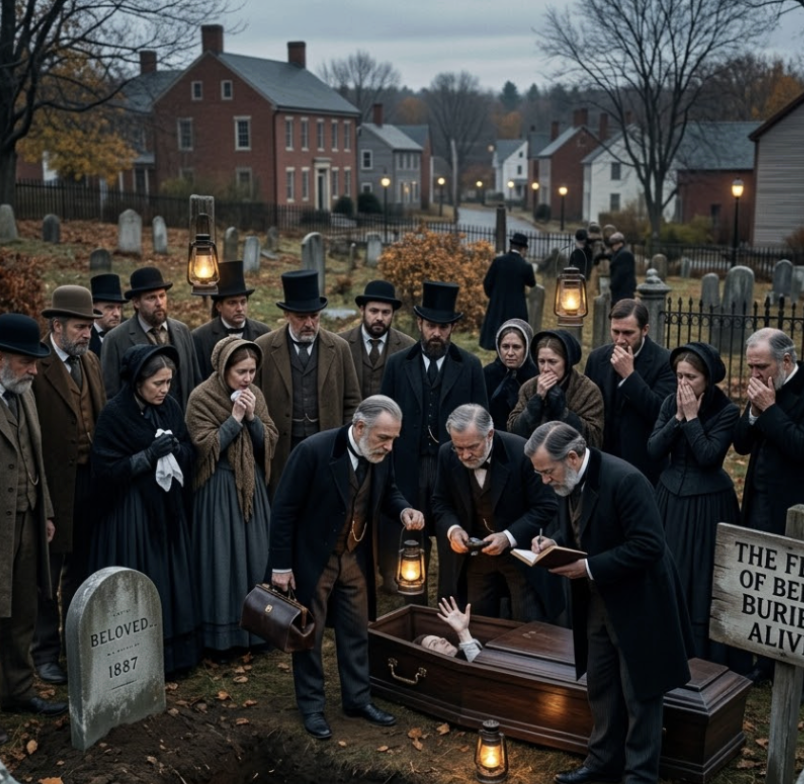
Imagine attending a funeral and suddenly seeing the person inside the coffin open their eyes.
It sounds like something from a horror movie.
Yet for centuries, stories like these spread across towns, newspapers, and entire countries, creating one of the deepest fears in human history.
The fear was not death itself.
It was being declared dead while still alive.
Before modern medicine, confirming death was not always as straightforward as it is today.
Doctors did not have advanced monitors, brain imaging, heart rhythm technology, or many of the tools used in hospitals now. In some cases, a person with an extremely weak pulse, shallow breathing, severe illness, or a deep coma could appear lifeless.
Without reliable methods to verify death, mistakes occasionally happened.
As a result, stories began circulating about people who unexpectedly regained consciousness after being presumed dead.
Some reportedly awoke before their funerals.
Others showed signs of life while being prepared for burial.
Whether every story was accurate or not, the impact on public imagination was enormous.
Throughout the eighteenth and nineteenth centuries, fear of premature burial became widespread in parts of Europe and North America.
The fear was so common that it even developed a name.
Taphophobia — the fear of being buried alive.
Many people became obsessed with the possibility.
Some individuals included special instructions in their wills.
Others requested delays before burial.
Families sometimes kept the deceased at home longer to ensure there was no sign of life.
Newspapers eagerly reported unusual cases, often adding dramatic details that made the stories even more frightening.
One reason these accounts spread so rapidly was because they touched a very specific human fear.
Most people can accept death as inevitable.
But the idea of remaining conscious while everyone believes you are dead is something entirely different.
It combines helplessness, isolation, and the loss of control in a way that few other fears can.
As public anxiety grew, inventors began developing strange devices designed to protect against accidental burial.
Some became known as “safety coffins.”
These coffins included mechanisms intended to alert people above ground if someone inside regained consciousness.
Certain designs featured bells connected to strings attached to the body.
Others included breathing tubes, signal flags, or special escape systems.
While many of these inventions were never widely used, their existence demonstrates how seriously people took the possibility.
Historians believe that some reports were likely exaggerated, misunderstood, or repeated so many times that facts became mixed with folklore.
However, there were genuine medical situations that could contribute to confusion.
Certain illnesses, neurological conditions, poisonings, and episodes of extremely reduced bodily activity could mimic death, especially in periods when medical knowledge was more limited.
Conditions such as deep comas, severe hypothermia, catalepsy, and other rare disorders sometimes made it difficult to distinguish between life and death using the methods available at the time.
As medicine advanced, these risks declined dramatically.
Doctors gained better understanding of brain function, circulation, respiration, and the signs of irreversible death.
New technologies allowed medical professionals to monitor patients with much greater accuracy.
Modern death certification procedures became far more rigorous than those used centuries ago.
Today, accidental declarations of death are extremely rare compared to the past.
Still, the old stories continue to fascinate people.
Part of their power comes from the fact that they exist at the boundary between reality and nightmare.
They force us to imagine a situation that feels almost impossible yet was once considered a genuine concern.
Many of the most famous accounts have survived not because of what happened afterward, but because of what they reveal about human psychology.
The stories expose a universal fear:
What if everyone else believes your story has ended while you are still somehow present?
That fear reaches deeper than concerns about burial itself.
It touches the human desire to be seen, heard, understood, and recognized.
In many ways, these tales are not only about death.
They are about the terrifying possibility of being overlooked when it matters most.
Ironically, the fear helped drive progress.
Public concern encouraged improvements in medical examination, death verification, funeral practices, and the development of more reliable methods for confirming when life had truly ended.
What once frightened entire communities eventually contributed to greater caution and better medical standards.
The most unsettling part of these stories is not whether every detail is true.
It is the realization that for much of history, people lacked the certainty we often take for granted today.
A weak pulse.
A shallow breath.
A deep unconscious state.
Sometimes those signs could blur the line between life and death in ways that modern medicine now works hard to prevent.
And perhaps that is why these stories still capture attention centuries later.
They are not merely ghost stories.
They are reminders of one of humanity’s oldest and most universal fears:
The fear of being forgotten, abandoned, or declared gone before our time has truly come.
Do you think the fear of being buried alive would have been one of the most terrifying fears to live with in earlier centuries?


