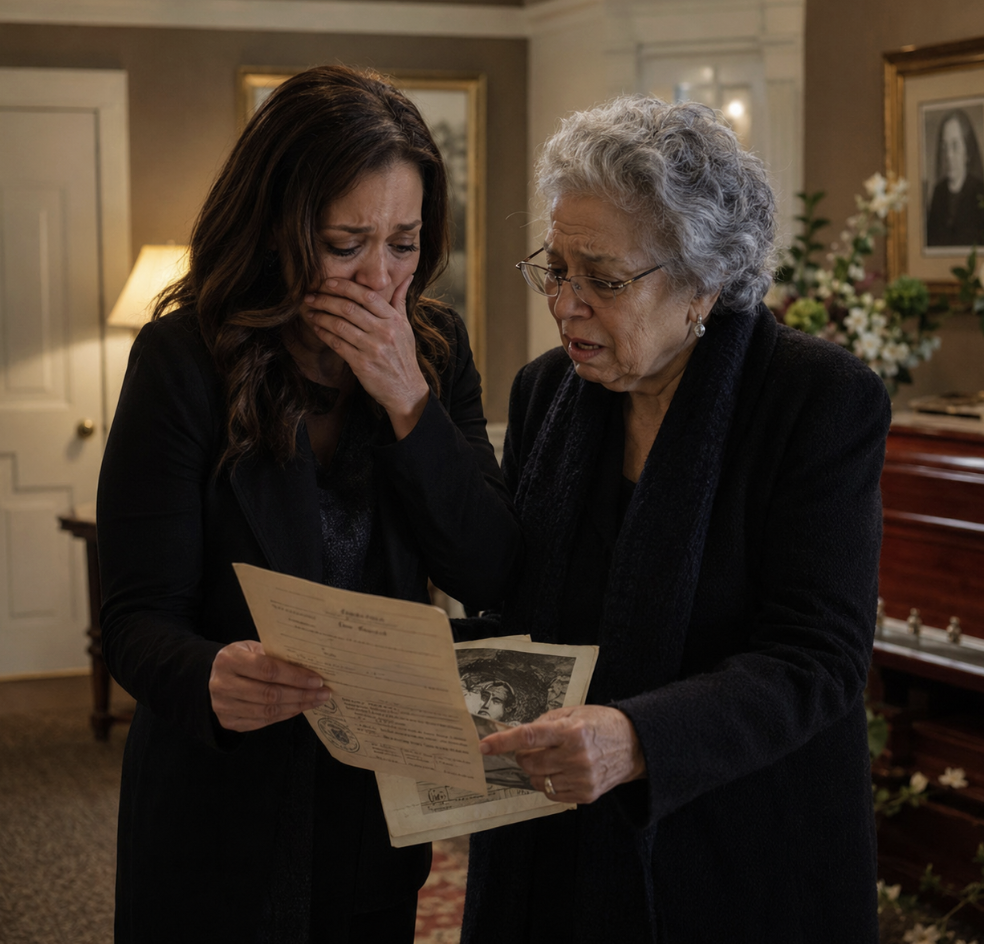
The first thing my father taught me about my mother was that she abandoned me.
Not accidentally.
Not reluctantly.
Not because she had no choice.
According to him, she chose to leave.
She chose another man.
She chose a different life.
And she never looked back.
I was seven years old when she disappeared.
At least that was the story.
And for more than thirty years, I believed it.
Children don’t question stories repeated often enough.
Especially when those stories come from the only parent they have left.
My name is Claire Harrison.
For most of my life, my mother existed only as a cautionary tale.
Whenever I asked about her, my father gave the same answer.
“She left.”
Simple.
Cold.
Final.
If I pushed further, he would add details.
“She ran off with someone else.”
“She didn’t want this family.”
“She made her choice.”
As I grew older, the details expanded.
Apparently she had betrayed him.
Destroyed the marriage.
Abandoned responsibility.
Walked away from her own child.
The story never changed.
And because it never changed, I accepted it as truth.
I hated her for years.
Not actively.
Not passionately.
Just quietly.
The way people hate a scar.
Something painful they learn to live with.
Every Mother’s Day felt strange.
Every school event felt incomplete.
Every family tree assignment at school felt awkward.
Friends talked about arguments with their mothers.
I wondered what it would be like to have one.
Yet even then, part of me imagined she wasn’t worth knowing.
After all, good mothers don’t leave their children.
That’s what I believed.
That’s what my father believed.
Or at least that’s what he wanted me to believe.
To be fair, my father wasn’t a monster.
That’s what makes this story difficult.
He worked hard.
Paid bills.
Attended school events.
Taught me to drive.
Helped me with homework.
He wasn’t cruel.
He wasn’t abusive.
He loved me.
Or at least I think he did.
But love and honesty are not always the same thing.
I understand that now.
I didn’t then.
As the years passed, my mother became less real.
More myth than person.
I had no photographs of her.
No letters.
No birthday cards.
No phone calls.
Nothing.
According to my father, she never tried to contact me.
Not once.
That fact seemed to confirm everything.
If she cared, wouldn’t she have come back?
Wouldn’t she have called?
Wouldn’t she have written?
The silence felt like proof.
By twenty-five, I stopped asking questions.
By thirty, I stopped thinking about her altogether.
Life moved on.
Career.
Marriage.
Divorce.
New city.
New responsibilities.
The older I became, the less space she occupied in my mind.
Then my father died.
A heart attack.
Sudden.
Unexpected.
He was seventy-two.
One day he was fine.
Three days later we buried him.
Grief is strange.
You expect sadness.
What you don’t expect is confusion.
After the funeral, I found myself sorting through decades of belongings.
Old tax records.
Photographs.
Receipts.
Insurance documents.
The usual debris of a life.
Nothing unusual.
Nothing revealing.
Nothing that challenged the story I had known since childhood.
Then the woman appeared.
I first noticed her standing alone near the cemetery gates after the service.
Elderly.
Gray hair.
Dark coat.
Watching.
At first I assumed she was a distant family friend.
Perhaps someone from church.
Perhaps an old neighbor.
Yet she never approached anyone.
Never spoke.
Never joined the gathering.
She simply watched.
Then left.
I forgot about her immediately.
Until two days later.
I was cleaning my father’s house when someone knocked on the door.
The same woman stood outside.
For several seconds neither of us spoke.
Then she asked:
“Are you Claire?”
Something about her voice made me uneasy.
“Yes.”
Her eyes filled with tears.
Not dramatic tears.
The kind people struggle to hide.
For a moment I thought she might be confused.
Then she said something impossible.
“I knew your mother.”
My entire body froze.
Nobody talked about my mother.
Nobody.
Not anymore.
The woman slowly removed a large envelope from her bag.
“I’ve been waiting thirty-one years to give this to you.”
My heart began pounding.
“What is it?”
She hesitated.
Then answered.
“The truth.”
I almost laughed.
The word sounded ridiculous.
Like something from a bad movie.
Yet something in her expression stopped me.
She wasn’t dramatic.
She wasn’t angry.
She looked tired.
Like someone carrying a burden for too long.
I invited her inside.
Her name was Evelyn Mercer.
She had once worked as a court clerk.
And according to her, she knew exactly what happened the year my mother disappeared.
At first I didn’t believe her.
Why would I?
A stranger arrives after my father’s funeral claiming everything I know is wrong?
It sounded absurd.
Then she handed me the envelope.
Inside were copies of court documents.
Custody hearings.
Protective orders.
Judicial rulings.
Records dating back more than three decades.
My hands trembled as I examined the first page.
The names were correct.
My mother’s name.
My father’s name.
My name.
The case number.
The dates.
Everything matched.
Then I reached a sentence that made my stomach drop.
Petitioner requests immediate enforcement of visitation rights.
I read it again.
Then again.
Visitation rights?
The document was filed by my mother.
According to my father, she had abandoned me.
Yet here was legal paperwork showing she was fighting to see me.
The room suddenly felt too small.
I flipped through more pages.
Another motion.
Another request.
Another hearing.
Again and again, the documents showed the same thing.
My mother wasn’t disappearing.
She was trying to come back.
My breathing became shallow.
“This isn’t possible.”
Evelyn’s expression broke my heart.
“I know.”
I continued reading.
Each page felt like a punch.
Because every page contradicted my childhood.
According to the records, my mother spent years attempting to regain contact.
Years.
Not weeks.
Not months.
Years.
Phone requests.
Legal motions.
Mediation attempts.
Court appearances.
The woman I believed had abandoned me apparently spent enormous effort trying to reach me.
Nothing made sense.
Nothing.
I looked up at Evelyn.
“If this is true… why didn’t I know?”
She closed her eyes briefly.
Then whispered:
“Because someone made sure you never would.”
A chill ran through my body.
I suddenly realized the story of my childhood was beginning to crack.
And I wasn’t sure what would remain when it finally broke apart.
For a long time, I simply stared at the documents spread across my father’s dining room table.
The paper felt heavier than it should have.
Every page contradicted something I had believed for more than three decades.
Every sentence created new questions.
And every answer seemed impossible.
I looked at Evelyn.
“Tell me everything.”
She nodded slowly.
Then she began.
According to Evelyn, my parents’ marriage had indeed fallen apart when I was seven years old.
That part was true.
There had been arguments.
Lawyers.
Court hearings.
Pain.
But the story ended there.
The affair?
The abandonment?
The mother who vanished without caring?
Those parts were not in any official record.
In fact, the records suggested something completely different.
When my parents separated, the court initially granted temporary custody arrangements while long-term decisions were being reviewed.
My mother expected regular visitation.
She expected shared parenting.
She expected to remain part of my life.
Instead, things began going wrong almost immediately.
Scheduled visits were canceled.
Phone calls were interrupted.
Letters disappeared.
Requests were denied.
At first, she assumed it was temporary.
Miscommunication.
Anger.
Bitterness from the divorce.
Then months became years.
The court records revealed a pattern.
One hearing after another.
One request after another.
One attempt after another.
Every time she tried to reconnect, another obstacle appeared.
I felt sick.
Because suddenly memories from childhood resurfaced.
Memories I hadn’t thought about in decades.
A woman standing across the street from my elementary school.
A figure I vaguely remembered watching from a distance.
At the time, my father told me she was a stranger.
Now I wasn’t so sure.
Another memory surfaced.
A birthday card that arrived when I was eight.
I remembered the envelope.
I remembered my father throwing it away before I could open it.
At the time, I thought nothing of it.
Now my hands began shaking.
Had that been her?
Had she been trying to reach me all along?
Evelyn seemed to read my thoughts.
“There were letters.”
I looked up immediately.
“What?”
“There were many letters.”
The room went silent.
“Your mother wrote constantly.”
I couldn’t speak.
For years, my father told me she never contacted me.
Never.
Not once.
Yet according to Evelyn, the opposite was true.
My mother wrote letters for birthdays.
Christmas.
First days of school.
Graduations.
Milestones.
Ordinary days.
Extraordinary days.
She kept writing even when she received no response.
The image devastated me.
A woman sitting alone somewhere, writing letters to a daughter who never answered.
A daughter who never answered because she never received them.
I pressed my hands against my face.
Everything hurt.
The betrayal.
The confusion.
The wasted years.
Most painful of all was realizing I had hated her.
Not because of something she did.
Because of something I was told.
Evelyn reached into her bag once more.
Then she placed another box on the table.
Unlike the court documents, this box looked old.
Worn.
Carefully preserved.
My pulse quickened.
“What is that?”
Her eyes filled with tears.
“The reason I came.”
Slowly, she opened the lid.
Inside were dozens of envelopes.
Hundreds of pages.
Photographs.
Birthday cards.
Letters.
So many letters.
All addressed to me.
My name appeared on every envelope.
Claire.
Claire Harrison.
Claire Elizabeth Harrison.
My vision blurred immediately.
I picked up the first letter.
The postmark was thirty years old.
I carefully unfolded it.
“Dear Claire,”
The handwriting was unfamiliar.
Yet somehow I knew.
My mother.
For the first time in my life, I was reading words written directly to me by the woman I believed had abandoned me.
The letter described a birthday.
My eighth birthday.
She apologized for not being there.
Promised she was trying.
Promised she loved me.
Promised she would never stop fighting.
I grabbed another letter.
Then another.
Then another.
Every one carried the same theme.
Love.
Hope.
Persistence.
Desperation.
She never stopped being my mother.
Not for one year.
Not for ten years.
Not for thirty.
The letters tracked the entire timeline of my life.
When I started middle school.
When I turned sixteen.
When I graduated.
When I went to college.
She wrote through all of it.
Even when she had no idea whether I would ever read a single word.
That realization broke something inside me.
Because I knew what kind of commitment that required.
Most people eventually stop knocking on a locked door.
My mother apparently never did.
Then I found a photograph.
A recent one.
Far more recent than I expected.
Perhaps ten years old.
My breath caught.
It was my mother.
The first clear photograph I had seen since childhood.
Older.
Gray hair.
Gentle eyes.
She looked nothing like the villain I had imagined.
She looked tired.
Kind.
Human.
On the back she had written:
“If you ever see this, I hope you know I never left willingly.”
I started crying.
Not quietly.
Not gracefully.
The kind of crying that comes when an entire foundation collapses.
Because that sentence destroyed thirty years of certainty.
For most of my life, I believed my mother chose someone else over me.
Now I was discovering she had spent decades trying to find a way back.
Eventually I managed to ask the question haunting me most.
“Why didn’t she come here herself?”
Evelyn lowered her eyes.
The answer arrived softly.
“She died three months ago.”
The room spun.
“What?”
Cancer.
The same word that had taken my father’s final years.
Only in her case, it happened faster.
Much faster.
She had spent her final months organizing documents.
Preparing letters.
Making arrangements.
And giving Evelyn one final request.
Find Claire.
Tell her the truth.
I felt physically unable to breathe.
Three months.
Three months.
After thirty-one years of separation, we had missed each other by three months.
The cruelty of it felt unbearable.
I could have met her.
Spoken to her.
Heard her voice.
Asked questions.
Made memories.
Instead, we remained strangers until the very end.
The grief arrived in waves.
Not only grief for losing her.
Grief for losing every year before that.
Every birthday.
Every Christmas.
Every conversation.
Every ordinary moment that should have existed.
I mourned a relationship that never had the chance to happen.
Over the following weeks, I read every letter.
Every single one.
Some were short.
Some stretched for pages.
Together they formed an alternative version of my life.
The life my mother desperately wanted to share.
She described watching from a distance at school events.
Seeing me graduate.
Learning about major milestones through mutual acquaintances.
Celebrating my achievements privately.
Praying for me constantly.
Loving me without permission.
Loving me without access.
Loving me anyway.
One letter affected me more than all the others.
It was written shortly before her death.
The handwriting shook noticeably.
The words were simple.
“I don’t know if you’ll ever read this.”
“But if you do, there is one thing I need you to understand.”
“I never stopped being your mother.”
“Not when the court dates ended.”
“Not when the letters came back unopened.”
“Not when the years passed.”
“Not even now.”
“Some people think motherhood ends when a child leaves.”
“They’re wrong.”
“It ends when a mother’s heart stops.”
“And mine still belongs to you.”
I cried for hours after reading those words.
Because they contained more love than I knew how to process.
Months later, I visited her grave.
For a long time, I simply sat there.
No speeches.
No dramatic moment.
Just silence.
The kind shared between two people who lost too much time.
Eventually I spoke.
I told her about my life.
My work.
My marriage.
My mistakes.
My hopes.
Everything.
The conversation lasted nearly three hours.
And when I finally stood to leave, I realized something.
The woman I spent decades hating never existed.
She was a story.
A narrative.
A version of events built by someone I trusted completely.
The real woman was far more complicated.
Far more loving.
Far more tragic.
As for my father, people often ask how I feel about him now.
The answer isn’t simple.
I loved him.
Part of me always will.
But love does not erase truth.
What he did stole something irreplaceable.
Not just from my mother.
From me.
From all three of us.
Yet carrying hatred would only continue the damage.
So instead, I carry something else.
The truth.
Today, the court documents remain in a folder.
The letters remain in a special box.
And every year on my birthday, I read one of them.
Not because I need proof anymore.
Because I finally have the chance to hear my mother’s voice.
The voice that spent thirty-one years trying to reach me.
The voice I never heard because someone else was speaking louder.
And perhaps the saddest lesson of all is this:
Sometimes the deepest wounds in a family are not caused by abandonment.
They are caused by lies about who abandoned whom.


