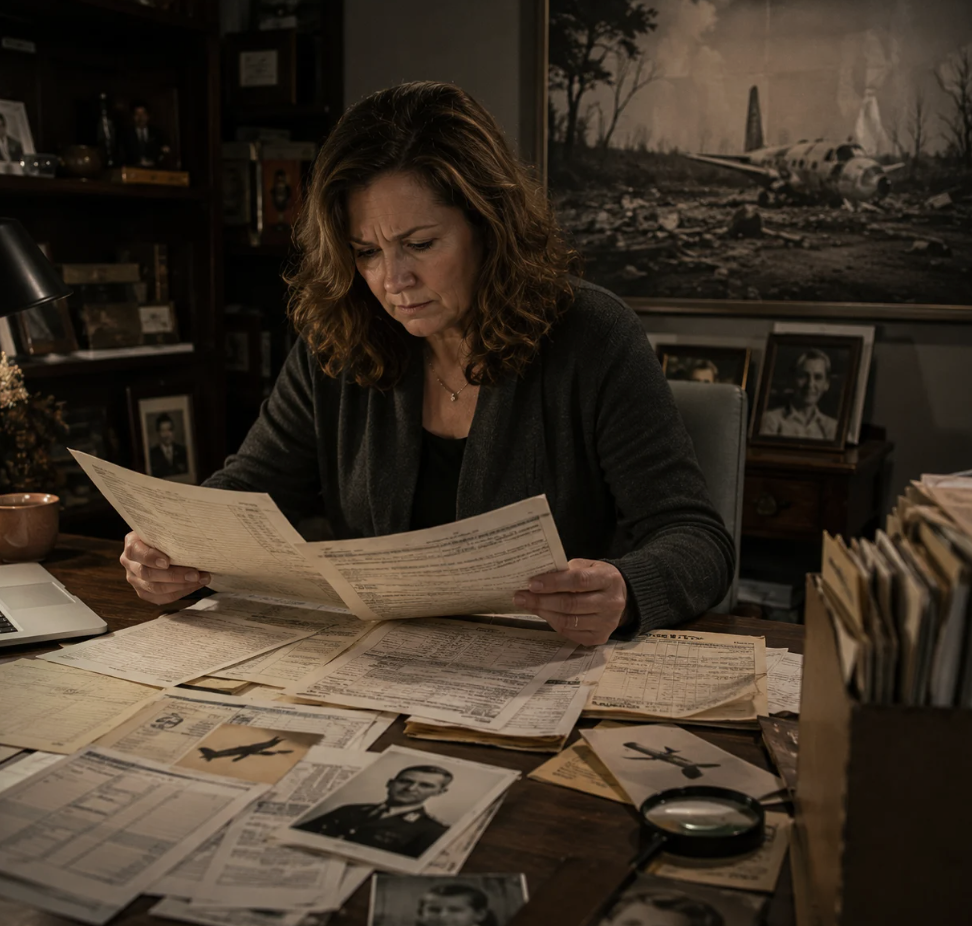
For twenty-five years, Caroline believed her father died in a plane crash.
His name was on the passenger list.
His funeral had an empty coffin.
And every year, her family mourned a man they thought had vanished into the sky.
Then one bank transaction appeared under another name.
And the signature beside it belonged to her father.
Caroline Hayes was nine years old when Flight 417 disappeared over the mountains.
She remembered the day in fragments, the way children remember trauma before they understand it. Her mother dropping a glass in the kitchen. The television flashing the same breaking-news banner. Neighbors entering the house without knocking. Her grandmother praying so loudly in the living room that it sounded less like faith and more like begging.
Her father, David Hayes, had been traveling for work. That was what Caroline had always been told. A short business trip. One routine flight. One promise before he left.
“I’ll bring you a snow globe from Denver.”
Then the aircraft vanished from radar during heavy weather. Search teams found wreckage days later across a remote mountain ridge. The crash was catastrophic. There were no survivors. Not every body was fully recovered.
That sentence became part of Caroline’s childhood.
Not every body was fully recovered.
It explained the empty coffin. It explained why she never saw her father one last time. It explained the silence whenever she asked too many questions. Adults repeated it gently, as though kindness could make absence easier.
But absence shaped everything.
Her mother, Elaine, changed after the crash. Before, she had been warm and social. Afterward, she became careful. She checked locks twice. Avoided interviews. Stopped taking Caroline to crowded events. She moved them to another neighborhood before the first anniversary of the crash, claiming it was too painful to stay in the old house.
Caroline believed grief made people smaller.
Only later would she understand that fear does the same thing.
The years passed. Caroline grew up responsible, cautious, almost painfully organized. She studied accounting because numbers felt safe. Numbers did not vanish in storms. Numbers did not kiss you goodbye and disappear. Numbers did not leave empty coffins behind.
By thirty-four, she had become a forensic accountant for a regional bank. Her job was to find money that moved strangely. Hidden transfers. Dormant accounts. Suspicious patterns. Names that did not belong where they appeared.
That was how she found him.
Not through a private investigator.
Not through a deathbed confession.
Not through some dramatic letter hidden in an attic.
Through a transaction file.
The assignment seemed boring at first. Caroline was reviewing old trust accounts connected to insurance settlements and long-term legal payouts. Most files were dull. Names, dates, routing numbers, signatures, beneficiaries, scanned documents.
Then one account caught her attention.
The name was Martin Bell.
Caroline had never heard it before.
But the account received a yearly deposit on the same date.
October 12.
The anniversary of Flight 417.
At first, she told herself it meant nothing. People received annual payments for all kinds of reasons. Settlements. Pensions. Structured benefits. But the memo line made her pause.
D.H. obligation.
D.H.
David Hayes.
Her father’s initials.
Caroline opened the archived signature card.
The air seemed to leave the room.
Martin Bell’s signature appeared at the bottom of the document. The handwriting was older and shakier than she remembered from childhood birthday cards, but the long final stroke beneath the name was unmistakable.
Her father always underlined his signature that way.
Always.
She printed the card with trembling hands and drove home in silence. That night, she opened the old memory box she kept in her closet. Inside were birthday cards, postcards, and one note her father had written the morning he left.
Be good for your mom. Back Friday. Love, Dad.
She placed that note beside Martin Bell’s signature.
The room tilted.
The handwriting matched.
Not almost.
Not possibly.
It matched.
She checked the account history again. Martin Bell had opened the account six months after the crash. Six months after David Hayes was declared dead. Six months after Caroline stood beside an empty coffin while adults cried around her.
For twenty-five years, money had moved quietly into an account under a different identity.
And every year, on the anniversary of the crash, someone paid Martin Bell.
Caroline should have reported the irregularity.
Instead, she drove to her mother’s house.
Elaine was seventy-two now, smaller than Caroline remembered, though still sharp-eyed. She lived alone in the same quiet way she had lived for decades. Curtains drawn at night. Porch light always on. Deadbolt turned twice.
Caroline placed the documents on the kitchen table.
“Who is Martin Bell?”
Her mother did not ask what she meant.
That was Caroline’s first answer.
Elaine looked at the papers, then slowly sat down. Her face changed in a way Caroline had never seen before. Not surprise. Not confusion. Defeat.
“Where did you find this?”
“At work.”
“You shouldn’t have looked.”
Caroline laughed once, bitterly.
“That’s your response?”
Elaine closed her eyes.
“Caroline…”
“My father died in a plane crash.”
Silence.
“Didn’t he?”
Elaine’s hands tightened around the edge of the table.
“Your father was on that plane.”
“That is not what I asked.”
The kitchen filled with the old silence Caroline knew from childhood. Only now, it no longer felt like grief. It felt like a locked door.
Elaine stood and walked to the pantry. From the top shelf, she removed an old coffee tin. Inside was a key.
“There’s a storage unit in Cedar Falls.”
Caroline stared at her.
“What?”
“Your father left instructions. If this ever came back, I was supposed to give you the key.”
“If what came back?”
Elaine’s voice broke.
“Him.”
The next morning, Caroline drove forty miles to Cedar Falls Storage.
Unit 28 sat near the back row. Rust lined the bottom of the metal door. The lock was old but well oiled. Someone had maintained it.
Inside were boxes.
Dozens of them.
Each labeled by year.
Every year after the crash.
Caroline opened the first box and found newspaper clippings about herself. School awards. A photograph of her at a spelling bee. Her high school graduation announcement. College acceptance letter photocopies. A wedding invitation. A divorce notice clipped from the local paper. Articles about promotions at work.
Her entire life had been collected.
Watched.
Preserved.
She felt sick.
In the back of the unit sat a locked file cabinet. The same key opened it.
Inside was one envelope.
Across the front, in her father’s handwriting, were the words:
For Caroline, when the lie becomes heavier than the truth.
She opened it with shaking hands.
My little girl,
If you are reading this, then one of two things has happened.
Either I failed to stay hidden, or you became too much like me and followed the paper trail.
I am sorry for both.
Caroline sank onto a plastic crate.
Her father’s voice rose from the page like a ghost.
He wrote that Flight 417 had not been the beginning of the story. It had been the end of one life and the forced beginning of another.
Months before the crash, David Hayes had worked as a financial controller for a defense contractor. Caroline had known he worked with numbers, but not the details. According to the letter, he discovered shell vendors, false invoices, and payments routed through companies that did not exist.
At first, he believed it was corporate fraud.
Then he traced one payment to accounts connected to illegal weapons shipments.
He copied files. Gathered evidence. Contacted a federal investigator.
Then the threats began.
A coworker who helped him died in what police called a home accident. David received anonymous calls. Elaine found a photograph of Caroline in their mailbox with no note.
That was when David realized the people involved knew his family.
The federal investigator promised protection, but the case was larger than anyone expected. Powerful executives. Political donors. Foreign accounts. Classified contracts.
If David testified publicly, his family would become a target.
Then Flight 417 crashed.
David had boarded the plane.
That part was true.
But before takeoff, federal agents removed him through a maintenance access point after receiving credible intelligence that someone planned to kill him during the trip or after landing.
The plane took off without him.
Hours later, it crashed.
David wrote that he had not caused the crash. He had not known it would happen. He had not imagined that a plane he was supposed to be on would go down.
But once it did, the government saw an opportunity.
A dead witness cannot be threatened.
A dead man can testify through sealed documents.
A dead father can keep his daughter alive.
Caroline stopped reading.
The storage unit felt too small.
Her father had survived by stepping off a doomed flight.
Everyone else had died.
And instead of coming home, he had stayed dead.
The letter continued.
I wanted to come back after the trial.
I swear to you, Caroline, I wanted to.
But the trial never happened the way we were promised.
Deals were made.
Names disappeared from indictments.
Some men went to prison.
Others walked away richer.
The people most dangerous to us remained free.
So I became Martin Bell.
At the bottom of the cabinet, Caroline found proof.
Photocopies of sealed correspondence.
Old case summaries.
A new identity packet.
A grainy photograph of her father with darker hair and a beard, standing beside a government vehicle.
And one cassette tape labeled:
The truth, if paper is not enough.
Caroline found an old recorder in another box.
Static crackled.
Then her father’s voice filled the room.
“Carrie, if you’re hearing this, I’m sorry.”
Nobody had called her Carrie since she was nine.
She broke.
The tape revealed more than the letter. David admitted he had watched Caroline from a distance twice. Once at her high school graduation. Once at her wedding. Both times he broke protocol. Both times he nearly came forward.
“I told myself watching was better than risking your life,” he said. “But there is no version of this where I was a good father. Only a living one.”
By the time the tape ended, Caroline no longer knew what she felt.
Rage.
Grief.
Relief.
Betrayal.
Then she found one final document.
A bank withdrawal.
Three weeks old.
Martin Bell had withdrawn $800 from a small branch in Montana.
Her father wasn’t just alive after the crash.
He was alive now.
And suddenly the mystery became a choice.
Find him.
Or let the dead stay dead.
Caroline did not tell Elaine she was going to Montana.
Not at first.
Her mother had carried the secret for twenty-five years, and Caroline no longer trusted her version of protection. She booked the flight herself, rented a car under her own name, and drove through miles of open road with the printed withdrawal record sitting on the passenger seat like a summons.
Martin Bell.
Mountain West Credit Union.
Red Hollow, Montana.
Population 3,412.
It was the kind of town where strangers were noticed before lunchtime and remembered by dinner.
Caroline checked into a motel with flickering neon and thin curtains. She barely slept. Every time a truck passed outside, she imagined her father walking beneath the orange parking-lot lights, old and alive and impossible.
The next morning, she went to the bank.
A teller in her sixties greeted her.
Caroline placed two photographs on the counter. One was David Hayes before the crash. The other was the grainy protected-identity photo from the storage unit.
“I’m looking for a man who may go by Martin Bell.”
The teller’s expression shifted.
“I can’t discuss customers.”
“I understand.”
“Then you understand I can’t help.”
Caroline placed one final photo on the counter.
Her father holding her on his shoulders by the lake.
The teller looked down.
Her voice softened.
“He’s your father.”
Caroline swallowed.
“Yes.”
The woman glanced toward the back office, then lowered her voice.
“He comes in every Thursday morning. First thing. Walks from the north side.”
“Where does he live?”
“I can’t tell you that.”
“Please.”
The teller hesitated.
“He gets coffee every morning at Ruthie’s Diner. Sometimes kindness is easier over pancakes.”
Caroline walked there with her heart pounding.
The diner smelled of bacon, coffee, and old wood. She sat in a booth facing the door. Every time the bell above the entrance rang, her entire body tightened.
At 7:42 a.m., an old man walked in wearing a brown jacket and carrying a folded newspaper.
Caroline knew him instantly.
He was older, thinner, weathered by time. His hair was mostly white. His shoulders bent slightly forward. But his eyes were the same.
Her father’s eyes.
David Hayes stood at the counter ordering coffee under the name Martin Bell.
Then he turned.
Their eyes met.
The newspaper slipped from his hand.
For several seconds, the whole diner seemed to vanish.
Then he whispered one word.
“Carrie.”
That broke her.
She stood so quickly the booth shook.
Her first instinct was to run into his arms.
Her second was to slap him.
She did neither.
She only said, “You were dead.”
Every conversation in the diner stopped.
David’s face collapsed.
“I know.”
“No,” she said. “You don’t get to say that like it’s sad. You were dead. We buried you.”
He stepped toward her.
She stepped back.
“Don’t.”
He obeyed.
That hurt more than resistance would have.
The waitress quietly led them to a back storage room. It smelled of flour, coffee, and cleaning supplies. Not exactly the place Caroline had imagined confronting a ghost.
For a long moment, father and daughter stared at each other like survivors of the same disaster standing on opposite shores.
David spoke first.
“How did you find me?”
“Bank records.”
Despite everything, something like pride moved across his face.
“Of course.”
“Don’t do that.”
His expression fell.
“Do what?”
“Act like you know me.”
He looked down.
“I deserve that.”
“You deserve worse.”
“I know.”
Caroline had rehearsed speeches on the flight. Accusations. Questions. Demands. But standing in front of him, she felt nine years old and forty-four at the same time.
“Did you love us?”
The question surprised even her.
David looked wounded.
“Every day.”
“Then how do you let people mourn you for twenty-five years?”
His eyes filled with tears.
“By telling yourself their grief is safer than their funeral.”
The room went silent.
He explained the story again. The corruption case. The threats. The last-minute extraction. The crash. The decision to remain dead. The protected identity. The men who had remained powerful enough to reach his family.
Caroline listened with her arms folded.
“Mom knew.”
“Not everything at first.”
“Enough.”
“Yes.”
“She let me cry at your grave.”
David covered his face with one hand.
“I asked her not to visit it.”
Caroline laughed bitterly.
“That was your solution?”
“No. There was no solution. There were only bad choices.”
He told her that after the crash, federal handlers informed Elaine. At first, the plan was temporary. David would testify through sealed channels. Arrests would follow. When the danger passed, he might return under controlled conditions.
But the case changed.
Witnesses recanted. Evidence vanished. A prosecutor resigned. Some defendants accepted quiet deals. The most dangerous people were never fully exposed.
David became a liability.
Alive, he was a witness.
Dead, he was a closed file.
“They told me if I came home, it would restart everything,” he said. “Not just for me. For you.”
“So you chose for us.”
“Yes.”
“Did anyone ask if I wanted a living father more than a safe lie?”
He did not answer.
That was answer enough.
She asked why the bank account still existed if it could expose him.
He said the account was part of an old monitored structure designed to make sure settlement payments and silence agreements remained intact. Once, those records sat buried inside sealed files. But banks merged. Systems changed. Archives became searchable.
“And you never thought your forensic-accountant daughter might find it?”
A sad smile touched his face.
“I hoped you would.”
Caroline stared at him.
“What?”
David reached into his jacket and removed a worn envelope.
“I’ve carried this for three years.”
Inside was a letter addressed to her. He explained that he had developed a heart condition. Not immediately fatal, but serious enough to make him think about time differently. He had considered sending the letter dozens of times, but fear stopped him.
Not fear of the old enemies.
Fear of her hatred.
“I told myself staying away was protection,” he said. “After a while, I think it became cowardice.”
That honesty landed harder than any excuse.
Caroline wanted him to be simple. A villain or a martyr. A selfish coward or a noble protector.
He was neither.
He was a man who survived something terrible, made impossible choices, and then hid inside those choices until they became a prison.
She asked about the crash.
“Do the victims’ families know you got off that plane?”
His face changed.
“No.”
“Your name is on memorials.”
“I know.”
“They mourned you beside people who actually died.”
“I know.”
“Do you understand how wrong that is?”
He looked at her then, and the shame in his eyes was real.
“Yes.”
That was the full cruelty of the lie.
It did not only steal her father from her.
It placed him among the dead.
It allowed his name to sit beside people who never had a chance to escape.
“You owe more people the truth than just me,” Caroline said.
David nodded.
“I know.”
“Then tell it.”
“If I do, some people may still come after us.”
“Us?”
“You. Your mother.”
Caroline stepped closer.
“You don’t get to use me as the reason for silence anymore.”
Something in him changed then.
Not dramatically.
Not like a movie.
But his shoulders lowered, as if a burden he had used as an excuse had finally been taken away.
That afternoon, Caroline called Elaine.
Her mother answered on the second ring.
“I found him.”
Silence.
Then a sob.
Elaine arrived two days later.
The reunion happened in the motel parking lot under a flat gray sky. Caroline watched from a distance as her mother stood before the man she had buried and protected for twenty-five years.
Elaine did not run to him.
She did not embrace him.
She looked at him for a long time.
Then she said, “You got old.”
David laughed through tears.
“So did you.”
Then Elaine slapped him.
Hard.
David accepted it.
Then Elaine collapsed into his arms.
Caroline turned away.
Not because she wanted to give them privacy, but because the sight hurt too much. Their grief had a language she did not speak. They had shared a marriage, a lie, a death that wasn’t real, and a life stolen by fear.
Over the next week, the three of them spoke more honestly than they ever had.
Elaine admitted she agreed to the deception because federal agents convinced her Caroline could be killed if David returned. Later, when years passed and no danger appeared, shame kept her silent.
“I didn’t know how to tell you I let your father be dead,” Elaine said.
Caroline asked the question that had lived inside her since childhood.
“At my tenth birthday, when I cried because Dad wasn’t there, did you know he was alive?”
Elaine closed her eyes.
“Yes.”
That answer broke something between them.
Maybe not forever.
But deeply.
Truth sometimes breaks what lies only pretend to protect.
David eventually agreed to meet federal authorities.
Not the old handlers. Most were retired, dead, or unreachable. A new team reviewed the old files. Some records remained sealed. Some had vanished. But enough survived to prove that David Hayes had entered protection after being removed from Flight 417 shortly before departure.
The revelation became public months later.
Not every detail.
Not every name.
But enough.
The story exploded.
Families of crash victims reacted with anger. Some said David dishonored the dead. Others said he had been used by a system that valued secrecy over truth. Reporters camped outside Elaine’s house. Neighbors whispered. Retired officials issued careful statements filled with phrases like extraordinary circumstances and regrettable emotional impact.
Caroline hated that phrase.
Regrettable emotional impact.
As if a little girl mourning an empty coffin for twenty-five years was paperwork.
David testified before a closed federal panel. Later, portions of his statement became public. He apologized to the families of Flight 417. He said he did not deserve a place among their dead. He said survival had become its own punishment.
Some accepted the apology.
Many did not.
Caroline understood both.
One woman whose sister died in the crash wrote Caroline a letter.
At first, Caroline feared opening it.
But inside, the woman wrote:
I don’t know whether I forgive your father. But I am sorry you lost him twice.
That sentence became the truest summary of Caroline’s life.
She had lost him once to a crash.
Again to the truth.
Over the following year, David moved to a small apartment near Caroline’s city. Not into Elaine’s house. Not into Caroline’s life as if nothing had happened. Just near enough to begin the slow work of knowing each other.
At first, they met every Saturday for breakfast.
The conversations were awkward.
What do you ask a father who missed your adolescence, graduation, wedding, divorce, promotions, and every ordinary Tuesday in between?
He asked about work.
She gave short answers.
She asked about Montana.
He gave careful ones.
Sometimes they sat in silence.
Sometimes she left early.
Sometimes he cried in the parking lot when he thought she could not see.
One morning, he brought the snow globe.
Caroline stared at it.
A tiny Denver skyline inside glass.
Fake snow floating when shaken.
“I bought it before the flight,” he said. “At the airport.”
She took it carefully.
Her father had promised to bring one home.
For twenty-five years, she thought the promise died with him.
Now it sat in her hands.
Small.
Absurd.
Devastating.
“I kept it in every place they moved me,” he said.
“Why?”
“Because it was the last promise I made to you as David Hayes.”
Caroline wanted to forgive him then.
Completely.
Cleanly.
The way people do in stories.
But real forgiveness is rarely that obedient.
Instead, she said, “Thank you.”
And for that day, it was enough.
Elaine and Caroline’s relationship recovered more slowly.
Every birthday, every holiday, every time Elaine had said, “Your father would be proud,” now carried another meaning. Elaine had known he was alive somewhere, perhaps reading clippings, perhaps watching from a distance.
Caroline once asked, “Did you ever hate him?”
Elaine answered, “Every day. And I loved him every day too.”
That was the terrible thing Caroline was beginning to understand.
Love and anger could occupy the same body.
Truth and betrayal could arrive in the same envelope.
A father could be alive and still absent.
A mother could protect and wound with the same decision.
Two years after the bank transaction, David’s heart condition worsened.
This time there was no fake death.
No sealed file.
No empty coffin.
Caroline sat beside his hospital bed holding the snow globe.
David looked smaller than she expected.
Human.
Not the ghost from childhood.
Not the fugitive from Montana.
Just an old man who had spent too long running.
“I’m sorry I missed your life,” he whispered.
Caroline held his hand.
“You didn’t miss all of it.”
He looked at her.
She hated that giving him comfort still felt natural.
“I’m here now,” she said.
Tears slid down his face.
“I don’t deserve that.”
“No,” she said honestly. “But I’m here anyway.”
He died three days later.
This time, Caroline saw his body.
This time, there was a grave with remains beneath it.
This time, the funeral did not require pretending.
The service was small. Elaine attended. So did a few people from David’s Montana life who had known him only as Martin Bell. A retired federal agent stood in the back and left before anyone could speak to him.
On the grave marker, Caroline insisted on both names.
David Hayes
Known also as Martin Bell
Father. Witness. Survivor.
Imperfect man.
Elaine objected to the final line.
Caroline refused to remove it.
“He doesn’t get to be cleaned up in death,” she said. “None of us do.”
Months later, Caroline returned to the memorial for Flight 417.
For the first time, her father’s name had been removed from the list of victims.
The empty space disturbed her more than she expected.
A name gone from the dead.
But not restored fully to the living.
She placed the Denver snow globe at the base of the memorial.
Not for her father alone.
For everyone who never came home.
Then she whispered, “I’m sorry.”
She did not know whom she was apologizing for.
Her father.
The government.
The lie.
The accident.
The years.
Maybe all of it.
Today, Caroline keeps copies of the bank records in a locked drawer.
The first transaction.
The signature card.
The letter from the storage unit.
And the photograph of her on David’s shoulders before the world split open.
Sometimes she still dreams of an airport gate where her father turns around before boarding. In the dream, he sees her. He chooses her. He comes home.
Then she wakes.
And remembers that life rarely offers the mercy dreams do.
Her father survived a plane crash he was supposed to die in.
But survival cost him his family.
His name.
His place among the living.
And perhaps the hardest truth Caroline carries is this:
He did protect her.
And he did abandon her.
Both are true.
That is what makes the story impossible to file away neatly.
Some families are broken by death.
Others by secrets.
Caroline’s family was broken by a man who became a ghost to keep them safe, then stayed a ghost long after the danger became harder to prove than the damage.
Do you think David was right to remain hidden to protect his family, or did staying away for twenty-five years become a betrayal no danger could justify?


