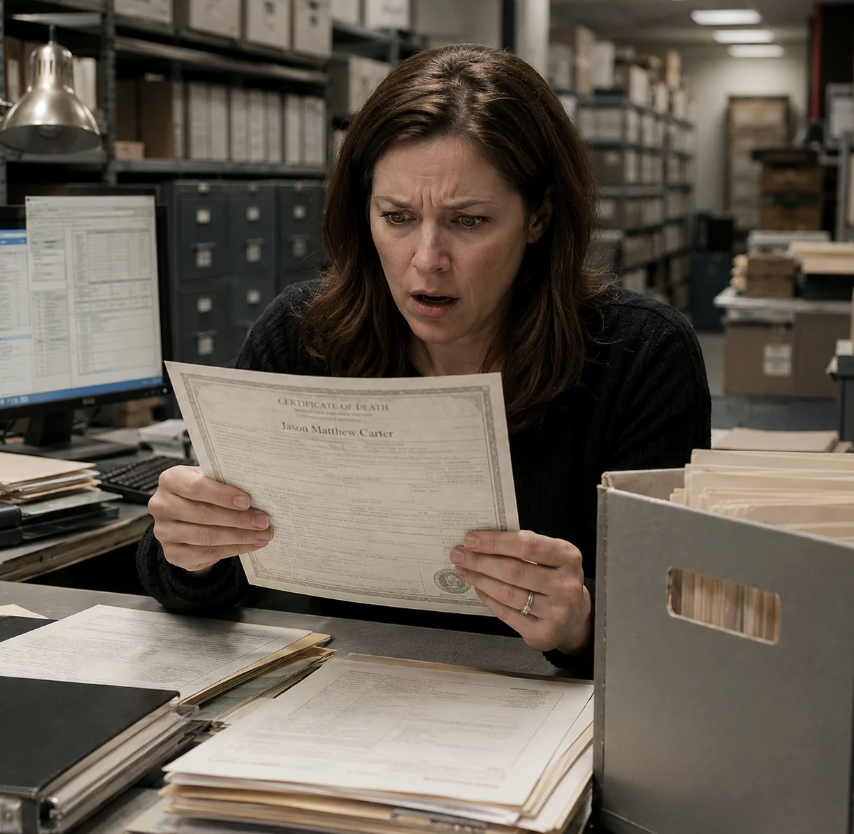
The document said my husband died seven years before we met.
At first, I thought it was a clerical error.
Then I found five more records confirming the same thing.
And that was the moment I realized I had never truly known the man I married.
My husband, Ethan Walker, was the most ordinary man I had ever met.
At least, that was what attracted me to him.
He wasn’t flashy.
He wasn’t rich.
He wasn’t trying to impress anyone.
When we met at a charity fundraiser in Chicago, he seemed refreshingly normal.
He worked as a project manager.
Liked old movies.
Hated social media.
Spent weekends fixing things around the house.
He remembered birthdays.
Held doors open.
Called his mother every Sunday.
For twelve years, I believed I knew everything important about him.
Then he disappeared for three days.
The strange thing wasn’t that he disappeared.
It was how everyone reacted afterward.
When Ethan finally returned home, he looked exhausted.
Not injured.
Not frightened.
Just… defeated.
I asked where he had been.
He claimed he was helping an old friend deal with a family emergency.
The explanation sounded rehearsed.
For the first time in our marriage, I caught him lying.
I couldn’t prove it.
But I knew.
A few weeks later, another strange incident occurred.
We were applying for a home equity loan.
The bank requested identity verification documents.
Routine paperwork.
Nothing unusual.
Until the loan officer called me privately.
“Mrs. Walker, there appears to be a discrepancy.”
I frowned.
“What kind of discrepancy?”
There was a pause.
Then she said something that made no sense.
“Your husband’s records appear incomplete before 2004.”
Incomplete?
Everyone has records.
School records.
Employment history.
Tax filings.
Medical documents.
The officer quickly brushed it off.
Probably a database issue.
Nothing serious.
But the conversation stuck with me.
That night, while Ethan slept, I searched through old family files.
I wasn’t looking for anything specific.
Just trying to understand what the bank had found.
Instead, I discovered something stranger.
There were almost no photographs of Ethan before his mid-twenties.
None from high school.
None from childhood.
None from college.
A few loose pictures existed, but they appeared oddly disconnected.
Different locations.
Different people.
No family albums.
No graduation photos.
No childhood memories preserved in boxes.
It felt wrong.
Most people accumulate evidence of their lives.
Ethan seemed to emerge from nowhere.
The next day I asked him directly.
He smiled.
“Most of my old stuff got lost years ago.”
The answer sounded reasonable.
Yet something about it felt incomplete.
Months passed.
Life returned to normal.
At least until my mother died.
While handling her estate paperwork, I spent hours inside state archives gathering legal documents.
The building contained public records stretching back decades.
Birth certificates.
Property transfers.
Marriage licenses.
Death records.
Thousands upon thousands of files.
The visit had nothing to do with Ethan.
Then I accidentally typed his name into the search system.
To this day, I don’t know why.
Maybe curiosity.
Maybe instinct.
Maybe something deeper.
The search returned one result.
My husband.
Date of death.
September 18, 1997.
I stared at the screen.
Certain I had read it incorrectly.
Then I looked again.
Same name.
Same birth date.
Same place of birth.
Everything matched.
According to the State of Illinois, Ethan Walker had died twenty-seven years earlier.
My hands began shaking.
The clerk noticed my expression.
“Are you okay?”
I quickly closed the screen.
“Yes.”
But I wasn’t.
Not even close.
Over the next week, I returned repeatedly.
Each visit uncovered more records.
Death certificate.
Burial permit.
Probate references.
Archived newspaper notices.
Every document pointed toward the same impossible conclusion.
My husband was legally dead.
And had been long before I met him.
I finally confronted him.
That night I placed copies of the records on the kitchen table.
Ethan walked in.
Saw the documents.
And immediately turned pale.
Not confused.
Not surprised.
Terrified.
For nearly a minute neither of us spoke.
Then I asked the question.
“Who are you?”
The answer should have been simple.
Instead, Ethan sat down slowly and whispered:
“I hoped you’d never find those.”
The room felt colder.
“Find what?”
“My death.”
No denial.
No excuses.
No claims of mistaken identity.
He admitted it instantly.
Which somehow made everything worse.
I demanded the truth.
Every bit of it.
Ethan stared at the documents for a long time.
Then he said something that changed everything.
“The man who died in 1997 was real.”
My heart stopped.
“What does that mean?”
“It means Ethan Walker really died.”
I couldn’t breathe.
If Ethan Walker died…
Then who was sitting across from me?
Before he could answer, someone knocked on the front door.
Three men stood outside.
Dark suits.
Federal badges.
One of them looked directly at Ethan.
Then at me.
And said:
“Sir, we’ve been trying to reach you. The case has reopened.”
Ethan closed his eyes.
As if he had feared this moment for years.
Then he turned toward me and spoke seven words.
“My real name isn’t Ethan Walker.”
My husband stood in our kitchen with three federal agents at the door and a death certificate on the table.
For twelve years, I had called him Ethan.
For twelve years, I had introduced him as my husband.
For twelve years, I slept beside a man who legally should not have existed.
Then he looked at me and said the name I had never heard before.
“My real name is Caleb Rhodes.”
The words meant nothing to me at first.
Not because they were ordinary.
Because they were impossible to connect to the man standing in front of me.
Caleb Rhodes sounded like a stranger.
A man from another life.
A man with another family.
Another past.
Another grave somewhere, maybe.
I stepped back without meaning to.
“Ethan…”
He flinched.
That hurt more than I expected.
One of the federal agents, a woman in her fifties with tired eyes, spoke gently.
“Mrs. Walker, we need to come inside.”
I didn’t move.
Ethan—or Caleb—looked at me.
“Please.”
That one word broke through my shock.
I opened the door.
The agents entered quietly, as if they had done this too many times before.
The woman introduced herself as Special Agent Marissa Hale.
The two men with her remained near the hallway, scanning windows, doors, exits.
That was when I understood this wasn’t about paperwork.
This was about danger.
Agent Hale placed a folder on our kitchen table beside the death certificate.
“Ethan Walker was a protected identity,” she said.
My voice barely worked.
“Protected from what?”
She glanced at my husband.
He nodded slowly.
“From the people I testified against.”
The next hour destroyed my marriage and rebuilt it into something I didn’t recognize.
Caleb Rhodes had grown up in St. Louis.
His father owned a trucking company.
Not a large one.
Not famous.
Just successful enough to handle regional freight contracts.
After college, Caleb joined the business.
He expected to spend his life there.
Then he noticed irregular shipments.
Incorrect manifests.
Strange payment routing.
Drivers being paid in cash.
Trucks moving at night without proper logs.
At first he believed his father was cutting corners.
Then he discovered something much worse.
The company was being used by a criminal network to move illegal goods, launder money, and transport evidence connected to violent crimes.
Caleb’s father wasn’t the mastermind.
He was trapped.
Threatened.
Controlled.
And too frightened to go to authorities.
Caleb wasn’t.
He secretly copied documents.
Recorded conversations.
Tracked shipments.
Gathered enough evidence to expose not only the network but several corrupt officials protecting it.
Then everything collapsed.
One night Caleb returned to the office and found his father dead.
Officially, suicide.
Unofficially, a warning.
Caleb went to federal authorities the next morning.
His testimony helped build a major case.
Several people were arrested.
Assets were seized.
Careers ended.
But the most powerful figure escaped conviction.
A man named Vincent Carrow.
I knew that name.
Everyone in Chicago knew that name.
Publicly, Carrow was a developer.
A philanthropist.
A political donor.
A man photographed at charity galas and hospital openings.
Privately, according to Agent Hale, he was the person Caleb had been running from for most of his adult life.
The trial became dangerous.
Witnesses recanted.
One disappeared.
Another died in a suspicious accident.
Caleb’s apartment was broken into twice.
A car followed him for days.
Then, three weeks before he was scheduled to testify, someone planted explosives in his vehicle.
He wasn’t inside when it detonated.
But investigators saw the attempt for what it was.
After that, the government made a decision.
Caleb Rhodes had to disappear.
Ethan Walker was created.
The real Ethan Walker had died years earlier with no immediate family and limited records.
The identity was repurposed.
Papers were built.
Background adjusted.
Records sealed.
A new life began.
My husband listened as Agent Hale explained, but his eyes stayed on me.
I realized he was watching my face for hatred.
For betrayal.
For disgust.
I had all three.
But I also had fear.
“Why didn’t you tell me?” I asked.
His answer came quietly.
“Because I wasn’t allowed to.”
“You married me.”
“I know.”
“You let me build a life with someone who wasn’t real.”
The room fell silent.
He looked down.
“At first, I told myself I was protecting you.”
“And later?”
“Later I was afraid you’d leave.”
That was the first honest answer he gave me that night.
And somehow it hurt more than the lie.
Agent Hale explained that protected witnesses were expected to avoid deep personal entanglements where possible, especially if active threats remained. But years had passed. Caleb rebuilt a life. He met me. He fell in love. He convinced himself the past was buried.
Then the case reopened.
Vincent Carrow had resurfaced in a federal corruption investigation.
Old witnesses were being contacted.
A former associate had agreed to cooperate.
And Caleb’s original testimony was suddenly important again.
That was why he had disappeared for three days.
He had been meeting federal officials.
The “family emergency” was a lie.
The real emergency was his past returning.
I asked the question I was afraid to ask.
“Am I in danger?”
No one answered quickly enough.
Agent Hale finally said:
“We believe there is potential exposure.”
Potential exposure.
It sounded like the kind of phrase people use when the truth is too frightening to say plainly.
Over the next forty-eight hours, my life became something I had only seen in movies.
Agents reviewed our home security.
Phones were checked.
Travel was restricted.
I was told not to discuss anything with friends or family.
Ethan packed a small bag.
Not casually.
Not like a man preparing for a trip.
Like a man who had done it before.
That image nearly broke me.
“How many times have you run?” I asked.
He froze.
“Twice before you.”
The first time after his father’s death.
The second after the car explosion.
And now possibly a third.
I wanted to scream.
Instead I asked something quieter.
“Did you ever plan to tell me?”
He didn’t answer.
That was answer enough.
The next twist came two days later.
Agent Hale returned with another file.
This one involved me.
Apparently, my archive search had triggered an alert inside a restricted records system.
The death certificate wasn’t supposed to appear publicly under normal search conditions.
A system migration error exposed it.
When I opened the file, the alert notified the U.S. Marshals contact team.
But someone else had accessed the same record hours later.
Someone outside the government.
Someone connected to Carrow.
My search had not only exposed Ethan’s secret.
It had exposed us.
I felt sick.
“So this is my fault?”
Ethan immediately said no.
But part of me believed it anyway.
If I hadn’t typed his name into that archive system…
If I hadn’t asked questions…
If I hadn’t placed the papers on the kitchen table…
Maybe our life would have continued.
A lie, yes.
But safe.
Agent Hale corrected me firmly.
“The breach wasn’t your fault. The identity was compromised because someone else was already looking.”
That sentence changed the shape of my fear.
Carrow’s people had been searching for Caleb before I found anything.
Maybe for months.
Maybe longer.
Suddenly Ethan’s strange behavior made sense.
His sudden disappearances.
His refusal to attend certain public events.
His dislike of photographs online.
His insistence that we never post vacation locations in real time.
All the little habits I called paranoia were survival skills.
But understanding is not the same as forgiveness.
For the next week, we lived inside our own home like strangers.
We slept in separate rooms.
We barely spoke.
He tried to explain pieces of his past.
I wasn’t ready to hear them.
Then I found the second secret.
Inside a locked drawer in his office was a metal box.
He had forgotten to take it when the agents instructed us to prepare emergency bags.
I know I shouldn’t have opened it.
But by then, trust had already shattered.
Inside were photographs.
Not many.
Just six.
A younger Caleb with his father.
Caleb standing beside a truck.
Caleb outside a courthouse.
And one photograph of a woman holding a toddler.
On the back was written:
Mara and Luke.
My chest tightened.
When Ethan came home, I placed the photograph on the counter.
“Who are they?”
The look on his face told me before he answered.
“My sister and nephew.”
I stared at him.
“You told me you had no siblings.”
“I had to.”
“Had?”
He closed his eyes.
“Mara was killed.”
The words were quiet.
Flat.
Dead.
He explained that after he testified, Carrow’s people couldn’t reach him directly. So they reached for family. Mara refused protection because she didn’t believe the danger was real. Months later, she and her little boy were killed in a house fire officially ruled accidental.
Caleb never accepted the ruling.
Neither did federal investigators, though they lacked proof.
That was the real reason he never told me the truth.
Not simply rules.
Not simply fear of losing me.
He believed everyone who loved Caleb Rhodes eventually paid for it.
So he became Ethan Walker completely.
No parents.
No siblings.
No past.
No photographs.
No history.
A man born from silence.
For the first time, my anger cracked.
Not disappeared.
Cracked.
Because behind the lie was not only deception.
There was grief.
A grief so deep he had amputated his own identity to survive it.
Still, I couldn’t ignore what he had done to me.
“You let me marry a ghost,” I said.
He nodded.
“I know.”
“You gave me a name that belonged to a dead man.”
“I know.”
“You made me part of your witness protection story without my consent.”
His eyes filled with tears.
“I know.”
That was the worst part.
He didn’t defend himself.
No excuses.
No speeches.
No attempt to turn himself into a hero.
He simply accepted that love built on omission is still built on a lie.
Then came the moment everything changed.
A federal convoy arrived before dawn.
We were told to leave immediately.
No time to pack more.
No goodbye calls.
No explanation to neighbors.
I stood in the bedroom holding my wedding ring.
For the first time since learning the truth, I considered taking it off.
Ethan saw me.
His face collapsed.
“I won’t ask you to come.”
I looked at him.
“If I stay?”
“They’ll relocate you separately until it’s safe.”
“And if I go?”
“You may have to disappear with me.”
There it was.
The choice no wife expects to make.
Stay in the life I understood, or follow a man whose name wasn’t real into a future that might never feel safe.
I didn’t answer immediately.
Instead I asked him one final question.
“Who are you now?”
He looked toward the window, where agents moved across our yard.
Then back at me.
“I don’t know anymore.”
That answer felt more honest than anything else.
I went with him.
Not because I forgave him.
Not because trust had returned.
But because I wanted the whole truth before deciding whether our marriage was dead.
We were moved to a safe house two states away.
The first days were tense.
Agents came and went.
Phones were restricted.
News broadcasts mentioned Vincent Carrow’s investigation but not Caleb’s name.
Still, I could feel the danger in every locked door.
At night, Ethan told me everything.
Slowly.
Painfully.
The childhood he erased.
The father he couldn’t save.
The sister whose funeral he never attended because doing so might expose him.
The nephew whose birthday he still remembered every year.
The courtroom testimony.
The new identity.
The loneliness of becoming someone else.
I listened.
Some nights I cried.
Some nights I hated him.
Some nights I understood him too well.
Then Agent Hale brought news.
The cooperating witness against Carrow had been attacked but survived.
His testimony, combined with old evidence Caleb preserved, might finally bring charges that could stick.
Caleb would need to testify again.
Publicly.
Under his real name.
The protected identity was no longer enough.
Ethan Walker would effectively die.
Caleb Rhodes would return.
I asked what that meant for our marriage.
Agent Hale looked uncomfortable.
Legally, our marriage under the assumed identity could be validated through sealed federal processes.
But emotionally?
That was ours to decide.
Two weeks later, Caleb testified.
I watched from a protected room.
He walked into court older, heavier, more tired than the young man described in old files.
But when he raised his hand and said his real name, something in me shifted.
Not healed.
Shifted.
For the first time since this began, he was no longer hiding.
The trial lasted months.
Carrow’s attorneys attacked Caleb’s credibility.
Called him unstable.
A liar.
A government-created fiction.
A man who had lived under a dead person’s name.
But Caleb held steady.
Documents supported him.
Other witnesses confirmed pieces.
Financial trails connected old crimes to new corruption.
And finally, after decades, Vincent Carrow was convicted on multiple federal charges.
Not for everything.
Not for Mara.
Not for the fire.
Not for every life ruined.
But enough.
Enough that he would likely die in prison.
When the verdict came down, Caleb didn’t celebrate.
He sat quietly.
Then cried for the first time since I had known him.
Not loud.
Not dramatic.
Just a broken man finally allowed to stop running.
Months later, we returned to Chicago under security supervision.
Our house felt different.
Every room held memories from a life that was both real and false.
The kitchen where I confronted him.
The hallway where agents stood.
The office where I found Mara’s photograph.
We had to rebuild everything.
Not from zero.
From wreckage.
Some marriages collapse because of affairs.
Some because of money.
Some because love fades.
Ours nearly collapsed because the man I loved had been legally dead before I met him.
Therapy helped.
Time helped.
Honesty helped most.
Caleb stopped using old phrases like “before I met you” when he meant “before Ethan existed.”
He told me stories without editing them.
I learned his father’s favorite song.
His sister’s laugh.
His nephew’s middle name.
The town where he grew up.
The grave he had never visited.
One year after the verdict, we went to St. Louis.
Caleb stood at his father’s grave for nearly an hour.
Then at Mara and Luke’s.
He brought flowers.
I stood beside him, not as the wife of Ethan Walker, but as the wife of Caleb Rhodes.
The distinction mattered.
On the drive home, he asked quietly:
“Do you wish you’d never found the death certificate?”
I thought about lying.
Then I didn’t.
“Some days.”
He nodded.
“But not today.”
He looked at me.
“Today I’m glad I finally know who I’m sitting beside.”
That was the beginning of forgiveness.
Not complete.
Not simple.
But real.
Years later, people who know us casually still call him Ethan.
Legally, that name remains tangled in documents.
But at home, when it is just us, I call him Caleb.
Not always.
But often enough that he remembers he exists.
The death certificate that nearly destroyed my marriage now sits in a locked file box.
Beside it is our wedding certificate.
Two documents that should not be able to belong to the same life.
Yet they do.
One says Ethan Walker died years before I met him.
The other says I married him.
Both are true in ways I never imagined.
My husband was a dead man on paper.
A witness in hiding.
A survivor of violence.
A liar.
A protector.
A victim.
A husband.
None of those truths erase the others.
That is the hardest part of loving someone with a hidden past.
You don’t get one simple answer.
You get contradictions.
And you decide whether love can survive them.
Do you think a protected witness has the right to hide their true identity from the person they marry, or does love require the truth no matter how dangerous it is?


