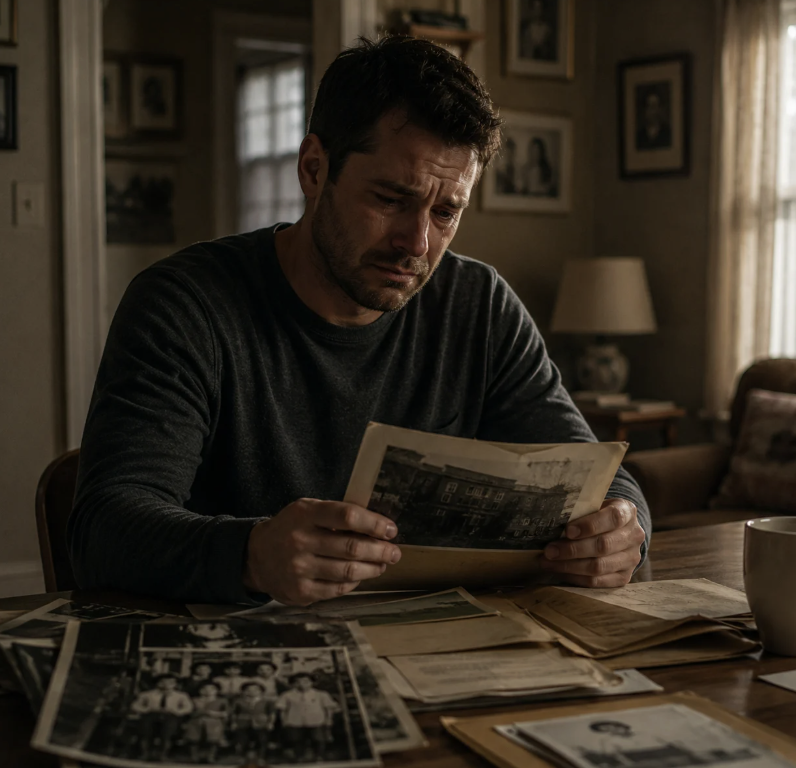
The first memory I have of my father is his back.
Not his face.
Not his voice.
Not his smile.
His back.
Walking away.
I was six years old.
Standing on the front steps of St. Anne’s Children’s Home with a small duffel bag clutched in both hands.
I remember the weather.
Cold.
Gray.
The kind of day that makes everything feel lonely.
My father knelt in front of me and said he needed to leave for a little while.
I asked how long.
He didn’t answer immediately.
Instead, he placed a hand on my shoulder.
Then he said something that would haunt me for decades.
“Be brave, Daniel.”
That was all.
No explanation.
No promise.
No goodbye worth remembering.
Just those two words.
Be brave.
Then he stood up.
Walked toward his car.
And disappeared from my life.
At least that was how I remembered it.
For years afterward, I waited.
Every day.
Every week.
Every birthday.
Every Christmas.
I waited for him to come back.
Children are surprisingly patient when hope is involved.
At seven, I waited.
At eight, I waited.
At nine, I started asking questions.
The nuns rarely answered.
Most of them simply said they didn’t know.
One finally told me the truth as she understood it.
“Your father left you here.”
Simple.
Direct.
Cruel.
Children understand more than adults realize.
I understood exactly what that meant.
He didn’t lose me.
He didn’t die.
He didn’t disappear.
He left.
That distinction changed everything.
Hope slowly transformed into anger.
Then anger transformed into hatred.
The kind of hatred that grows quietly.
Year after year.
Without anyone noticing.
The orphanage became my world.
I learned to fight.
Learned to survive.
Learned not to depend on anyone.
Other children talked about parents.
I pretended I didn’t care.
The truth was I cared more than anyone.
Every family adoption day hurt.
Every holiday hurt.
Every goodbye hurt.
But nothing hurt as much as imagining my father living somewhere comfortably while I sat in a dormitory wondering why I wasn’t worth keeping.
At thirteen, I stopped using his last name.
At sixteen, I stopped talking about him entirely.
At eighteen, I left the orphanage.
And I made myself a promise.
I would never need him.
Never look for him.
Never forgive him.
Life moved forward.
I joined the military.
Worked construction.
Started a business.
Failed.
Started another.
Succeeded.
Married.
Divorced.
Built a life.
A decent life.
Yet no matter how much success I achieved, one wound never healed.
My father.
Sometimes people asked about my family.
I always gave the same answer.
“I don’t have one.”
Technically it wasn’t true.
Emotionally it was.
Then, when I was forty-two years old, I received a phone call.
A hospital in Montana.
An elderly man had died.
No spouse.
No living relatives listed.
No emergency contacts.
Only one name remained in his records.
Mine.
For a moment I thought there had been a mistake.
Then the nurse read his name.
My father.
The man I hadn’t seen in thirty-six years.
The man I hated.
The man who abandoned me.
The man who was now dead.
My first reaction surprised me.
Nothing.
No grief.
No sadness.
No tears.
Just emptiness.
The next week I traveled to Montana to settle his affairs.
Partly out of obligation.
Partly out of curiosity.
Mostly because I wanted closure.
His house was small.
Modest.
Almost lonely.
Not the mansion I had imagined during childhood.
Not the luxurious life I pictured whenever resentment took over.
Just a simple home occupied by a simple old man.
That realization annoyed me.
I wanted a villain.
I wanted evidence that abandoning me had benefited him.
Instead, I found a life that looked strangely ordinary.
The funeral was small.
Very small.
Seven people attended.
None of them seemed to know much about him.
A neighbor.
A mechanic.
A grocery store owner.
A retired teacher.
Ordinary people.
After the service, I expected to return home and forget everything.
Instead, a lawyer approached me.
“Mr. Mercer?”
I nodded.
“There is something your father instructed us to deliver after his death.”
Immediately my stomach tightened.
The lawyer handed me a sealed envelope.
Thick.
Official.
Marked with several government stamps.
I frowned.
“What is this?”
His answer changed everything.
“I honestly don’t know.”
Back at my hotel room, I opened it.
Inside were dozens of documents.
Some heavily redacted.
Some marked confidential.
Several bearing federal agency seals.
At first I assumed it was some mistake.
Then I saw my father’s name.
Again.
And again.
And again.
The further I read, the stranger everything became.
Protective relocation authorization.
Witness security evaluation.
Identity reassignment approval.
Threat assessment report.
I stared at the pages in disbelief.
None of it made sense.
My father wasn’t a criminal.
He wasn’t law enforcement.
He wasn’t anyone important.
Yet here he was.
Buried inside federal records.
Then I reached the page that made my blood run cold.
Across the top were the words:
FEDERAL WITNESS PROTECTION PROGRAM
And directly beneath them…
My father’s name.
For several seconds I simply stared.
Unable to process what I was seeing.
Witness protection?
My father?
Why?
How?
The answer arrived on the next page.
And it shattered everything I thought I knew about my life.
For a long time, I couldn’t move.
The hotel room had gone completely silent except for the hum of the air conditioner.
Witness protection.
The words seemed impossible.
My father was the last person I would have associated with something like that.
He wasn’t mysterious.
He wasn’t powerful.
He wasn’t connected to organized crime, at least as far as I knew.
He was simply the man who abandoned me.
Yet the documents in front of me told a very different story.
I forced myself to keep reading.
The next pages described events that had occurred nearly four decades earlier.
Before my father left me at St. Anne’s.
Before I entered the orphanage.
Before my life split into a before and after.
The heavily redacted reports revealed that my father had served as a key witness in a federal investigation involving a large criminal organization operating across several states.
Names were blacked out.
Locations were partially hidden.
Entire paragraphs had been removed.
But one thing was clear.
People had died.
Witnesses had disappeared.
Threats had been made.
And my father had agreed to testify.
That decision placed him in immediate danger.
Not just him.
Anyone connected to him.
Including a six-year-old son.
Me.
I continued reading until dawn.
Every new page overturned another piece of my childhood.
One report summarized the threat assessment.
The language was cold.
Clinical.
Government language.
Yet one sentence burned itself into my memory.
“Subject’s minor child may be considered a leverage target.”
Leverage target.
Not son.
Not child.
Leverage target.
I sat there staring at those words for nearly ten minutes.
Because suddenly the story looked different.
Horribly different.
I had spent decades believing my father left because he didn’t want me.
Now I was beginning to wonder if he left because he was afraid someone else did.
The next morning I contacted the lawyer.
Within hours he arranged a meeting with a retired federal agent whose name appeared repeatedly throughout the files.
His name was Richard Hayes.
Eighty years old.
Retired for nearly twenty years.
When I showed him the documents, he immediately recognized them.
Then he looked at me for a long moment.
“You look like him.”
The statement irritated me.
“I don’t know whether that’s a compliment.”
A sad smile crossed his face.
“It is.”
For the next three hours, Richard Hayes told me a story I should have heard decades earlier.
According to him, my father had not originally been a witness.
He had been an accountant.
A very ordinary accountant.
Unfortunately, he worked for people who were not ordinary.
Over time he discovered financial records connecting several violent crimes to powerful individuals.
At first he stayed quiet.
Then he witnessed something that changed him forever.
One of his coworkers disappeared.
Officially, it was treated as a missing-person case.
Unofficially, everyone knew what happened.
My father became terrified.
Not just for himself.
For me.
For my mother.
For our entire family.
Eventually federal investigators approached him.
What followed was nearly two years of secret cooperation.
Evidence.
Documents.
Testimony.
Financial records.
Enough information to destroy multiple criminal operations.
But cooperation came with consequences.
The moment his role became known, death threats followed.
Then surveillance.
Then attempted attacks.
The threat was considered severe.
According to Hayes, federal authorities strongly recommended witness protection.
There was only one problem.
Families complicated everything.
The more people involved, the harder it became to keep everyone alive.
The documents confirmed that authorities proposed several options.
None were good.
All carried risks.
Then I asked the question that mattered most.
“What about me?”
The room became quiet.
Hayes sighed.
Then he answered.
“Your father refused to bring you into the program.”
I felt anger immediately.
Of course he did.
Even now.
Even after everything.
Then Hayes continued.
“He thought it would destroy your life.”
I stared at him.
“What?”
Your father had spent weeks arguing with federal officials.
He believed growing up under a false identity, constantly relocating, constantly looking over your shoulder, would ruin your childhood.
He wanted another option.
A safer option.
An impossible option.
Then came the part that changed everything.
According to Hayes, my father eventually reached an agreement with authorities.
Temporary separation.
A secure location.
A new identity for him.
Confidential monitoring for me.
The arrangement was supposed to last only a few years.
Three at most.
Once the primary threats diminished, reunification would be considered.
That never happened.
The criminal investigations expanded.
New arrests triggered new threats.
Additional witnesses were targeted.
Several people connected to the case were murdered.
The danger lasted far longer than anyone expected.
Years became decades.
And the separation became permanent.
I sat silently.
Trying to process it.
Trying to understand.
Trying not to hate him.
Then I asked the obvious question.
“If he loved me so much, why didn’t he tell me?”
Hayes looked genuinely saddened.
“He tried.”
That answer hit harder than anything else.
Because I had already heard those words once before.
My mother had tried.
Now apparently my father had too.
Hayes opened a folder.
Inside were copies of letters.
Dozens of them.
My stomach dropped.
Not again.
Letters.
Always letters.
The first one was dated six months after he left.
The second a year later.
Then another.
Then another.
Birthday letters.
Christmas letters.
Updates.
Apologies.
Expressions of love.
All written by my father.
None delivered.
Why?
Because federal officials repeatedly blocked them.
Any communication risked revealing locations.
Patterns.
Identities.
Connections.
The letters remained archived instead.
Stored.
Forgotten.
Waiting.
For me.
I spent the next several days reading them.
Every single one.
Some were difficult.
Some were devastating.
Many contained details that shattered the image I carried for decades.
One letter described the day he left me at the orphanage.
I nearly couldn’t read it.
His handwriting became shaky halfway through.
“You cried when I stood up.”
“I nearly stayed.”
“God help me, I nearly stayed.”
I had to stop reading.
My hands wouldn’t stop trembling.
Because I remembered that day.
I remembered feeling abandoned.
I had never once considered what it might have felt like from his side.
The letter continued.
“If I stay, they may kill us both.”
“If I leave, you’ll hate me.”
“I pray hatred is the price and not your life.”
I broke down completely.
For thirty-six years I believed he walked away without looking back.
Now I was reading evidence that he never truly left emotionally.
Only physically.
Another letter described my eighth birthday.
Another my tenth.
Another my high school graduation.
How could he know about graduation?
The answer appeared later.
Federal authorities quietly monitored major public records.
Newspaper announcements.
Yearbooks.
Public events.
Tiny fragments of information.
Enough to let him know I was alive.
Enough to keep him going.
One passage shattered me more than any other.
“Today I saw a photograph of you in a newspaper.”
“You look taller than me now.”
“I stared at that picture for nearly an hour.”
“The waitress thought I was crazy.”
“Maybe I am.”
“No father should know his son through newspaper clippings.”
I couldn’t stop crying.
Because suddenly my childhood looked different.
Not healed.
Not fixed.
Different.
The villain I spent decades hating was slowly becoming a tragic human being.
Flawed.
Terrified.
Desperate.
Alone.
One week later I returned to his house.
For the first time, I looked beyond my anger.
Beyond my assumptions.
Beyond my resentment.
And I started noticing things.
A framed photograph of me from high school.
A newspaper clipping announcing my military service.
An article about a business award I received years earlier.
A wedding announcement.
Every milestone.
Every achievement.
Every public trace of my existence.
He had collected them all.
An entire wall of evidence that he never stopped watching from afar.
I sat in that house until sunset.
Then I found one final envelope hidden inside a desk drawer.
Unlike the others, it was recent.
Very recent.
Written only months before his death.
Across the front were the words:
“For Daniel, if this finally reaches him.”
My chest tightened.
Slowly, I opened it.
Inside was a single letter.
No explanations.
No legal details.
No discussion of witness protection.
Just honesty.
“I know you hate me.”
“You earned that right.”
“I missed your childhood.”
“I missed your birthdays.”
“I missed your victories.”
“I missed your worst days.”
“No explanation can return those years.”
Then came the sentence that changed everything.
“But if there is one thing I need you to know, it is this.”
“I did not leave because I didn’t love you.”
“I left because I loved you more than I trusted the world around us.”
I stopped reading.
Because for the first time in forty-two years, I believed him.
Not completely.
Not perfectly.
Forgiveness is more complicated than that.
But I believed him.
The rest of the letter was short.
He apologized.
He expressed regret.
He admitted mistakes.
Then he ended with a simple request.
“If someday you find a way to forgive me, do it for yourself.”
“Carrying all that anger must be exhausting.”
He was right.
It was.
I spent decades carrying a wound that never healed because I never understood it.
Today, people sometimes ask whether I forgave my father.
The honest answer is yes.
Eventually.
Not because what happened was acceptable.
Not because the pain disappeared.
Because the truth finally arrived.
And truth changes things.
I still lost my childhood.
He still lost his son.
Neither of us got those years back.
That tragedy remains.
But another truth remains too.
The man I believed abandoned me spent the rest of his life making sure I stayed alive.
Even when it cost him everything.
Even when it cost him me.
The strangest part is that I spent decades calling him a coward.
Then I discovered he had spent years risking his life to testify against dangerous people.
I spent decades believing he didn’t care.
Then I discovered entire boxes filled with evidence proving otherwise.
And I spent decades hating a man whose greatest fear was that I would hate him.
Sometimes life doesn’t reveal the truth until it’s too late for conversations.
Too late for reunions.
Too late for second chances.
But not too late for understanding.
My father died believing I might never know why he left.
I live with the knowledge that he never truly did.


