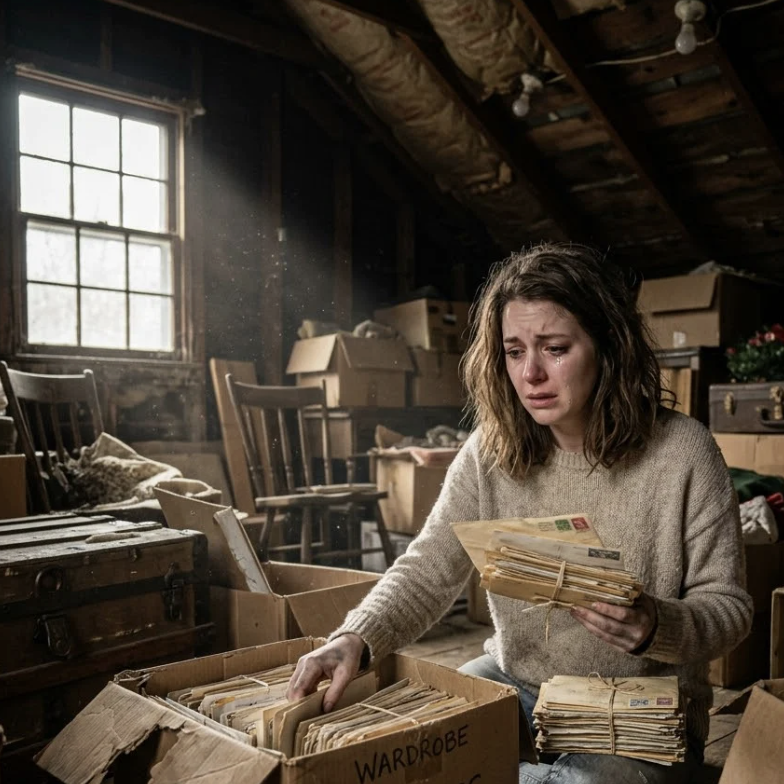
For fourteen years, Emma believed her father was dangerous.
Her mother told her he had hurt them.
The court told her he had lost the right to see her.
And every birthday he missed became another reason to hate him.
Then Emma found a box in the attic.
Inside were hundreds of letters she was never supposed to read.
And by the time she reached the last one, the woman she had trusted most in the world no longer looked like the victim of the story.
She looked like the reason it had been destroyed.
Emma Caldwell was four years old when the court took her father out of her life.
She remembered very little from before that.
A deep voice singing badly in the kitchen.
A pair of large hands lifting her onto a bicycle.
The smell of sawdust on a flannel shirt.
A man laughing when she called pancakes “breakfast cookies.”
Those memories became dangerous later.
Her mother, Valerie, told her they were not real memories.
“Your mind is trying to protect you,” she would say. “Children remember what they wish happened, not what actually happened.”
So Emma learned not to mention them.
In the official story of her childhood, her father, Nathan Caldwell, had been violent, unstable, and unsafe.
Valerie said he had screamed. Threatened. Broken things. Terrified them. She said the court saved them by granting her full custody and banning Nathan from contact.
Emma grew up believing that.
Why wouldn’t she?
Her mother was the one who stayed.
Her mother made lunches.
Signed school forms.
Sat beside her during fevers.
Paid rent.
Worked double shifts.
Wiped tears.
Nathan was only a name attached to absence.
A man she was told to fear.
When Emma asked why he never sent birthday cards, Valerie’s face always tightened.
“Because men like him only love control.”
When Emma asked whether he ever tried to apologize, Valerie said, “People like that don’t change.”
When Emma asked if he knew where they lived, Valerie said, “I hope not.”
By the time Emma was twelve, she stopped asking.
By sixteen, she hated him.
By eighteen, she had built a whole identity around surviving a father she barely remembered.
Valerie encouraged that version.
She praised Emma’s strength.
Told relatives they had escaped a nightmare.
Accepted sympathy from church women and coworkers.
Whenever someone mentioned Nathan, Valerie lowered her voice in that practiced way people use when a wound is both private and useful.
Emma defended her mother fiercely.
If anyone suggested there might be two sides to a divorce, Emma shut it down.
“My dad was abusive,” she would say.
The sentence became armor.
Simple.
Final.
Unquestionable.
Nathan never appeared.
Never knocked on the door.
Never showed up at school.
Never called.
Never sent gifts.
Or so Emma believed.
Then Valerie got sick.
It began with fatigue.
Then weight loss.
Then appointments.
Then the diagnosis.
Ovarian cancer.
Advanced.
Aggressive.
The kind of illness that turns the future into medical schedules and quiet panic.
Emma was twenty-six by then, working as a social worker in Raleigh, engaged to a kind man named Daniel, and still visiting her mother every Sunday. When Valerie called with the news, Emma moved back into her childhood home within a week.
Caring for Valerie was complicated.
Love often is.
Some days, Valerie was grateful.
Other days, she became sharp and controlling.
She criticized the way Emma folded laundry.
The soup she made.
The doctors she questioned.
The fiancé who called too often.
Emma told herself illness made people difficult.
Besides, Valerie had sacrificed everything for her.
Surely a daughter could sacrifice comfort in return.
During the final weeks, Valerie became more emotional. She cried at strange times. Once, Emma found her sitting at the kitchen table holding an old photograph.
When Emma stepped closer, Valerie slipped it into her robe pocket.
“What was that?”
“Nothing.”
“Mom.”
Valerie looked toward the ceiling.
“Just ghosts.”
Emma assumed it was a picture of her father and decided not to ask.
Three weeks later, Valerie died.
The funeral filled the church.
People called her brave.
A survivor.
A devoted mother.
A woman who had endured more than most.
Emma stood beside the casket accepting condolences, feeling numb. She had lost the only parent who had stayed.
That was what she kept thinking.
The only parent who stayed.
After the funeral, Emma remained in the house to sort through Valerie’s belongings.
At first, the work was practical.
Insurance papers.
Medical bills.
Clothes.
Kitchen items.
Then came the attic.
She almost skipped it.
The attic had always been Valerie’s space, full of plastic bins, Christmas decorations, old furniture, and boxes labeled in her careful handwriting. Emma climbed the pull-down stairs on a Saturday morning with a flashlight and a trash bag.
Most boxes contained ordinary things.
Tax returns.
Old blankets.
School artwork.
Then she found one box shoved behind a broken mirror.
Unlike the others, it had no label.
The tape across the top looked newer.
Emma cut it open.
Inside were envelopes.
Hundreds of them.
Bundled by year.
Each addressed to Emma Caldwell.
Her childhood address.
Her teenage address.
Even her college dorm.
The return name on the first envelope made her hands go cold.
Nathan Caldwell.
Her father.
Emma sat back on her heels.
For several seconds, she did not move.
Then she opened one.
The letter was dated three months after the custody hearing.
My sweet Emma,
Today you turn five.
I do not know if this letter will reach you.
I am told I am not allowed to call or visit.
But I need you to know Daddy remembered.
I bought you the purple kite you wanted.
I cannot send it because your mother’s attorney returned the last package unopened.
So I am keeping it for you.
Maybe one day you will ask me about this birthday.
If you do, I want to be able to say I was thinking of you.
I have never stopped.
Love,
Daddy
Emma read the letter twice.
Then opened another.
And another.
Every birthday.
Every Christmas.
First day of school.
Lost tooth.
Middle school graduation.
High school graduation.
College acceptance.
Letters written year after year by a man she had been told never cared.
Some envelopes had been opened.
Some remained sealed.
None had been given to her.
At the bottom of the first bundle was a returned package receipt.
Refused.
Signed by Valerie Caldwell.
Emma’s throat tightened.
There had to be an explanation.
Maybe Nathan was manipulating her.
Maybe the letters were part of abuse.
Maybe Valerie hid them to protect her.
But the letters did not sound threatening.
They sounded desperate.
Careful.
Heartbroken.
He never insulted Valerie.
Never demanded that Emma hate her mother.
Never described court details.
He wrote about missing school plays he could not attend, parks they used to visit, songs he sang when she was little, and small promises he still hoped to keep.
One letter from when Emma was ten stopped her cold.
Your mother says you are afraid of me.
I do not blame you.
Children believe the parent who is allowed to speak.
If you are afraid, I will wait.
If you are angry, I will wait.
If you never want to know me, I will still love you from wherever I am allowed to stand.
Emma pressed the page against her mouth.
Allowed to stand.
For years, she imagined him free and indifferent.
But what if he had been trapped outside her life?
At the bottom of the box was a legal folder.
Inside were custody documents, restraining orders, sworn statements, and court transcripts.
Emma read until her eyes hurt.
According to Valerie’s testimony, Nathan had been violent.
A doctor’s note documented bruises.
A neighbor claimed to have heard screaming.
A police report referenced a disturbance.
The court had granted Valerie full custody and severely restricted Nathan’s contact.
Everything matched the story Emma knew.
Then she found a second folder beneath the first.
This one was labeled in Nathan’s handwriting.
Evidence never admitted.
Inside were photographs of Valerie taken before the alleged incident, showing the same bruises she later attributed to Nathan. There were medical records indicating she had fallen down stairs at work. There were emails between Valerie and her attorney discussing “strategy.” There was a handwritten statement from the neighbor who had testified, later recanting, saying she never saw Nathan touch Valerie and had felt pressured.
Emma’s breathing changed.
Her skin felt cold.
Then she found an audio cassette.
The label read:
Valerie — August 14 — before hearing.
Emma had to search the house for something that could play it. She eventually found an old tape recorder in a kitchen drawer beneath batteries and extension cords.
Static hissed.
Then her mother’s voice filled the room.
“I don’t care what he says. If he gets visitation, he wins.”
A man’s voice answered, muffled.
“You understand what you’re alleging.”
“I understand exactly what I’m alleging.”
“Valerie, this kind of claim—”
“He will not take my daughter.”
Emma stopped the tape.
Her hands were shaking so badly she nearly dropped the recorder.
My daughter.
Not our daughter.
My daughter.
She pressed play again.
Valerie’s voice continued.
“Nathan thinks being gentle makes him safe. It makes him weak. The judge will believe a crying mother before a man who can’t even raise his voice.”
The tape ended with a click.
Emma sat in the attic for nearly an hour.
The house below her suddenly felt unfamiliar.
Every wall held echoes of things her mother had said.
Men like him only love control.
People like that don’t change.
I hope he doesn’t know where we live.
What if those sentences had never been protection?
What if they were cover?
By evening, Emma had opened more than seventy letters.
One contained a photograph.
Nathan standing outside a courthouse, holding a small stuffed rabbit.
On the back he had written:
They would not let me give this to you.
The rabbit was pink.
Emma remembered a pink rabbit.
Not from owning it.
From wanting one so badly she cried in a toy store.
Valerie had told her they couldn’t afford it.
Nathan had bought it.
Valerie had refused it.
That tiny detail broke something in Emma more than the legal documents did.
Because lies are not only large things.
They live in birthdays.
Toys.
Cards.
Empty chairs at school plays.
Fathers who look absent because someone locked every door.
Emma did not sleep that night.
By morning, she knew what she had to do.
She searched for Nathan Caldwell online.
There were several men with that name.
But only one lived two counties away.
Age fifty-eight.
Owner of Caldwell Furniture Repair.
No wife listed.
No children listed.
Emma stared at the address for nearly thirty minutes.
Then she drove.
The shop sat on a quiet street behind an old hardware store. A bell rang when she opened the door. The air smelled of wood polish and sawdust.
A man stood at a workbench sanding the leg of an antique chair.
He looked up.
The tool slipped from his hand.
Emma knew him immediately.
Not from memory exactly.
From herself.
The shape of his eyes.
The line of his mouth.
The way his face collapsed when he saw her.
“Emma?”
She wanted to speak.
No sound came.
Nathan gripped the edge of the workbench.
As if the sight of her might knock him down.
“You’re real,” he whispered.
That sentence ruined her.
Not hello.
Not where have you been.
You’re real.
As though he had spent fourteen years loving a child who existed mostly in letters and court documents.
Emma took one step forward.
Then another.
“I found the box.”
Nathan closed his eyes.
Tears ran down his face.
For a long moment, neither moved.
Then Emma asked the question that had been burning through her since the attic.
“Did you hurt us?”
Nathan’s face twisted.
“No.”
One word.
Simple.
Devastated.
She should have felt relief.
Instead, she felt the floor disappear.
Because if he was telling the truth, then the mother she had buried as a survivor had stolen fourteen years from both of them.
Nathan offered her a chair.
Then changed his mind, as if he suddenly remembered fatherhood required more than furniture.
“Do you want water? Coffee? I have tea. I don’t know if you drink tea.”
The awkward kindness nearly broke her.
“I don’t know what I want.”
He nodded.
“That makes sense.”
They sat in the back office surrounded by invoices, wood samples, and old photographs. On the shelf behind his desk, Emma noticed a purple kite still wrapped in plastic.
Her fifth birthday.
He had kept it.
For fourteen years.
Nathan followed her gaze.
“I couldn’t throw it away.”
Emma covered her mouth with her hand.
He did not rush her.
Did not defend himself immediately.
Did not demand forgiveness.
Instead, he placed a thick binder on the desk.
“I made copies of everything in case you ever came.”
Everything.
Court records.
Returned letters.
Receipts.
Appeals.
Petitions.
Proof of supervised visitation requests denied or delayed until they became meaningless.
He had fought.
Not perfectly.
Not successfully.
But he had fought.
The official restrictions eventually loosened when Emma became a teenager, but by then Valerie claimed Emma wanted no contact. Nathan sent letters anyway. Valerie kept them anyway. Emma hated him anyway.
Nathan explained that after years of court battles, debt, humiliation, and failed petitions, he accepted one painful truth.
If he kept pushing, Valerie would tell Emma he was dangerous.
If he stepped back, maybe Emma would grow up with less fear.
“So I waited,” he said.
Emma stared at him.
“For fourteen years?”
His voice broke.
“For longer than that.”
Because even after Emma turned eighteen, he stayed away. Valerie had told him Emma wanted nothing to do with him. Nathan believed forcing contact would only confirm everything she had been told.
“I thought loving you meant not terrifying you,” he said.
Emma wanted to hate him for that too.
For believing Valerie.
For not showing up anyway.
For leaving her alone with a lie.
But the pink rabbit, the purple kite, the letters, the binder, the tears in his eyes—they all told the same story.
He had been erased.
Not absent.
Erased.
And Emma had helped keep him erased because she believed the person holding the eraser.
That afternoon, she left the shop with copies of documents and a promise to return.
Nathan did not hug her.
He asked first.
“May I?”
That question broke her more than the embrace.
Because a violent man would not have asked permission.
She nodded.
When he hugged her, she remembered sawdust.
A flannel shirt.
A voice singing badly in the kitchen.
Memories Valerie had called false.
They were not false.
They had been buried.
And now they were waking up.
The private journal was hidden in Valerie’s bedroom, inside a locked drawer Emma had almost ignored.
By then, she had already found enough to destroy the story she grew up believing. The letters. The returned packages. The legal documents. The cassette tape. The purple kite still wrapped in plastic at Nathan’s shop. Any one of those discoveries would have been enough to make Emma question her childhood.
But the journal did something worse.
It answered why.
Emma found the small brass key taped beneath Valerie’s vanity drawer, tucked so carefully it seemed designed to be discovered only by someone desperate enough to search every inch of the room. The locked drawer opened with a soft click. Inside were old checkbooks, faded photographs, a dried corsage, and three journals tied together with a ribbon.
The first page was dated two months before the custody hearing.
Valerie’s handwriting was sharper than Emma remembered.
Nathan thinks being decent makes him untouchable.
He does not understand that everyone leaves me eventually.
He will not take Emma too.
Emma read the sentence three times.
Not because it was complicated.
Because it was simple.
Too simple.
Valerie had not written that Nathan frightened her. She had not written that he harmed Emma. She had not described danger, bruises, or abuse. She wrote about losing.
He will not take Emma too.
Emma kept reading.
The journals revealed a woman nothing like the mother Emma had protected in memory. Valerie had been terrified of abandonment, furious that Nathan wanted joint custody, humiliated that their marriage had failed, and convinced that if Emma had a relationship with him, she would eventually choose him.
One entry described watching Nathan kneel to tie Emma’s shoes during a supervised exchange before the court order became final.
She looked at him like he hung the moon.
I hate that.
I carried her.
I feed her.
I bathe her.
And he gets one smile and becomes the hero.
The words made Emma feel physically sick.
She had spent years believing her mother’s fear came from trauma.
Now she saw something more painful.
Possession.
Valerie had loved Emma, but that love had become tangled with control. She had confused motherhood with ownership. She had confused Nathan’s love for Emma with a threat against her own.
Then Emma found the entry that explained the false testimony.
I did what I had to do today.
The doctor wrote down the bruises.
He didn’t ask enough questions.
Thank God.
Emma froze.
The entry continued.
The bruise on my arm looks worse than it is. The stairwell at work finally gave me something useful. I told Karen I fell during an argument. She will repeat it. She always repeats what sounds dramatic.
Emma covered her mouth.
Karen.
The neighbor who had testified.
The woman whose later recantation sat in Nathan’s evidence folder.
The next pages were worse.
Valerie wrote about crying in court. About choosing specific words. About saying Nathan “raised his hand” without explicitly saying he struck her until the attorney asked again. About watching the judge’s face change. About Nathan staring at her as though he no longer recognized her.
That look almost made me stop.
Almost.
Then I imagined Emma calling another woman Mommy one day.
So I kept going.
Emma slammed the journal shut.
For a moment, she thought she might vomit.
Her whole childhood had been built on a sentence Valerie wrote without remorse.
So I kept going.
That night, Emma called Nathan.
He answered on the second ring, as if he had been sitting beside the phone.
“Emma?”
“I found her journals.”
Silence.
Then a slow breath.
“I’m sorry.”
Those words angered her.
“Why are you apologizing?”
“Because you’re the one having to read them.”
Emma sat on the edge of Valerie’s bed, surrounded by proof of the lie that had stolen them from each other.
“Did you know why she did it?”
Nathan was quiet for a long time.
“I suspected.”
“Why didn’t you say?”
“I did. In court. In petitions. To attorneys. To anyone who would listen.”
“And nobody believed you?”
His voice was tired.
“Not enough.”
Emma looked down at the journals.
“She wrote it all down.”
That made Nathan go silent.
“All of it?”
“Enough.”
The next morning, Emma returned to Nathan’s shop with a box of copies.
They sat in the same back office, the purple kite still visible on the shelf. Emma placed the journals between them.
Nathan did not reach for them immediately.
His hands rested on the desk, large and scarred from years of furniture work. Emma noticed how carefully he held himself, as if afraid any sudden movement might frighten her.
“You can read them,” she said.
“I believe you.”
“I need you to read them.”
He looked at her.
“Why?”
“Because I need someone else to know what she did.”
That was the truth.
Emma had carried her mother’s story publicly for years. She had defended Valerie. Repeated her version. Used the word abuse as fact. Looked at Nathan’s absence and turned it into evidence against him. Now she needed the truth witnessed.
Nathan opened the journal.
Emma watched his face as he read.
She expected anger.
She expected rage.
Instead, she saw grief deepen.
When he reached the entry about court testimony, his eyes filled with tears.
“She knew,” he whispered.
Emma felt her throat tighten.
“She knew she was lying.”
He closed the journal carefully, as though even the evidence of his destruction deserved gentleness.
“I used to wonder if she convinced herself it was true,” he said. “Some people repeat a lie long enough that it becomes shelter.”
“She didn’t.”
“No.”
That small word felt like a verdict.
For weeks, Emma did not know what to do with the journals.
A lawyer told her there might be limited legal recourse because Valerie was dead and the custody case was long closed. Another attorney suggested filing a petition to vacate or amend parts of the record, at least symbolically. Nathan said he did not care about court anymore.
Emma did.
Not because she wanted revenge against a dead woman.
Because paper had helped destroy her father.
Paper should help restore him.
So she filed.
The process was slow and humiliating in a different way. Emma had to submit copies of the letters, the journals, the recanted witness statement, the audio recording, and Nathan’s years of rejected contact attempts. She had to write a declaration admitting that she had believed false claims about her father for most of her life.
The declaration was the hardest part.
My name is Emma Caldwell.
I was a minor child in the custody case of Caldwell v. Caldwell.
For fourteen years, I believed my father, Nathan Caldwell, had abused my mother and posed a danger to me.
Based on recently discovered evidence, I now believe those claims were false.
She cried after writing that sentence.
Not because it was beautifully worded.
Because it was the first time she had told the truth in a language the legal system could understand.
News spread quietly at first.
Then loudly.
A cousin found out.
Then an aunt.
Then someone from Valerie’s old church.
Soon, people who had spent years praising Valerie’s bravery began whispering. Some defended her immediately.
“She must have had her reasons.”
“Maybe the journals don’t tell everything.”
“You can’t judge a dead woman.”
Others felt betrayed.
Karen, the neighbor whose statement had helped Valerie, called Emma crying.
“I didn’t know,” she said over and over. “I swear I didn’t know.”
Emma wanted to hate her.
Instead, she asked, “Did you ever actually see him hurt her?”
Karen sobbed.
“No.”
“Then why did you testify like that?”
“I thought I was helping your mother.”
That sentence became another wound.
So many people had “helped” Valerie.
Her attorney.
The doctor who did not ask enough questions.
The neighbor who repeated dramatic details.
The relatives who assumed.
The church women who accepted the story because it fit the image of a suffering mother.
Everyone helped.
And Nathan disappeared.
Three months later, the court granted a hearing to review the newly discovered material. It was mostly symbolic. The custody order no longer had practical effect. Emma was an adult. Valerie was gone. Nathan had long ago stopped seeking visitation.
Still, the courtroom mattered.
Nathan wore a navy suit that looked slightly too formal for him. Emma sat beside him. Daniel, her fiancé, sat behind her with one hand resting quietly on her shoulder. Across the aisle sat Valerie’s sister, Aunt Marianne, who refused to look at Nathan.
The judge was not the same one from fourteen years earlier. She was younger, careful, and visibly troubled by the documents.
Nathan was allowed to speak.
He stood slowly.
For a moment, Emma saw the man he might have been if life had not spent years pushing him down.
“I loved my daughter,” he said. “I never stopped. I did not know how to fight a lie without hurting her more. Maybe that makes me weak. Maybe I should have done more. But I want the record to show that I was not absent because I didn’t care. I was absent because every door was closed and every knock was called a threat.”
Emma began crying before he finished.
Then she spoke.
Her voice shook, but she did not stop.
“I repeated things about my father that were not true. I was a child. I believed my mother. But belief does not undo damage. I want his name cleared because I cannot give him back the years he lost. This is the only thing I know how to give.”
Aunt Marianne walked out halfway through.
Nathan watched her leave without expression.
After reviewing the evidence, the judge issued a written order weeks later. It did not erase the past. It did not punish Valerie. It did not magically restore fatherhood.
But it acknowledged serious concerns about the original allegations and stated that newly discovered evidence substantially undermined the basis for the custody restrictions.
The language was legal.
Dry.
Insufficient.
But when Nathan read it, he cried.
Emma realized then that sometimes even a small official sentence can matter to someone who has been officially destroyed.
After that, rebuilding began.
Not in a cinematic way.
There were no instant family dinners full of laughter.
No perfect reconciliation.
No magical replacement for fourteen stolen years.
At first, Emma and Nathan met every Wednesday evening.
Coffee.
Then dinner.
Then walks.
They had to learn basic things.
She hated olives.
He loved black coffee.
She became anxious when people raised their voices.
He hummed while fixing things.
She had inherited his habit of tapping a pen against her thumb when thinking.
That discovery made him smile for nearly a full minute.
“You did that as a toddler,” he said.
Emma had to look away.
Because every ordinary detail became a reminder of what they lost.
He should have known her favorite childhood book.
He should have been at her school plays.
He should have taught her to drive.
He should have scared her prom date.
He should have walked her through heartbreaks, graduations, bad jobs, and birthdays.
Instead, they were trying to build a father-daughter relationship using leftovers.
One evening, Emma brought him one of the unopened letters from the attic.
It was from her twelfth birthday.
“Read it to me,” she said.
Nathan’s hands trembled.
“I don’t know if I can.”
“Please.”
So he read.
My dear Emma,
Today you are twelve.
I wonder if you still like drawing horses.
I wonder if you still hate peas.
I wonder if your laugh sounds the same.
I bought you a sketchbook today. Your mother will probably return it. That’s all right. I bought one for myself too.
I drew a terrible horse in it.
You would laugh at me.
I hope wherever you are today, someone makes you laugh.
I love you.
Dad.
By the end, both were crying.
Emma whispered, “I did still hate peas.”
Nathan laughed through tears.
“I knew it.”
That became their ritual.
Every few weeks, they opened another letter.
Slowly.
Carefully.
Not all at once.
The letters were too heavy to consume in one sitting. Each one represented a missed year, a locked door, a version of Nathan standing outside her life with love in his hands and nowhere to put it.
The hardest part was reconciling the mother Emma loved with the woman who caused the damage.
Grief became complicated.
Emma still missed Valerie.
That made her angry.
She would remember her mother making pancakes on snow days, then remember the cassette tape. She would smell Valerie’s perfume on an old scarf and cry, then feel guilty for crying. She would hear Valerie’s voice in old home videos saying, “Smile for Mommy,” and wonder how many smiles had been shaped by lies.
Daniel once asked gently, “Do you hate her?”
Emma answered honestly.
“Not all the time.”
That was the truth.
Some days, she did.
Some days, she pitied her.
Some days, she missed her so badly she forgot to be angry.
Some days, she understood that Valerie had been wounded long before the custody battle and had turned that wound into a weapon.
Understanding did not excuse it.
But it made hatred harder to carry cleanly.
Six months after the hearing, Emma visited Valerie’s grave.
She brought no flowers.
Only one copied page from the journal and one of Nathan’s letters.
She sat in the grass for nearly an hour before speaking.
“You told me he left.”
The cemetery was quiet.
“He didn’t.”
Wind moved through the trees.
“You told me I was safer without him.”
Her voice broke.
“I wasn’t. I was just lonelier.”
She placed the copied journal page beside the headstone.
Then the letter.
“I loved you,” Emma whispered. “I still do. But I won’t protect your lie anymore.”
That was not forgiveness.
But it was release.
The following spring, Emma married Daniel.
She had planned a small ceremony.
Nothing dramatic.
Nothing expensive.
Before finding the box, she had intended to walk down the aisle alone in honor of her mother.
Now that choice felt impossible.
She asked Nathan two months before the wedding.
They were sitting in his workshop while he repaired an antique rocking chair.
“I know we lost a lot of time,” she said.
Nathan set down his tools.
“And I know this might feel strange.”
His eyes already filled.
“Emma.”
“Would you walk me down the aisle?”
He covered his mouth with one hand.
For a few seconds, he could not speak.
Then he nodded.
“Yes.”
One word.
But it carried fourteen years of waiting.
On the wedding day, Nathan arrived early. His suit was pressed. His hands shook. In his pocket, he carried the pink rabbit from the refused package, not because Emma needed it now, but because he said some promises deserved to be present when new ones were made.
Before the doors opened, Emma slipped her arm through his.
“I’m sorry,” she whispered.
Nathan looked at her.
“No.”
“I hated you.”
“You were a child.”
“I believed her.”
“You were a child.”
“I repeated it.”
He turned fully toward her then.
“Emma, listen to me. You do not owe me guilt for surviving the story you were given.”
That sentence became another beginning.
They walked down the aisle together.
Some guests cried because they knew.
Others whispered because they thought they did.
Aunt Marianne did not attend.
Karen sent a card.
Inside she wrote only:
I am sorry I helped close a door I never should have touched.
Emma kept the card, not because it fixed anything, but because apologies mattered more when they did not demand forgiveness.
Years passed.
Nathan became Grandpa Nate to Emma’s children.
The first time her daughter climbed into his lap with a picture book, Emma had to leave the room and cry in the bathroom. Not from sadness alone. From grief and gratitude colliding.
Nathan never pushed.
Never corrected her parenting.
Never spoke badly of Valerie in front of the children.
When Emma once asked why, he said, “Because I know what it feels like to have a parent turned into a monster. I won’t do that to you, even now.”
That was when Emma understood the difference between truth and revenge.
Nathan wanted truth.
Valerie had wanted control.
For Emma, healing did not mean pretending the past no longer hurt. It meant refusing to let the lie choose the future too.
She eventually donated copies of the documents to a family-court reform organization. Not with Nathan’s full name, not publicly, but as part of a broader effort to show how false testimony and gatekeeping can damage children for life. She knew some people would misuse stories like hers to dismiss real abuse victims, and she refused to let that happen.
So whenever she spoke about it, she was careful.
“My mother lied,” she would say. “That does not mean every mother lies. My father was falsely accused. That does not mean every accused father is innocent. It means courts must seek truth carefully because children live inside the consequences.”
That became her mission.
Not defending all fathers.
Not attacking all mothers.
Truth.
Careful truth.
Human truth.
Painful truth.
Fourteen years after losing custody, Nathan stood in Emma’s backyard holding his granddaughter’s hand while she chased bubbles across the grass. He looked older now, his hair mostly gray, his body slower from years of work. But when he laughed, Emma remembered the kitchen voice from childhood.
Bad singing.
Pancakes called breakfast cookies.
A father she had not invented.
One evening, after everyone left, Emma found Nathan sitting alone on the porch.
“Are you okay?”
He nodded.
“I was just thinking.”
“About what?”
He watched the yard where the children had been playing.
“All the things I missed.”
Emma sat beside him.
“I think about that too.”
He looked at her.
“Then I think about all the things I didn’t.”
She leaned against his shoulder.
That was the only answer they had.
Not enough.
But real.
The attic box now sits in Emma’s home office.
She did not throw it away.
She could not.
Inside are the letters, the returned receipts, copies of the court order, Valerie’s journals, and the pink rabbit. Not because Emma wants to live in pain, but because some evidence deserves preservation.
Her children will know the truth one day.
Not all at once.
Not as a weapon.
But as a lesson.
That love should never require lies.
That children are not prizes to be won.
That silence can injure as deeply as shouting.
That a parent kept away is not always a parent who left.
And that sometimes the person called a monster is the one who spent years writing letters no one let you read.
Do you think Emma should forgive her mother because fear drove her actions, or are some lies too damaging to excuse even after death?


