
CHAPTER 1: The Dishwashing Shaming
Part 1
💔 **My Mother Forced My Daughter to Scrub Dishes and Publicly Shamed My Wife at My ‘Welcome Home’ Party — Then My Child’s Whisper Exposed Her Cruel Game.**
I just came home early from a business trip, hoping to surprise my wife and daughter.
Instead, I found my mother hosting a party for two dozen guests.
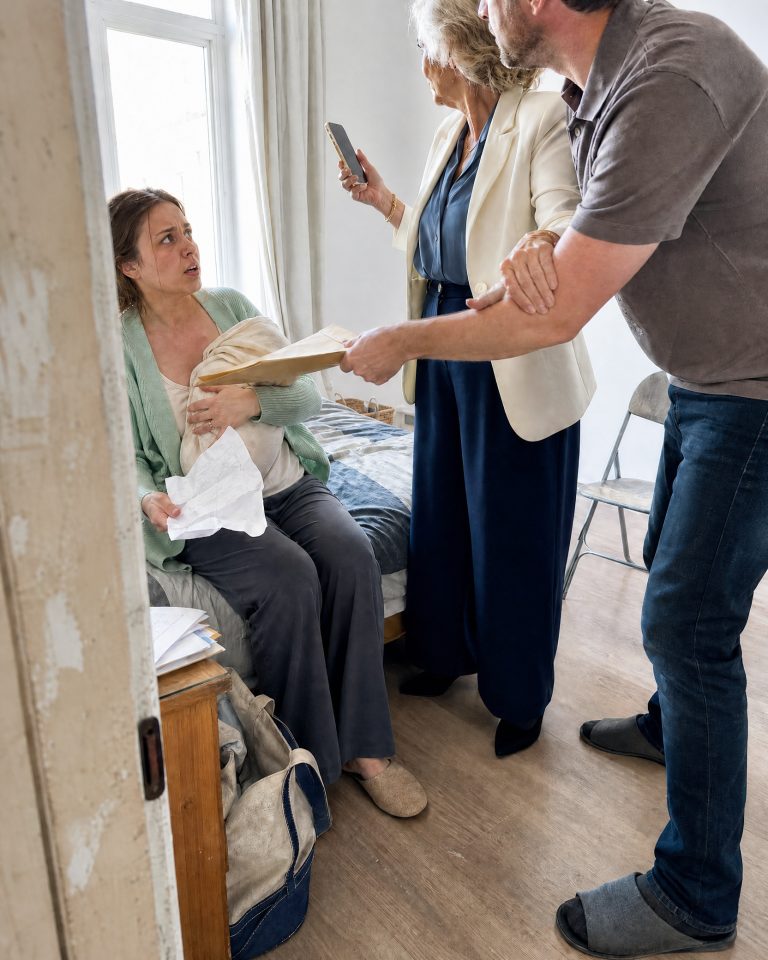
My five-year-old daughter, Sofia, was hunched over a sink full of dirty dishes, scrubbing frantically.
My wife, Sarah, stood by, her left hand heavily bandaged.
My mother, Elena, watched Sofia coldly.
“If you don’t finish washing, you won’t eat,” she declared to my crying child.
A sharp gasp escaped my throat.
I moved immediately, pushing past a cluster of unfamiliar faces, the festive chatter suddenly feeling like a mocking drone.
Elena’s back was to me, her voice cutting through the noise.
“See, my friends?” she announced, gesturing vaguely towards Sofia.
“This is how we teach responsibility. Not like *some* people, who let their children become soft and forget their duties.”
A ripple of knowing murmurs spread through her guests.
The air in the kitchen felt thick and suffocating.
Sofia’s small shoulders shook with sobs, her wet hands red and chapped.
“Elena, what is going on here?” I demanded, my voice tight.
My mother spun around, her eyes widening in surprise for only a split second before a performative smile plastered itself on her face.
“Javier! My son! You’re home early!” she exclaimed, moving to embrace me.
I stiffened, not returning her hug.
My gaze was locked on Sofia, then on Sarah’s heavily bandaged hand.
“Mama, why is Sofia washing dishes during a party?” I asked, my voice barely controlled.
“And what happened to Sarah’s hand?”
Elena waved a dismissive hand.
“Oh, Sofia is just learning. It builds character. And Sarah, she had a little accident. Very clumsy, that one.”
Her eyes flicked to Sarah, a cold, hard glint I hadn’t seen before.
I knelt beside Sofia.
Her face was tear-streaked, her hair damp with dishwater.
“It’s okay, *mija*,” I murmured, gently touching her arm.
“Dad’s here now.”
Sofia looked up at me, her big, brown eyes wide with fear and something else I couldn’t quite decipher.
She leaned in close, her voice a tiny, shaky whisper.
“Dad needs to see inside Grandma’s locked drawer.”
My blood ran cold.
Before I could ask what she meant, Elena clapped her hands, drawing everyone’s attention.
“Come, everyone! Let’s not disturb the children’s lessons!” she chirped, steering her friends away from the sink.
She paused, turning back to Sarah, her voice dropping, though still loud enough for many to hear.
“You see, *mami*?” Elena said to one of her friends, gesturing to Sarah.
“The American ways make them forget. A child needs a firm hand. This is what happens when a mother allows too much freedom, too many *modern* ideas.”
She glanced pointedly at Sarah’s bandaged hand.
A few women nodded, their eyes darting from Elena to Sarah, then to me.
Sarah flinched, pulling her hand back slightly.
The raw wound was visible for a moment beneath the loose bandage.
It wasn’t a “clumsy accident.”
Elena’s words, her icy gaze, the forced labor, Sarah’s injured hand, and Sofia’s terrified whisper coalesced into a chilling picture.
This wasn’t a welcome home party.
This was a carefully staged ritual, designed to shame Sarah and assert Elena’s control, using my own daughter as a pawn.
A knot of dread tightened in my stomach as I watched Elena’s triumphant smile.
What else had she done, under the guise of “tradition,” that I had been too blind to see?
Part 2
My vision blurred with anger.
I pulled Sarah’s arm gently, away from Elena’s guests.
“Your hand, Sarah,” I whispered, my voice raw.
“What is going on with Sofia?”
Sarah pulled away, avoiding my eyes.
“It’s fine, Javier,” she said, voice tight.
“Please, not now. Let’s not make a scene.”
She glanced towards Elena.
“There’s more, but not now.”
Her refusal spurred me on.
After the last guest left, I confronted Elena in the living room.
“Mama, we need to talk,” I stated.
“About Sofia, and Sarah’s injury.”
Elena sighed, placing a hand on her chest.
“Ay, Javier. Always so protective. I was only helping, for Sofia’s own good.”
She adopted a sorrowful look.
“Sarah is so *American*. She lets Sofia run wild. No discipline. The child will never learn.”
Her gaze sharpened.
“Her hand? She is clumsy. But honestly, I worry. Many in our circle see it. They ask me if Sarah is capable of raising Sofia in our traditions.”
My stomach churned.
Elena twisted the narrative, painting Sarah as an unfit mother and justifying her cruelty by claiming community support.
She hinted that these concerns were widely shared in the community, unsettling me, as I realized my mother had been cultivating this image.
Chapter 2: Elena’s Secret Phone
I found Sofia the next morning, unusually quiet at the breakfast table.
She picked at her cereal, her eyes cast down.
“Sofia, honey,” I said softly, leaning closer. “What about Grandma’s locked drawer?”
She hesitated, then looked up at me, her small face clouded.
“Grandma said it was a secret place.”
I nodded, encouraging her.
“What did she keep there?”
Sofia slid off her chair and took my hand. She led me to Elena’s bedroom, past the neatly made bed and the framed photos.
She stopped in front of a small, ornate wooden box on Elena’s dressing table. It was carved with intricate patterns, an antique that had always been there.
“Grandma was always talking to her phone,” Sofia whispered, her voice barely audible.
“Saying bad things about Mama Sarah.”
My heart hammered against my ribs.
Sofia pointed to the box.
“She put the phone in there after.”
The implication hung heavy in the air, a cold weight. It wasn’t a drawer of documents; it was a hidden communication device, and my mother had been using it to speak ill of my wife.
This was a betrayal deeper than I had imagined.
Chapter 3: The Forgotten Device
I remembered an old brass key, kept on a hook in the garage, meant for an antique cabinet full of family photos. It was a long shot, but the lock on Elena’s ornate box looked similar.
I retrieved the key, my hand clammy with a mixture of dread and resolve.
Back in Elena’s bedroom, I carefully inserted the key into the small lock. It turned with a soft click, startlingly easy.
The lid lifted to reveal a shallow compartment.
Inside, nestled beneath some worn rosary beads and a faded, dried marigold — items meant to signify piety — lay a small, dark object.
It was an older model burner phone, clearly not Elena’s usual smartphone. Its screen was dark, cold to the touch.
My stomach dropped. This wasn’t just a simple disagreement between women; this was calculated, hidden malice.
Elena had manufactured an entire secret life of deception, right under our noses.
Sofia’s innocent observation had just revealed a far more sinister truth about my mother’s two-faced nature.
Chapter 4: The Digital Echoes of Malice
With a growing sense of dread, I pressed the power button on the burner phone. The screen flickered to life, showing a basic interface.
It was already logged into an application. I tapped it, and a private online forum loaded, specifically for “Traditional Matriarchs of Our Community.”
My blood ran cold as I started scrolling through the threads. Elena’s username, a thinly veiled pseudonym, appeared repeatedly.
She had been soliciting advice, not subtly, on “asserting dominance” over an “Americanized daughter-in-law.”
I saw threads where she asked about “disciplining” a “stubborn granddaughter” who wouldn’t conform to traditional expectations.
Then, a series of posts dedicated entirely to Sarah. Elena had fabricated negative stories, painting my wife as negligent and disrespectful.
She detailed invented arguments, non-existent slights, all designed to fuel community gossip and isolate Sarah.
The words burned off the screen, a digital echo of the malice Sofia had unwittingly exposed. This wasn’t just gossip; this was a calculated campaign of character assassination.
Chapter 5: A Wife’s Painful Confession
I found Sarah in Sofia’s room, reading her a bedtime story. Her bandaged hand still looked pale.
I waited until Sofia was asleep, then pulled Sarah aside, the burner phone clutched in my hand. I showed her the forum posts.
Her eyes widened as she read Elena’s venomous words, and then tears began to stream down her face.
“Oh, Javier,” she whispered, her voice breaking.
“This is how it really happened,” I said, my own voice hoarse with suppressed rage.
“The hand. Tell me the truth about your hand.”
Sarah took a shaky breath.
“Elena was making Sofia wash the dishes with a huge kitchen knife,” she confessed, her words tumbling out.
“She said Sofia needed to learn to be a woman, even with the sharp ones.”
My stomach clenched at the image.
“I tried to stop her, to take the knife away from Sofia. Elena… she shoved me. Hard.”
Sarah touched her bandaged hand.
“I fell back against the counter edge. It was sharp.”
A deep, ugly cut had been the result.
“Why didn’t you tell me?” I asked, a fresh wave of pain washing over me.
“I was ashamed,” she admitted, fresh tears starting. “And I didn’t want to make things worse between you and your mother. I know how important she is to you.”
The weight of her unspoken suffering crashed down on me.
Chapter 6: The Unspoken Trauma
Sarah continued, her voice gaining strength as the dam of her silence finally broke.
“It wasn’t just the hand,” she said, looking me in the eye. “There were other things, always small, always under the guise of ‘helping’ or ‘tradition.’”
She described how Elena would purposefully rearrange Sarah’s art supplies, leaving small, traditional clay figurines or woven textiles on her canvas, implying Sarah’s modern art was somehow “un-Mexican.”
“Or she’d comment on Sofia’s skin,” Sarah added, her jaw tightening. “Saying she was ‘too light,’ not ‘truly’ part of the family, because she didn’t look enough like *us*.”
The casual cruelty of those words made my blood boil. It was a direct attack on my daughter’s identity, and on Sarah’s.
I felt a crushing weight of guilt settle in my chest. How had I been so blind?
My mother had meticulously crafted these subtle, insidious wounds, and I had dismissed them as cultural differences. Sarah had suffered silently, protecting me.
The realization was a sickening punch to the gut.
Chapter 7: Javier’s Divided Loyalties
The betrayal was a bitter pill to swallow. The image of the loving, if strict, mother I had cherished fractured into a thousand pieces.
Her words in the forum were not those of a concerned matriarch; they were the calculated machinations of a manipulator.
I began to see how my own difficult, poverty-stricken past, and the deep reverence for my Mexican roots that Elena had so carefully instilled, had made me vulnerable.
I had always given her the benefit of the doubt, believing her actions, however harsh, were rooted in love and tradition.
It was a misunderstanding that had cost my wife and daughter dearly.
Now, with chilling clarity, I understood. Elena’s actions weren’t about preserving culture or family values.
They were about exerting control, about wielding power, and about projecting her own deep-seated insecurities onto my family.
My loyalty had been misplaced, twisted into a weapon against those I loved most.
Chapter 8: An Unofficial Confidante
I knew I couldn’t navigate this alone without causing an even greater public rupture. I needed counsel, but discreetly.
I made an appointment with Ms. Anya Sharma, a community social worker known for her integrity, at the local advocacy center.
Her office was simple, filled with stacks of pamphlets. She listened patiently as I recounted, carefully, a “hypothetical” situation mirroring my own.
Her gaze was serious, empathetic, understanding the cultural nuances I didn’t explicitly state. She knew.
“Officially, Mr. Rodriguez, I can’t advise you on a specific family matter,” she said, her voice soft but firm.
“However, these are some common ‘hypothetical scenarios’ regarding parental alienation and emotional abuse within culturally specific contexts.”
I picked up the paper, my fingers tracing the bullet points. It was exactly what I needed.
She had just crossed a professional line, offering me unofficial guidance out of pure conscience.
“Thank you,” I managed, my voice thick with gratitude.
Chapter 9: Elena’s Retaliation Escalates
The blow came swiftly, days after my meeting with Anya. My phone buzzed with an unfamiliar number.
It was Child Protective Services. An anonymous report had been filed against Sarah.
The allegations were chilling: emotional neglect and an “unstable temper” that supposedly made her unfit.
My blood ran cold. This was Elena, without a doubt.
Later that afternoon, my business partner, Marco, called me into his office, his face tight with concern.
“Javier, I need to be upfront with you,” he started, his gaze troubled.
“There are rumors circulating among potential clients.”
My gut tightened.
“About what?” I asked, though I already suspected.
“About your ‘chaotic home life,’ and an ‘unpredictable nature’,” Marco said, picking his words carefully.
“Some comments were made about your ‘difficult immigrant past’ and whether you’re ‘stable enough’ for major projects.”
The words were precise, cutting. Elena was not just targeting Sarah; she was coming after my entire life, professional and personal.
Chapter 10: CPS and Cultural Nuances
The CPS investigation began, a dark cloud hanging over our home. Sarah was under immense stress, constantly worried about Sofia.
I leaned heavily on Ms. Anya Sharma’s “hypothetical scenarios,” carefully crafting our responses. I framed Elena’s actions within a cultural context, explaining the perceived “tradition” of strict discipline.
I knew CPS might not immediately understand the insidious nature of Elena’s abuse.
Anya maintained her official distance, never contacting me directly about our case.
But one afternoon, her number flashed on my phone.
“Mr. Rodriguez, I was just reviewing some generalized community cases,” she said, her voice neutral.
“Have you ever observed any particular ‘patterns of behavior’ in certain matriarchs when family dynamics shift?”
The question hung in the air, a clear, subtle cue. Elena was known for this.
She knew my mother’s tactics, and this was her quiet way of confirming it, crossing the line for us again.
I understood immediately.
Chapter 11: The Permit Sabotage
Just as we were battling CPS, another front opened up. A crucial permit for my architecture firm, vital for a multi-million dollar commercial development, hit a brick wall.
It was suddenly delayed indefinitely by the city’s licensing department. Every call was met with vague excuses.
“It’s just bureaucracy, Javier,” my partner, Marco, grumbled, running a hand through his hair. “But it feels… targeted.”
“Targeted how?” I asked, my heart sinking.
“The clerk handling our file,” Marco continued, looking frustrated.
“Ricardo Mendoza. He’s a distant cousin of your mother’s, isn’t he?”
The name clicked into place. Ricardo, or “Ricky,” was indeed a distant relative, a low-level clerk Elena sometimes mentioned.
He also had a reputation for being easily swayed by family favors, or threats.
“He’s known for ‘losing’ files if the right ‘encouragement’ isn’t given,” Marco added, his voice laced with suspicion.
Elena was reaching into every aspect of my life, trying to dismantle it piece by piece.
Chapter 12: Evidence of Elena’s Tactics
The permit delay lit a new fire under me. I pulled out Elena’s burner phone again, determined to find more.
I painstakingly scrolled through the archived forum posts, digging deeper this time.
My fingers trembled as I found a chilling thread. Elena, under her alias, openly advised other women to “discipline” children.
Her suggestions included withholding food or denying privileges for perceived disobedience.
She cited her own methods, subtly detailing how she had successfully “broken” a child’s will.
In another, older thread, she gloated about anonymously spreading rumors. The target was a new daughter-in-law in the community.
Elena detailed how these whispers had effectively isolated the woman from her new family and social circle.
It mirrored Sarah’s experience almost exactly. This wasn’t just a random act of malice; it was Elena’s playbook.
A pattern of deliberate, calculated cruelty.
Chapter 13: The Weakest Link
Ricky Mendoza worked on the third floor of the city hall, his cubicle tucked away in a corner. I made a private appointment, using my firm’s name.
He looked surprised to see me, a flicker of unease in his eyes.
“Mr. Rodriguez,” he said, trying for a professional tone.
“How can I help you with your permit?”
I leaned forward slightly, placing several neatly organized printouts on his desk. They were Elena’s forum posts, specific ones.
“This isn’t about the permit, Ricky,” I said, my voice low and steady.
“This is about how certain family members operate.”
He glanced at the papers, initially confused, then his eyes widened as he recognized the content. The threads about withholding food from children, the deliberate spreading of rumors.
“These are… private,” he stammered, his face blanching.
“These are also evidence of a systematic pattern of manipulation and abuse,” I countered, keeping my voice firm. “And when combined with professional misconduct, like ‘losing’ crucial permits for political favors, they could easily lead to a full-scale investigation.”
Ricky’s forced composure visibly crumbled.
Chapter 14: Ricky’s Confession
Ricky Mendoza began to sweat profusely, wiping his brow with the back of his hand. His facade completely shattered.
“She… she pressured me,” he stammered, his voice barely a whisper.
“Leveraged our family connection. Said she’d ‘help’ me out with some community matters.”
He admitted Elena had indeed promised him “favors” if he slow-walked my permit.
“And she hinted,” Ricky continued, his eyes darting around the cubicle, “that if I didn’t cooperate, she might ‘mention’ my own… shortcomings… to certain people in the community.”
The threat of public humiliation was a powerful motivator for him.
He quickly pulled up my file on his computer. Within minutes, my crucial permit was approved, the status updated in the system.
“Please,” Ricky pleaded, “don’t say anything about this.”
As I stood to leave, he discreetly slid a folded printout across the desk. It was an obscure, unofficial community registry, with names and small notes scribbled next to them.
“She’s done this before,” he whispered.
“To others.”
The paper was a map to Elena’s unseen network.
Chapter 15: The Unseen Network
I took Ricky’s printout home, my mind reeling. It wasn’t an official document, more like a handwritten roster of community elders and their “proteges.”
Many names had small, coded notes next to them, hinting at past “interventions” or “guidance.”
I cross-referenced some names with Elena’s forum posts. The connections were chillingly clear.
She had advised or influenced many of these individuals in the forum.
I recognized patterns: similar family disputes, sudden community rumors, even mysterious permit delays in other family businesses that had suddenly resolved.
Elena’s manipulation wasn’t an isolated incident, a mere personal vendetta.
She was a central, insidious figure in a subtle, damaging network, using cultural norms and her respected matriarch status to maintain power and control over generations.
She had built an empire of influence through calculated cruelty.
Chapter 16: The Final Preparations
I knew, unequivocally, that I could not let Elena’s actions continue. My family’s safety and peace depended on it.
I called her, keeping my voice neutral, almost deferential.
“Mother,” I said, “I need to speak with you about a difficult family matter. I’d appreciate your wisdom.”
The phrase, I knew, would appeal directly to her ego, her belief in her own indispensable authority. She readily agreed to meet at a quiet café the next day.
That night, I meticulously organized all my evidence. The forum printouts, highlighted and annotated.
Ricky Mendoza’s confession, written down in detail. Even the notes from Anya Sharma’s “hypothetical scenarios,” discreetly placed.
Each piece of paper represented a wound inflicted, a lie propagated.
I rehearsed my words, determined to remain calm, to expose her without descending into her own level of vitriol.
This was not about anger; it was about justice.
Chapter 17: The Café Confrontation
Elena arrived at the café, radiating an air of confident, almost smug superiority. She chose a small table in the corner, away from other patrons.
“So, Javier,” she began, her eyes sparkling with self-satisfaction.
“I knew you would eventually come to your senses about Sarah.”
She immediately launched into unsolicited advice about Sarah’s “American stubbornness.” She lectured me on how I must “control my home” and “assert my authority.”
My hands, hidden under the table, gripped the stack of papers.
“Actually, Mother,” I interrupted, my voice steady, “I wanted to talk about *your* influence.”
I pulled out the printouts, laying them carefully across the small table, facing her. My finger landed on a post.
“Here, where you advised other women to ‘discipline’ children by withholding food.”
Elena’s eyes, fixed on the printed words, widened slightly. Her smug smile faltered.
“And here,” I continued, moving to another page, “where you fabricated stories about Sarah, deliberately poisoning community opinion.”
The color drained from her face.
“And this,” I added, pushing forward a printout detailing Ricky Mendoza’s confession about the permit.
“About how you used our family connection to sabotage my business.”
Her initial shock gave way to a cold, calculating fury, her eyes hardening into chips of ice.
“Furthermore,” I continued, pressing on, “a certain professional I consulted, who must remain anonymous, confirmed that these manipulative ‘patterns of behavior’ are well-known among ‘certain matriarchs’ in the community.”
The mention of an outside professional, of her methods being cataloged, hit her harder than anything else. Her carefully constructed public persona, built on cultural authority, was crumbling.
She knew then that her actions were not seen as traditional, but as abusive. And it was her own son, using her own cunning, who had exposed her.
Chapter 18: Elena’s Bitter Exit
Elena initially denied everything, her voice sharp with disbelief and outrage.
“These are lies!” she hissed, glaring at the papers.
“Fabrications from a disloyal son and his American wife!”
Then, her denial quickly dissolved into a venomous tirade.
“Sarah has turned you against your own blood! You have forgotten your roots, Javier!”
Her voice rose slightly, though still controlled, laced with accusation.
“You are a disgrace to this family, a dishonor to your heritage!”
She stood abruptly, her chair scraping loudly on the cafe floor. With a final, piercing look of contempt, she pulled out a few dollar bills, placing them precisely under her coffee cup.
She then turned and walked out, leaving me alone at the table, the echoes of her harsh, hateful words hanging heavy in the air.
Chapter 19: The Quiet Departure
I returned home later that day, the café confrontation replaying in my mind.
Elena’s packed suitcases stood by the front door, silent sentinels of a finality I had both dreaded and yearned for.
She left without a word, not to me, not to Sarah, not even a glance at Sofia.
Her departure from the house was a quiet, almost furtive affair. She moved quickly, avoiding eye contact with the few neighbors who happened to be outside.
Her usual grand, matriarchal presence was reduced to a hurried, understated retreat.
The community, already rife with whispers about the CPS investigation and the permit delays, was left to draw its own conclusions about the sudden absence of their proud, influential matriarch.
The silence she left behind was deafening.
Chapter 20: A Mending Home
In the weeks that followed Elena’s departure, a quiet, almost imperceptible healing began in our home.
The tension that had permeated every corner, every interaction, slowly dissipated.
Sarah’s hand mended fully, the scar a faint line, a reminder of what they had overcome.
Sofia, slowly but surely, began to come out of her shell. Her laughter, once hesitant, now echoed freely through the rooms.
Javier and Sarah spent hours talking, openly discussing their struggles, the fears Sarah had suppressed, the guilt Javier carried.
They rebuilt their trust, strengthened their communication, forging a partnership more resilient than ever before.
I realized the absence of my mother’s oppressive presence had lifted a heavy, invisible weight from our entire family.
We could finally breathe.
Chapter 21: Sofia’s Birthday
A year later, on Sofia’s next birthday, we celebrated at a peaceful local park. Sunlight filtered gently through the ancient oak trees, dappling our picnic blanket.
Sarah and Sofia laughed, their faces bright, as they shared a slice of rainbow cake.
“This is the best cake ever, Mama!” Sofia giggled, frosting on her nose.
“You deserve the best, mija,” Sarah replied, wiping it gently.
I watched them, a pang of bittersweet grief mixing with profound relief in my chest. I knew I had done the right thing.
I walked over to a quiet corner of the park, near a small memorial stone dedicated to local pioneers, and sat on a bench for a moment.
I reflected on the past year. I had saved my family from an unseen, insidious danger.
But the cost was immense: the permanent loss of my mother, and a deep, irreparable fissure in my connection to a part of my heritage I once cherished.
I had won the battle, yes. But to do so, I had sacrificed a fundamental piece of my personal history.
Chapter 22: Unseen Roots, New Branches
I rose from the bench, letting the silence settle. Then, I turned and walked back to Sarah and Sofia.
“Are you ready to go home, my little birthday girl?” I asked, picking up Sofia and swinging her gently.
She giggled, her arms around my neck, her joy infectious.
“Yes, Daddy!”
I smiled, a genuine, unburdened smile that reached my eyes.
We packed up our picnic, leaving behind a few crumbs for the birds. As we walked hand-in-hand out of the park, I held my family close.
Some foundations, once broken, can never be rebuilt, no matter how deeply rooted they once felt.





+ There are no comments
Add yours