
In 1879 Arizona, My Cult Boss Chained an Apache Girl to the Chapel Porch—What I Did That Night Changed Everything


Part 1
He handed me the iron key and four silver dollars, ordering me to guard the captive while he prepared the evening sermon.
I gave the girl a tin cup of well water and loosened the iron ring around her raw, swollen skin.
By midnight, two armed cult enforcers were drinking whiskey behind the stables, openly plotting to break into the lockup and execute her before the territorial circuit judge could arrive.
I had six bullets in my Remington revolver, $4 in my pocket, and no allies in a settlement of forty armed zealots.
Dusk settled over New Zion of the Gila, painting the adobe walls in shades of orange and violet. The air, still hot, carried the scent of dry earth and cooking fires.
Elder Amos Kincaid stood before me, his shadow long and imposing against the fading light. He was a man built of granite and scripture, his eyes holding the unshakeable conviction of a prophet.
He extended a calloused hand. Four silver dollars, dulled by countless transactions, rested in his palm.
“Your weekly wages, Silas,” Kincaid said, his voice a low rumble. “As agreed.”
I took the coins. They felt cool and heavy in my own hand, a meager reward for three days spent guarding a settlement filled with watchful, unsmiling faces.
Kincaid gestured with his chin towards the small adobe lockup adjacent to the chapel. Inside, the sixteen-year-old Chiricahua girl, Nalin, was barely visible through the single, barred window.
“Keep her chained to that oak pillar until morning. The territorial circuit judge will arrive with the sunrise. Until then, she’s your charge.”
His words hung in the air, heavy with unspoken finality. He did not need to elaborate on what the judge’s arrival would mean for Nalin. Everyone in New Zion knew the drill.
The Elder turned without another word, his dark, homespun coat blending into the deepening shadows as he walked towards the chapel door. A moment later, the heavy oak groaned shut behind him.
I walked towards the lockup, the clinking of my spurs loud in the quiet square. The adobe structure, squat and plain, radiated the last of the day’s heat.
Nalin was slumped against the thick oak pillar, the iron ring around her ankle glinting faintly. Her buckskin dress was torn in places, her hair matted with dust and dried blood.
Her eyes, dark and piercing, watched my every move. There was no fear in them, only a deep, weary assessment.
I knelt, the movement slow and deliberate to avoid startling her. The air in the small room was stale and warm.
“Water,” I murmured, holding out the tin cup filled from the well.
She took it with a hesitant hand, her fingers brushing mine, surprisingly cool. She drank slowly, deliberately, her throat working. Every swallow seemed a monumental effort.
While she drank, I reached for the iron ring around her ankle. The metal had chafed the skin raw, leaving an angry red welt. I worked at the screw, easing it slightly to provide some relief.
As I did, my fingers brushed against a small, stitched leather pouch tied around her neck with a thin rawhide thong. It was hidden beneath her dress, almost invisible.
My eyes flicked to Nalin. She watched me, unblinking, as if daring me to acknowledge it.
My gaze returned to the pouch. It felt firm, containing something flat and rigid. Curiosity, a dangerous trait in New Zion, pricked at me.
Without thinking, I gently untucked it from beneath her collar. It was crude, hand-stitched, but secure.
I gave a slight tug on the rawhide string. The pouch opened, revealing a folded piece of thick, official-looking paper. It was stiff, creased from being kept close to her skin.
I unfolded it carefully, the paper rustling softly in the quiet room. My eyes scanned the bold, stamped lettering.
It was a Land Office receipt. Territorial Land Office, 1878.
My breath hitched. My gaze dropped to the details: “One-acre parcel, including Gila River Spring frontage.” Below that, the name of the purchaser: “Nalin, daughter of Cochise, for the sum of $15 gold.”
My head snapped up. New Zion’s lifeblood, its very reason for existence, was the pure, abundant spring water. Kincaid had claimed the land as a divine gift, a sign of God’s blessing upon his flock.
This receipt, faded but irrefutable, stated otherwise. It showed that Nalin’s family had legally bought the very ground the cult now occupied, the spring included, a year before Kincaid even built New Zion.
The implications hit me like a physical blow. Kincaid hadn’t been gifted this land; he had taken it. And Nalin, the “wild raider” Kincaid preached about, was the true owner.
A cold dread coiled in my gut. I folded the receipt with trembling fingers, slipping it back into the pouch, securing the rawhide.
My ears strained against the quiet. The faint clink of metal from behind the chapel caught my attention. It was too regular, too distinct to be accidental.
The sound of rifles being cleaned.
Then, voices. Low and hushed, but cutting through the twilight stillness. Jedediah Pike, Kincaid’s chief enforcer, and Eli Rust, one of his more brutal gunmen.
Their words drifted, carried on a stray breeze from behind the chapel.
“…judge shows up, things get complicated,” Pike slurred, his voice thick with whiskey.
A metallic click, the sound of a rifle bolt sliding home, punctuated his sentence.
“Ain’t no need for a trial,” Rust muttered, his voice cold. “Heard the Elder say she won’t make it to morning.”
“Midnight,” Pike chuckled, a harsh, guttural sound. “We go in at midnight. One shot each, make it look like she tried to bolt.”
My blood ran cold. The truth, clear and terrible, settled over me. This wasn’t about justice or the law. It was about theft, concealed by murder.
And I was standing right in the middle of it.
Part 2
I found Kincaid in his private study, a heavy ledger open before him. He looked up, a slight frown creasing his brow.
“Silas,” he said, his voice even, “what is it?”
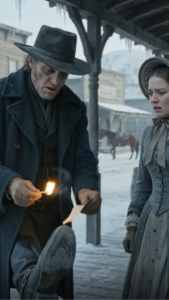
I laid the folded Land Office receipt on his desk. “This paper,” I said, “says the girl owns the spring.”
Kincaid glanced at the document, then back at me. He opened a desk drawer, the sound soft in the quiet room.
He pulled out a thick document, stamped with a territorial seal. “Under this writ, Silas,” he said, holding it up, “signed by Deputy Marshal Granger, anyone aiding a rebellious native faces immediate hanging for treason.”
He laid the writ beside the receipt. “Your four dollars pays for silence.”
The chapel clock began to chime the hour, eleven measured tolls echoing through the compound.
More Stories







+ There are no comments
Add yours