If you walk out of Apex Media to play live-in nurse to that washed-up recluse, you are dead to this family and blacklisted from Hollywood, my uncle Victor Cross told me five years ago.


Part 1
I turned my back on his Beverly Hills agency anyway, giving up my six-figure salary to care for eighty-four-year-old Eleanor Westwood in her decaying Pasadena bungalow until her final breath.
When her estate attorney summoned me yesterday, he pushed a faded 1974 studio deed across the desk and uttered a sentence that turned my world upside down.
“Eleanor wasn’t a stranger—she was your mother’s biological mother, the studio founder Victor stole Apex Media from fifty years ago, and she secretly watched you grow up your entire life.”
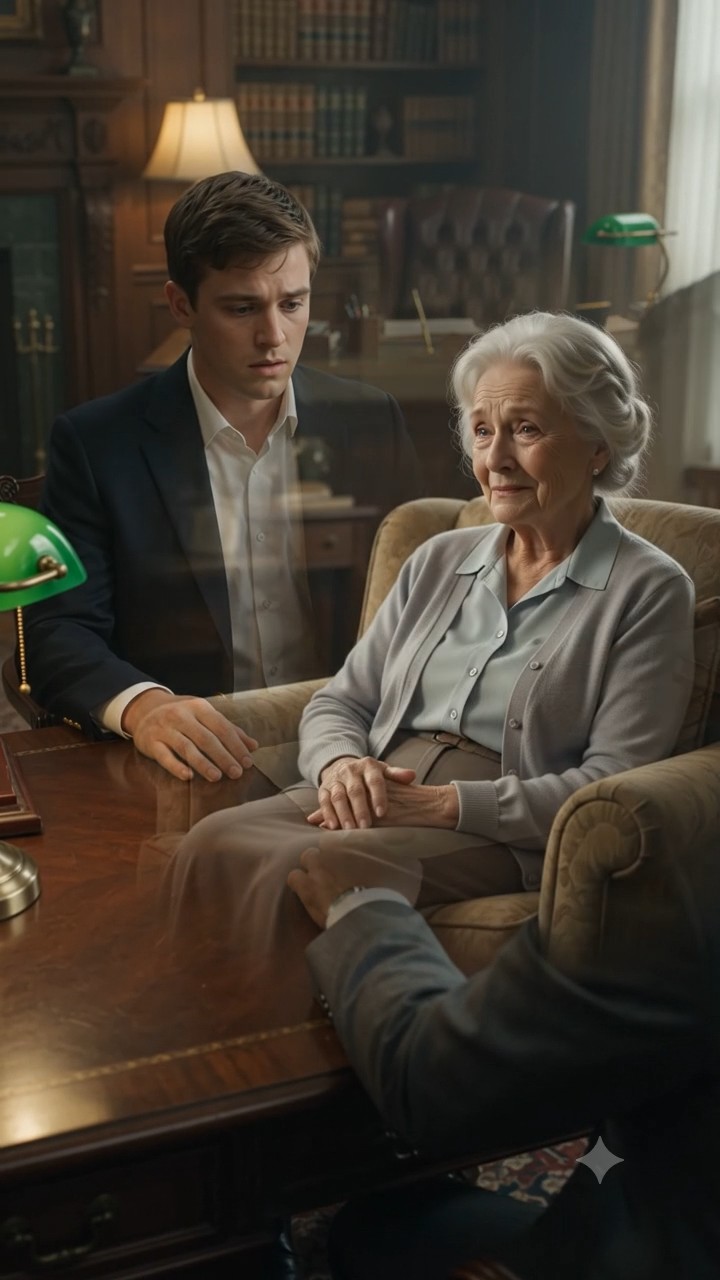
The heavy oak door of Arthur Pendelton’s downtown office clicked shut behind me, muffling the distant city noise. The room smelled of old paper and leather polish. It was a stark contrast to the sterile, glass-and-steel towers of Beverly Hills I’d left behind five years prior.
Pendelton, a man whose tailored suit seemed as ancient and well-preserved as his office furniture, gestured towards a plush armchair.
“Mr. Bennett, thank you for coming.” His voice was dry, precise, like the rustle of old legal documents.
I sat, the armchair sinking around me, reminding me of Eleanor’s soft, worn sofa. A fresh wave of grief, dull and persistent, washed over me. It had only been three days since she passed.
“Of course,” I replied, my voice a little hoarse. “How can I help?”
He steepled his fingers on the desk, his gaze steady, almost piercing. “I represent the estate of Eleanor Westwood.”
I nodded slowly. “Yes, I know. I was her caretaker. For the last five years.”
The unspoken weight of that sacrifice hung in the air. Five years of scrubbing floors, preparing meals, managing medication, all for a woman my family had dismissed as a delusional recluse. A woman I believed was a stranger, albeit one I had come to deeply love.
Pendelton picked up a slim, yellowed file. “I understand you were not compensated during that period.”
“No,” I confirmed. “Eleanor didn’t have much. And I didn’t care about the money.”
My uncle, Victor, had certainly cared about it. He’d seen my choice as a personal insult, a dramatic rejection of the empire he’d built. A waste of my supposed potential.
“Indeed,” Pendelton said, a flicker of something I couldn’t quite place—perhaps approval, perhaps sorrow—in his eyes. “That selfless devotion, Mr. Bennett, is precisely why Eleanor chose you.”
Chose me for what? I wondered. There wasn’t much left to choose from in her small, quiet life.
He pushed a document across the expansive mahogany desk. It was an original studio deed, brittle and faded, dated 1974. The header read “WESTWOOD PICTURES.” Beneath it, a name: ELEANOR WESTWOOD. FOUNDER & CEO.
My breath hitched. Westwood Pictures. The name itself felt like an echo from a past I barely knew.
“Eleanor,” Pendelton began, his voice dropping slightly, “was more than just a woman in need of care, Mr. Bennett. She was a visionary. A true pioneer in Hollywood.”
I leaned forward, confusion warring with a strange, nascent curiosity. This wasn’t the narrative my family, especially Victor, had spun about her. Not the eccentric old lady who had simply “worked in films” they’d vaguely referenced.
“Fifty years ago,” Pendelton continued, “Eleanor Westwood founded Westwood Pictures. It was an innovative, independent studio that quickly became a rising star. Until it was… acquired.”
He paused, letting the word hang in the air like a poorly concealed accusation.
“Acquired by whom?” I asked, though a cold dread was already forming in the pit of my stomach. The timelines, the names, the vitriol from my uncle… it was all starting to coalesce into a shape I didn’t want to recognize.
“By your uncle, Victor Cross,” Pendelton stated plainly, his eyes fixed on mine. “Or, more accurately, by his father, who then folded it into what would become Apex Media. They effectively stripped Eleanor of her creation, erasing her from the industry’s history books.”
My mind raced back to Victor’s casual dismissals of Eleanor, his almost obsessive need to paint her as irrelevant. It was a lie. A calculated, devastating lie.
“But that’s not all,” Pendelton went on, his voice softening, a rare crack in his professional facade. “There’s a deeper connection, one that Eleanor carried with her, silently, for decades.”
He picked up another document, a worn photograph this time. It showed a young woman, vibrant and full of life, holding a baby. The woman was unmistakably a younger Eleanor. The baby…
My eyes widened. The baby had my mother’s distinctive curl of hair, her small, delicate chin.
“Eleanor Westwood,” Pendelton said, his voice low and solemn, “was your biological grandmother, Mr. Bennett. Your mother, Chloe, was her daughter.”
The air left my lungs. The world tilted. Grandmother. Eleanor, my sweet, quiet Eleanor, who I’d spent five years serving, cooking for, reading to, was *family*. Not just family, but a monumental figure whose legacy had been stolen by my own uncle, the same man who’d banished me for tending to her.
“She watched you, Mr. Bennett,” Pendelton continued, “from afar. She saw you grow up. She knew about your dreams of making films, your independent spirit. And when Victor cast you out, she knew you were the only one who would truly care for her.”
A wave of overwhelming emotion hit me: shock, a profound sense of betrayal by my mother and uncle, but also a deep, aching tenderness for Eleanor. All those years, her quiet smiles, the way she’d sometimes look at me with a depth of feeling I couldn’t quite fathom at the time. She knew. She had always known.
“Why… why didn’t she ever say anything?” I whispered, my voice thick with unshed tears.
“Too heartbroken, too afraid of Victor’s power, perhaps,” Pendelton mused. “But she made sure you would eventually know the truth. And reclaim what was rightfully hers.”
He reached into his desk drawer and pulled out a small, tarnished brass key. It looked like something from an antique shop.
“This is the key to her old Pasadena bungalow,” he explained, holding it out to me. “Specifically, the master bedroom closet. Inside, you’ll find some personal effects she meticulously preserved. And the critical legal proof of her original ownership.”
The key felt heavy in my palm, suddenly the most important object in the world.
“Victor’s lawyers will be moving to lock down the estate soon,” Pendelton added, his gaze holding mine. “You need to retrieve it before they do.”
Part 2
I clutched the brass key. Victor’s lawyers. Forty-eight hours. The urgency hit me like a physical blow. I didn’t waste another second.
The drive to Pasadena felt endless, even though it was a route I’d driven hundreds of times. Each streetlamp, each familiar corner, was a stark reminder of Eleanor and the quiet life we’d shared.
Pulling up to the bungalow, a knot tightened in my stomach. The porch light, which I usually left on, was dark. A brightly colored “ESTATE ACCESS RESTRICTED” notice was taped to the front door, along with a “PROPERTY OF APEX MEDIA” sticker, crudely slapped over the peeling paint. Victor’s lawyers had already been here.
I fumbled with the key, my hands trembling slightly, and unlocked the back door. The house was cold and still, steeped in the silence of absence. Dust motes danced in the slivers of sunlight cutting through the drawn blinds.
I walked straight to the master bedroom, the floorboards creaking under my weight. The air was heavy with the scent of lavender and old paper, Eleanor’s unique blend.
The closet was exactly as I remembered it: a jumble of worn clothes, old hatboxes, and forgotten treasures. I pushed aside a rack of Eleanor’s dresses, their fabric soft against my fingers.
My eyes scanned the shelves, then dropped to the floor. In the back corner, tucked behind a stack of moth-eaten blankets, sat a rusty, cylindrical metal container. It was a vintage 35mm film canister, no bigger than a coffee can.
Its faded label, scrawled in Eleanor’s elegant handwriting, read: “Unedited Outtakes – 1974.”
My heart hammered against my ribs. This had to be it.
I pulled it out, the metal cool and gritty beneath my touch. With a grunt, I pried open the lid. Inside, not film, but a thick, aged document, carefully wrapped in clear archival plastic.
I unwrapped it, the paper crackling faintly. It was a deed, just as Pendelton described. “1974 Stock Trust Deed.”
My gaze fell to a bold, embossed seal near the bottom. It declared: “62% Controlling Interest.” And the company name: “WESTWOOD PICTURES.”
Eleanor hadn’t just left me her modest bungalow. She had bequeathed 62% controlling stock in Westwood Pictures, the original studio entity that still secretly owned Apex Media’s infrastructure.
More Stories









+ There are no comments
Add yours