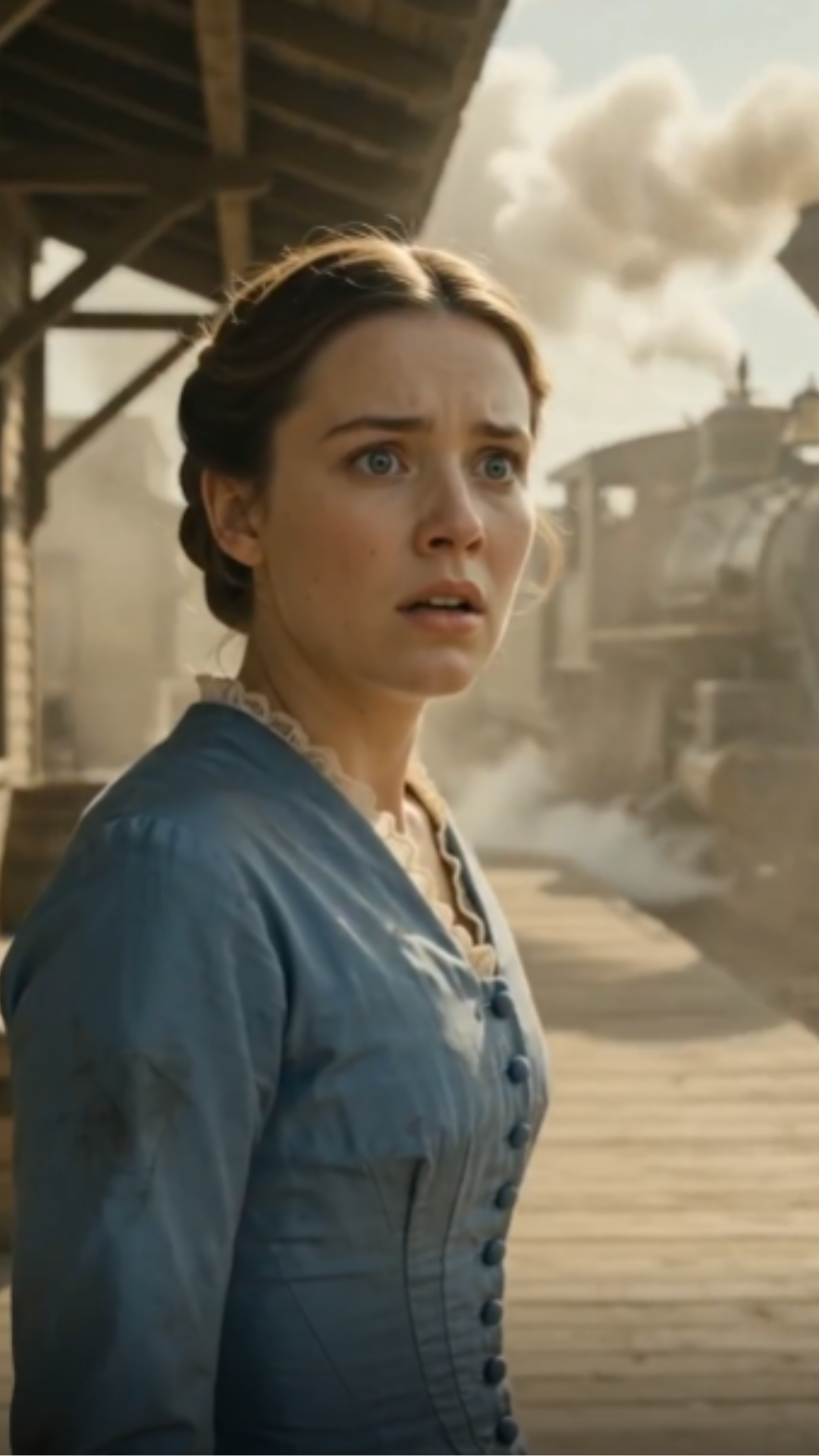
If you are looking for Silas O’Driscoll, you are staring right at him, the grey-bearded man said, holding out a weathered hand on the muddy wooden platform of the Fort Griffin depot.


Part 1
I stood in my faded blue silk dress with $14.50 left to my name, staring at a man who was at least forty years older than the warm, poetic letters I had been reading for six months in Baltimore.
When I followed him to his desolate ranch house twelve miles outside town, I found a terrified twenty-two-year-old man hiding behind a pile of hay sacks in the barn, trembling so hard he could barely hold a pitchfork.
The older man had written every single line to secure a bride for his mute, traumatized son, but neither of them knew that a ruthless stranger was already waiting in town to tear the land from under our feet.
My hand hesitated, suspended in the dry West Texas air, before I clasped the man’s calloused fingers. His grip was surprisingly firm, but his eyes held a deep weariness that hadn’t been hinted at in his elegant script.
“Clara Higgins,” I managed, my voice feeling thin and reedy in the dusty afternoon.
A gust of wind, smelling of hot prairie grass and distant cattle, whipped at the hem of my travel dress. The platform was quiet, save for the hiss of the train’s steam and the distant shouts of a freight crew. My future, it seemed, was embodied in this sixty-two-year-old stranger.
He gestured toward a battered wagon hitched to a pair of lean, dust-covered mules. “Welcome to Shackelford County, Miss Higgins. Best to get out of the sun.”
I climbed into the wagon, the wood groaning beneath me. The seat was hard, worn smooth by years of use. My small trunk was hoisted in with a dull thud.
The old man settled beside me, flicking the reins. The mules lurched forward, pulling us away from the depot, past a scattering of rough-hewn buildings that comprised Fort Griffin. There was a general store, a saloon whose doors swung open to reveal dark shadows, and a boarding house with a proprietor already watching us from the porch.
He didn’t speak for a long time, only staring straight ahead at the endless, shimmering horizon. The rhythmic creak of the wagon wheels and the occasional snort from the mules filled the silence. The landscape was vast and unforgiving, a stark contrast to the verdant hills of Maryland.
“You look… surprised,” he finally said, his voice raspy.
I clutched my reticule, feeling the faint crinkle of the few dollars remaining inside. “$14.50,” I thought to myself. “That’s all that’s left.”
“The letters,” I began, then trailed off, unsure how to articulate the deception. “They spoke of a young man. A vibrant future.”
He cleared his throat. “Silas is my name, Miss Higgins. The letters, they were from me. For my boy.”
His gaze didn’t meet mine. He kept his eyes fixed on the distant, rolling land. The sun beat down relentlessly, baking the air, and my faded blue silk dress, once a symbol of modest prosperity, now felt like a cruel joke.
“Your boy?” I prompted, a cold knot tightening in my stomach.
“He’s a good boy. My only boy.” He paused, a flicker of something painful crossing his face. “Suffered a bad turn in the war. Don’t speak much. Don’t take to strangers.”
The twelve miles to the ranch stretched endlessly. Dust clung to everything, coating my skin and hair. As we finally turned off the main track onto a narrow, rutted path, a small, dilapidated house emerged from the heat haze. The paint was peeling, the porch sagged, and the chimney looked precariously close to crumbling. It was not the picture of a thriving homestead painted in the letters.
A ramshackle barn stood nearby, its wooden doors half-open, revealing a shadowed interior.
The old man pulled the wagon to a halt. “This here’s home,” he announced, his voice lacking any pride. “My boy, Thomas, he spends most of his time in the barn.”
I stepped down, my feet sinking slightly into the dry earth. A profound silence hung over the ranch, broken only by the buzzing of flies. No welcoming sounds, no dogs, no chickens. Just the wind whistling around the eaves.
“Thomas?” I asked, looking toward the barn.
“He’ll be in there. He… he gets anxious with new folk. Best if you just go on in slow.” Silas, the father, stayed by the wagon, unhitching the mules. He looked as if he couldn’t bring himself to enter the barn with me.
My heart hammered against my ribs. This wasn’t just a misrepresentation of age; this was a complete unraveling of the future I had clung to. I walked toward the barn doors, pushing one open further. The interior was dark and cool, smelling of hay and old wood.
“Thomas?” I called out softly, my voice hesitant.
A rustling sound came from behind a tall stack of hay bales. My eyes adjusted to the dim light, discerning a figure huddled low to the ground. He was young, exactly the age I had imagined, but his posture was one of profound fear.
He clutched a pitchfork, its tines pointed toward the ground, but his hands trembled so violently that the implement swayed. His face was pale, his eyes wide with a terror that seemed to swallow all light. He was trying to shrink himself out of existence, pressing back against the rough wood, as if the hay sacks offered a fortress against my presence.
Part 2
I pulled back, the air thick with the boy’s silent terror. This wasn’t a marriage; it was a desperate plea for a caretaker, a trap laid with elegant words. I turned and walked out of the barn, blinking in the harsh sunlight. Silas stood by the wagon, his back to me, fiddling with a harness.
“Silas,” I said, my voice sharper than I intended.
He flinched, then turned slowly. His gaze still wouldn’t meet mine.
“You led me here under false pretenses,” I continued, anger simmering beneath my shock. “You spoke of a vibrant future, of a partner. This boy is clearly…” I trailed off, not wanting to name his condition.
“He’s a good boy,” Silas mumbled, still avoiding my eyes. “He just needs time. Someone to look after him when I’m gone.” His voice was low, laced with a plea I couldn’t ignore.
“I need to go back,” I stated, my resolve hardening. “To Fort Griffin. To the train.”
He finally looked at me, a deep weariness etched into his weathered face. “Can’t rightly do that, Miss Higgins. Not right away.”
“Why not?” My voice rose. “I still have funds for my ticket.”
Silas sighed, his shoulders slumping. “Your ticket, Miss Higgins. Getting you here was… complicated. I used a bank draft. From Baltimore.”
My breath hitched. My entire body stiffened. “Baltimore? What firm?”
“The Baltimore Merchants’ Trust,” he said, his voice barely a whisper. “It was the only way I could secure the fare.”
The world seemed to tilt. The Baltimore Merchants’ Trust. The very firm that had bankrupted my father, taking every penny we owned and ruining my name. The source of the $18,000 debt that drove me to this desolate place.
“That firm is bankrupt!” I gasped, the words tearing from my throat. “It’s fraud, Silas! I’m complicit in fraud!”
He just nodded, a silent admission of guilt and desperation.
A wave of nausea washed over me. I was trapped, bound to this desolate ranch and this mute boy, now an unwitting participant in a financial crime.
“Take me back to the depot!” I demanded, my voice raw. “Now!”
The words were barely out when the distinct rumble of an approaching carriage echoed down the dusty track. A finely polished black buggy, pulled by two high-stepping bay horses, rolled into the ranch yard, kicking up a plume of red dust.
It was a stark, jarring contrast to the poverty of the O’Driscoll homestead. The carriage pulled to a neat stop. A tall, impeccably dressed man, with a severe expression and keen, piercing eyes, stepped down.
He surveyed the ranch house, then fixed his gaze on us. “Silas O’Driscoll?” he called out, his voice sharp and authoritative. “Micah Gentry. I’m here regarding the O’Driscoll homestead.”
More Stories







+ There are no comments
Add yours