
Montgomery Matriarch Stripped Her Son's Pregnant Wife of Everything — Until Fate Intervened and Shattered Their Legacy


Part 1
💰 **My Husband Said His Mother’s Word Was Law, Stripping Me and Our Unborn Child of Everything — But I Knew Their Legacy Was About to Crumble.**
I only asked my husband, Ethan, about our household finances. Three weeks later, he declared his mother’s word was sovereign, and my future, along with our unborn child’s, was entirely dependent on her goodwill.
I had quietly endured his mother’s daily dismissals for months, her barbed comments about my “unsuitability” for the Montgomery name. But when Ethan asserted he could have a hundred wives but only one mother, something in me snapped.
I said nothing in response, merely looked at him. I knew then I had to uncover the truth, because the Montgomery family’s storied legacy was about to crumble.
Months of Eleanor Montgomery’s veiled insults had chipped away at me. She would eye my modest dress from across the Charleston parlor, then remark loudly about ‘maintaining appearances for the Montgomery name’.
Ethan, my husband, would just nod, preoccupied with his phone. Our household accounts, once a shared responsibility, had become a mystery only he and his mother controlled.
One evening, the silence of our opulent penthouse was punctuated by my gentle question about a large, unexplained withdrawal from our joint account. I was trying to plan for the baby’s arrival, trying to understand where our money was going.
Ethan barely looked up from his tablet. “My mother’s word is sovereign, Claire,” he said, his voice flat, devoid of warmth. “Your future, and the baby’s, is entirely dependent on her goodwill.”
A cold knot formed in my stomach. I was carrying his child, our first, due in just a few months, yet he spoke as if we were supplicants, dependent on the whims of others.
Then came the line that changed everything, delivered with a detached finality. “I could have a hundred wives, Claire, but only one mother.” His gaze was unwavering, almost challenging me to disagree.
I didn’t argue. The breath caught in my throat, my jaw tightening, a quiet, furious defiance settling deep within me.
I had spent months trying to be the perfect Montgomery wife, enduring Eleanor’s daily dismissals, her barbed comments about my ‘unsuitability’ for their storied name, her constant reminders of my ‘modest’ background.
But that night, as I watched Ethan, the truth hit me with sickening clarity: their elaborate, generations-old legacy was about to crumble, and I was going to be the one to uncover why.
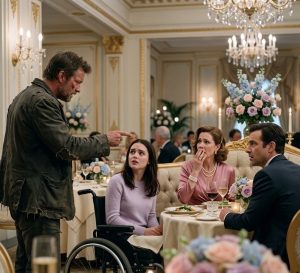
Two weeks later, the entire Montgomery clan, a formidable assembly of old Charleston money, gathered in Eleanor’s impossibly grand dining room. The crystal chandelier, a true heirloom, glittered with thousands of facets, reflecting off the antique silver and the polished mahogany table set with their finest china.
Eleanor stood at the head of it all, a vision in emerald silk, a triumphant, almost predatory glint in her eyes. She cleared her throat, a soft, deliberate sound that nonetheless commanded immediate silence from every cousin, aunt, and distant relative present.
“I have wonderful news for our family,” she announced, her voice resonating with an authority that had governed this family for decades. “Arthur Jenkins, our esteemed family lawyer, has finalized the Montgomery Legacy Trust.”
She gestured to Mr. Jenkins, a stoic, impeccably dressed man who offered a slight, deferential bow. A low hum of murmurs and whispers rippled around the table, a mixture of curiosity and approval.
“This trust,” Eleanor continued, her gaze sweeping across the room with practiced grace, “is designed to protect our ancestral wealth, to preserve the Montgomery name and its assets for generations to come. Julian, as the eldest and most fiscally responsible, will serve as the primary executor.”
My blood ran cold. Her eyes swept across the room again, lingering on me for a fraction of a second, just long enough to convey a silent message, before moving on to Ethan, who sat beside me, smiling faintly, completely oblivious.
I felt a sudden, profound chill despite the oppressive warmth of the room. Eleanor then outlined the trust’s stipulations: only direct male descendants and their *recognized* heirs would have immediate access or control over its significant assets.
By extension, this meant my unborn child, due to my ‘unsuitable’ status, was subtly, but effectively, excluded from any direct inheritance or meaningful control. It was, she declared with a final, dismissive wave of her hand, for ‘generational protection,’ ensuring the Montgomery name remained untarnished.
Part 2
The implication hung heavy in the air. Later that week, still unsettled by Eleanor’s announcement, I found myself in Arthur Jenkins’s office.
I was ostensibly helping to organize some older family legal documents for his archives, a chore I’d taken on weeks ago.
Buried deep within a dusty box of decades-old financial papers, something fragmented caught my eye. It was an unsigned draft addendum, almost overlooked.
This wasn’t the “Legacy Trust” Eleanor had spoken of. It was a draft for Ethan’s monthly allowance agreement, dated months prior.
A specific clause detailed a staggering 70% of his gross earnings being diverted. This wasn’t for a general trust, but a “Legacy Infrastructure Fund” managed by Eleanor herself.
The fund’s explicit purpose was a “family property expansion” project Julian was undertaking. My stomach dropped.
This isn’t about protecting Ethan’s future; it’s about systematically draining his present.
More Stories














+ There are no comments
Add yours