
A 4-Year-Old's Offhand Comment Exposes a Chicago Immigrant Family's Cultural Deception and a Hidden Paternity Secret


Kosta Petrov, increasingly agitated by the persistent whispers of defiance, decided to reassert his absolute authority. He hosted a mandatory, lavish family dinner at the Petrov estate, an event usually reserved for significant milestones or holidays. He sent out personal invitations, each one carrying the unspoken command of his presence. Alek received his, a stark white card with Kosta’s crest, specifying his attendance was required, without Sofia.
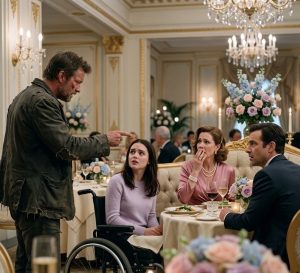
Alek arrived, tense and distant. The grand dining room, usually a place of boisterous conversation, felt stifling. Crystal chandeliers glittered above a table laden with an array of traditional Eastern European dishes, but the atmosphere was heavy, formal, devoid of genuine warmth. Kosta sat at the head, his eyes sweeping over the assembled family members, settling on Alek with a pointed gaze.
He spoke about family legacy, about the importance of tradition, about loyalty. Each word was a veiled message, a direct address to Alek’s recent insubordination. He spoke of “maintaining purity” and “avoiding distractions that tarnish the family name.”
Alek listened, his jaw clenched, picking at the elaborate food on his plate. He avoided Kosta’s eyes, focusing instead on the antique silver cutlery, a physical manifestation of the family’s ancient wealth and rigid structure. The petty cruelty was not only the public shaming but also the deliberate exclusion of Sofia, further isolating Alek within the family.
Meanwhile, Lena, emboldened by Alek’s subtle gestures—the children’s books, the art supplies, the quiet knowledge that he was trying—decided to make a calculated move. She knew Kosta’s routines. He always took his evening stroll through the public garden adjacent to the Petrov estate, a meticulously manicured expanse of green that bordered the private family grounds.
The following afternoon, Lena dressed us in our warmest coats. “We’re going to the park, darlings,” she said, her voice betraying none of the nervous anticipation she felt. She packed a small picnic basket, though the crisp autumn air was too cold for a leisurely meal. Her heart hammered against her ribs, a frantic drumbeat of courage and fear.
She knew the exact time Kosta would be out. She led us to the edge of the public garden, to the very spot where the wrought-iron fence of the Petrov estate met the public path. It was a deliberate act of defiance, an assertion of our presence, a visual statement that we were real, undeniable.
“Look, children,” she said, pointing to a particularly vibrant patch of late-blooming marigolds inside the estate’s grounds. “Aren’t they beautiful?”
Milena and Stefan, engrossed in chasing a squirrel, paid little attention. But I, Elara, the observant one, looked up. I saw Kosta, a solitary figure in a dark overcoat, walking slowly along the gravel path within the estate, his hands clasped behind his back.
I nudged my mother. “Mommy, it’s the man with the eyes like ours!”
Lena’s grip tightened on my hand. She watched Kosta, whose gaze, drawn by our presence, had already fixed upon us. He stopped, his posture rigid, his face a mask of shock and fury. We stood there, three small figures framed against the backdrop of the public park, looking directly at him.
It was a deliberate confrontation, a silent declaration. Lena wanted Kosta to see us, to acknowledge our existence not through legal papers, but through the raw, undeniable reality of our presence. She wanted him to feel the weight of our sapphire eyes, mirroring his own.
Kosta’s face, usually so composed, contorted for a brief moment into a grimace of pure rage. He turned abruptly, cutting his stroll short, retreating quickly back towards the imposing mansion. His hurried exit was a small victory, a crack in his carefully constructed facade of control.
Lena held her breath until he was out of sight. Then, a slow, triumphant smile spread across her face. She had done it. She had made him see. She had asserted our right to exist, not just as legal entities, but as living, breathing children, full of life and joy, right on the edge of his carefully guarded empire.
The children, oblivious to the silent battle that had just unfolded, continued to play, their laughter echoing through the park. But Lena knew. Kosta knew. He had seen us. And he could no longer pretend we didn’t exist, not when we stood so defiantly, so innocently, at the very boundary of his world. The pressure on Kosta was mounting, not just from Alek’s quiet rebellion, but from the undeniable reality of three small children who carried his mark, standing on his doorstep.
More Stories














+ There are no comments
Add yours