
CEO Husband Tried to Seize My Inheritance After His Affair Put His Secretary in ICU — He Didn't Know I Held the Key to His Empire


Thomas’s announcement of the biotech division sale was a declaration of war, not just against me, but against the very corporate governance of Kinsley Holdings. It was a move so reckless, so blatant in its disregard for protocol, that it finally stirred Mr. Davies into decisive action.
I called him immediately after the news broke, my voice tight with a mixture of anger and desperation. “Mr. Davies, did you see the news? Thomas is selling the biotech division to a shell company! This is corporate fraud!”
His voice, usually frail, was now infused with a surprising steel. “I did, Eleanor. And I am utterly appalled. This is beyond greed; it is an act of corporate vandalism. Your grandfather would be rolling in his grave.”
“He’s trying to hollow out the company, to make it worthless to me even if I manage to fight him off,” I explained, the words tumbling out. “He believes he’s untouchable.”
“Not anymore,” Mr. Davies declared, his tone firm. “Thomas Kinsley has overstepped. Grossly. This is a direct challenge to the board’s authority, and I will not allow it. Not while I draw breath.”
He promised to act immediately, to leverage his decades of influence and his position as Chairman to convene an emergency board meeting. His words were a balm to my frayed nerves, a powerful ally stepping forward just when I needed it most. He was not just a family friend; he was the ethical backbone of Kinsley Holdings.
The next day, the corporate world watched in astonishment as Mr. Davies, despite his advanced age, publicly issued a scathing statement. He announced the immediate convening of an emergency board meeting, citing “grave concerns regarding CEO Thomas Kinsley’s recent unilateral decisions and a blatant disregard for corporate governance.” He asserted his historical right as Chairman, a power he rarely wielded, to override Thomas’s authority.
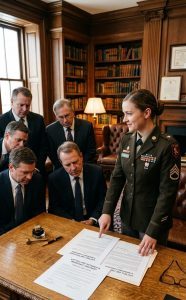
The emergency board meeting was a tense affair, held remotely via secure video conference due to Mr. Davies’s limited mobility. I was invited as a major shareholder, my presence a visible reminder of Thomas’s betrayal. The Kinsley Holdings boardroom, usually a place of quiet power, crackled with barely suppressed tension.
Mr. Davies, his face projected onto the large screen at the head of the table, looked formidable. His voice, clear and unwavering, cut through the nervous silence. “Ladies and gentlemen of the board, we are here today to address an unprecedented crisis. CEO Thomas Kinsley has announced the sale of our lucrative biotech division without board approval, to an entity whose ownership is, at best, opaque.”
He continued, laying out Thomas’s blatant disregard for protocol, his breach of fiduciary duty, and the clear evidence of his intent to strip the company of its most valuable assets for personal gain. He presented the evidence meticulously, his mind as sharp as ever. He spoke of the company’s founding principles, of my grandfather’s vision, subtly contrasting it with Thomas’s rapacious ambition.
Thomas, also present via video link, looked stunned, his usual smug confidence replaced by a visible unease. He attempted to argue, to justify his actions, but Mr. Davies swiftly cut him off.
“Mr. Kinsley,” Mr. Davies said, his voice cold, “your actions speak for themselves. This is not leadership; it is corporate malfeasance. It is an insult to the legacy of this company and a betrayal of every shareholder.”
He then called for a vote of no confidence, his gaze sweeping across the virtual faces of the board members. The decision was swift and decisive. Board members, many of whom had served under my grandfather, were outraged by Thomas’s audacious moves. The betrayal of the company’s core values, rather than just my personal inheritance, proved to be Thomas’s undoing.
One by one, they cast their votes. A ripple of unease, then a growing wave of condemnation. The final tally was overwhelming. Thomas was immediately suspended from his executive powers. His authority as CEO was stripped, effectively removing him from immediate control of Kinsley Holdings.
I cast my vote with a heavy heart, not with triumph, but with a grim sense of justice. It was a victory, yes, but a hollow one, for the fate of Evelyn Reed still weighed heavily on my conscience.
Thomas’s face, projected onto the screen, drained of color. He slammed his fist onto his desk, a sound that echoed through the virtual meeting. He looked utterly defeated, his empire crumbling around him, not by my hand alone, but by the combined force of the board’s moral outrage, instigated by Mr. Davies.
“This isn’t over,” Thomas spat, his voice laced with venom, before his video feed abruptly cut out.
But for now, it was. Mr. Davies, despite his age, had risen to the occasion, protecting Kinsley Holdings from its greedy CEO. His decisive call had halted Thomas’s corporate coup, buying me crucial time. The biotech division was safe, for now. But the ultimate victory still hinged on that one, water-damaged letter, still being meticulously restored in Dr. Hayes’s lab.
More Stories




+ There are no comments
Add yours