
At Governor Reed's Funeral, His Daughter Laughed When Her Husband Called Her Useless – He Didn't Know She Held the Key to His Political Empire


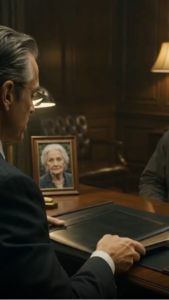
I sat in Arthur’s study, surrounded by the ghosts of his choices. Chloe’s notarized affidavit lay open on one side of the desk, detailing Marcus’s systematic fraud. On the other, the heavy, leather-bound “black book” sat closed, its secrets echoing in the quiet room. I now understood the full, complicated nature of my inheritance.
The power I held was immense, a double-edged sword. I could publicly expose Marcus Albright, tear down his carefully constructed public persona, and ensure he faced the full legal consequences of his embezzlement. That would be justice, pure and unadulterated, a clean victory.
But that path would inevitably lead to the “black book.” Exposing Marcus’s fraudulent campaign tactics would highlight the very mechanisms that Arthur himself had, at times, employed or covered up. The ensuing scandal would not stop with Marcus; it would inevitably ripple back, tarnishing my father’s meticulously crafted legacy, potentially damaging the very foundation he had devoted his life to building. The institution I was fighting to protect would be caught in the crossfire.
My father’s note about “necessary collateral” echoed in my mind. He had made his choices. Now, it was my turn.
I recalled Marcus’s sneering remarks at the funeral, his condescending tone, his public declaration of my “uselessness.” The desire for public vindication was strong, a visceral urge to shatter his arrogance with undeniable proof. But that urge, I realized, was a luxury I could not afford. The foundation, my father’s life’s work, was more important than my personal satisfaction. That, too, was a lesson from the “black book.”
Benjamin sat silently opposite me, watching, waiting. He knew the dilemma I faced. He knew Arthur had placed this burden directly upon my shoulders.
“If I go public,” I said, breaking the silence, my voice hoarse, “the foundation could be irreparably damaged. Questions would be raised about Arthur’s past, about his judgment, about the integrity of the institution itself.”
Benjamin nodded slowly. “Arthur understood that. He structured his final test to force you to choose between pure vengeance and strategic preservation. He wanted to see if you possessed the wisdom to make the difficult, often unpopular, choice.”
The weight of it was staggering. My father hadn’t just given me the tools to fight Marcus; he had given me the tools to understand the true cost of power. He was asking me to accept a victory that would be largely unseen, a quiet act of stewardship rather than a triumphant public declaration. It felt like a petty cruelty, a final, painful lesson from a manipulative father, but also an undeniable truth.
I thought about Julianna, my daughter, growing up with the Reed name, a name that signified integrity and public service. I wanted her to inherit a foundation that was strong and untarnished, not one embroiled in scandal, even if that scandal revealed a complex truth about her grandfather.
My decision solidified. I would not publicly destroy Marcus. I would use the evidence, and the knowledge from the “black book,” as leverage. I would force him into a silent retreat, a private downfall that would leave the foundation intact and my father’s legacy, complicated though it might be, preserved in the public eye. The irony was palpable: Marcus, who craved public adulation, would be undone in the quiet secrecy he had always preferred for his own crimes.
“Chloe’s affidavit and the black book,” I finally said, looking at Benjamin, “will be our leverage. Not for public prosecution, but for total, undeniable control.”
Benjamin’s eyes narrowed slightly, a look of profound respect on his face. “A silent checkmate, Evelyn. Arthur would be proud.”
I picked up Chloe’s affidavit, then a specific page from the “black book”—the one detailing Arthur’s nearly identical campaign finance maneuver from twenty years prior. These two documents, paired together, were a potent, devastating combination. They proved Marcus’s crimes, and they showed he was not alone in employing such tactics, even if the intentions behind them were vastly different.
I knew exactly how to use them. The confrontation would not be a courtroom drama or a press conference exposé. It would be a private reckoning, a quiet judgment delivered in the very room where Arthur Reed had once contemplated his own complex moral landscape. Marcus Albright would fall, not with a bang, but with a profound and silent understanding of his own defeat, leaving the foundation, and my father’s legacy, to me. The serpent would be unbound, its coil broken, but not without leaving its own lasting mark.
More Stories















+ There are no comments
Add yours