Darius returned to the fellowship hall, Omar’s signed confession clutched in his hand. The Community Council waited in tense silence. Pastor Thomas, his face still streaked with tears but now set with a quiet resolve, followed closely behind him.
The sight of the confession, the indisputable proof, sent a fresh wave of shock through the room. Darius handed it to Aunt Carol, who carefully unfolded the pages. Her eyes, usually so sharp, widened as she read Omar’s damning words. She passed it around the table, each elder reading it in stunned disbelief, their faces growing harder with every line.
Deacon Silas watched, his head bowed, knowing his part in this drama was now fully exposed. The silence was thick with the weight of shattered trust.
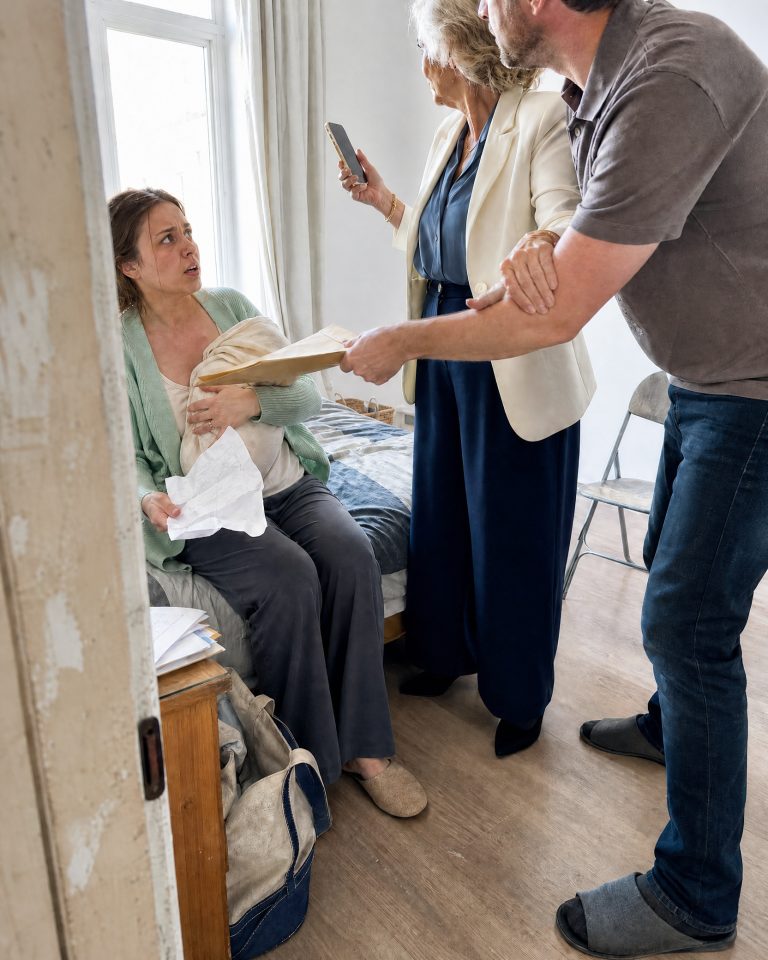
Omar, who had been summoned to the meeting during Darius’s absence, sat slumped at the far end of the table. He had arrived with an air of practiced indignation, ready to play the victim once more. But as the confession circulated, his facade began to crumble, a visible crack in his carefully constructed lies.
“Omar,” Aunt Carol said, her voice trembling with a mixture of anger and grief. “Is this your handwriting? Is this your signature?”
Omar looked at the document, his eyes darting wildly. He tried to deny it, to claim it was a forgery, another one of Darius’s attempts to “ruin his good name.” But the evidence was overwhelming, written in his own distinctive script, detailing crimes only he could have committed.
“It’s… it’s not what it looks like,” Omar stammered, his voice losing its usual charismatic charm, replaced by a desperate, whiny tone. “Darius is trying to frame me. He’s always been jealous.”
“Jealous of what, Omar?” Mr. Henderson boomed, his patience exhausted. “Jealous of you stealing from your own mama and papa? Jealous of you blackmailing our Pastor and Deacon?”
Omar finally broke. He buried his face in his hands, his body shaking with ragged sobs. His attempts to deny everything collapsed under the irrefutable evidence. The public humiliation, the utter destruction of his carefully crafted image, was a profound and specific personal cruelty. His pretense of success and piety was shattered forever.
The Council deliberated for a long, solemn hour. They spoke in low, grave tones, discussing the magnitude of Omar’s betrayal, the damage he had inflicted on his family and the community’s trust. They weighed the options, the pain evident on each elder’s face.
Finally, Aunt Carol stood, her gaze sweeping across the room, settling on Omar. Her voice, though heavy with sorrow, carried the full authority of the Council.
“Omar Jenkins,” she began, her voice steady. “The Community Council has heard the evidence. We have seen your confession, signed by your own hand. Your actions against your parents, against our Pastor, against our Deacon, and against the very fabric of this community, are beyond egregious.”
Omar looked up, his face a mess of tears and snot, awaiting his fate.
“We have decided,” Aunt Carol continued, “that for a period of ten years, you are formally banished from Heritage Grove. You will have no claim to any Jenkins family land, and any assets you have remaining, however minimal, will be used to make financial reparations to your parents for the harm you have caused.”
A collective sigh went through the room. Ten years. It was a severe sentence, a complete severing of his ties to the community that had nurtured him.
“Your reputation here is permanently ruined,” Aunt Carol concluded, her voice cold and unyielding. “You have broken sacred trusts. You must leave. There will be no official police charges, but your social and familial ties are severed. You are to depart this town by dawn tomorrow.”
Omar could only nod, his body trembling. He was stripped bare, his attempts to maintain a facade utterly destroyed. No police, but a judgment far more impactful in this tight-knit community.
Darius watched as Omar was escorted out of the fellowship hall by two grim-faced elders. He was a solitary figure, his shoulders slumped in defeat, his once-charismatic presence reduced to nothing. He left the room, his entire life in Heritage Grove collapsing around him.
Justice, in its own way, had been served. But Darius felt no triumph, only a deep weariness. The cost of this truth, the shattering of his family, the exposure of corruption, felt immense. He had won the battle, but the war for his heart felt far from over.
The image of Omar, leaving in disgrace, was a poignant one. His brother, reduced to a hollow shell, exposed by his own greed. It was a specific, personal cruelty for Omar, a justice delivered not by the law, but by the community he betrayed.



+ There are no comments
Add yours