
Banished from Montana for rejecting a powerful baron, she blew the whistle on his corrupt land empire, sacrificing everything for a justice that never fully arrived.


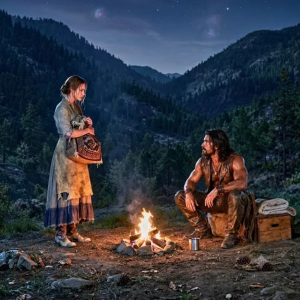
Elias quickly doused the dying embers of their campfire. The sudden darkness was absolute, save for the faint glow of the distant stars. We flattened ourselves against the rough bark of a pine, the icy wind whipping around us.
The crunch of hooves grew louder, then faded into the vast silence of the Montana night.
“They’re gone,” Elias whispered, his voice low.
I slowly straightened, my muscles aching from the cold and the tension. The air felt heavy, even after the immediate threat had passed.
“They won’t stop,” I said.
Elias nodded, his gaze fixed on the spot where the horsemen had vanished. “Marsh doesn’t leave things to chance. He sends his men to make a point, to make sure you know he’s watching.”
We spoke in hushed tones, discussing Marsh’s methods. Elias explained how the baron operated with ruthless efficiency, using his influence over the territorial bank to freeze accounts. He would then claim properties for “unpaid debts,” often for trivial amounts or fabricated charges.
“There was a family, the Millers, just last fall,” Elias recounted. “Good, honest folks with prime grazing land. Marsh called in a loan for a broken fence post they didn’t even know they owed.”
He paused, a grim line set on his face.
“They lost everything. Marsh didn’t just take their land; he had his men demolish their modest cabin brick by brick, leaving only a pile of splinters to make way for his new fence line.”
The image burned in my mind: a home reduced to rubble, a family’s life shattered for a mere fence post. It was a petty, vicious display of power. Marsh wasn’t simply expanding his empire; he was erasing the very presence of those who stood in his way.
“He does it to intimidate everyone else,” I concluded. “To show what happens if you cross him.”
Days later, the bitter cold had settled deeper into my bones, and our rations were running low. I was gathering sparse firewood when I saw a figure on the distant horizon. He was old, frail, struggling through the snow.
My heart quickened. There was something familiar about his gait, despite the burden of age.
He drew closer, his face etched with exhaustion, beard frosted white. It was Jedediah Finch, my great-uncle, a territorial surveyor I hadn’t seen in years.
“Abigail?” he rasped, his voice barely a whisper. His eyes, though tired, held a spark of recognition and a deep sorrow.
I rushed to him, helping him to Elias’s small cabin. He was clearly ill, worn out by the arduous journey through the unforgiving winter landscape. Elias helped me settle him by the small, crackling fire.
After we warmed him with hot tea and a small portion of stew, Jedediah struggled to speak. His hands trembled as he held the cup.
“I heard the rumors in Elk Creek,” he began, his voice raspy. “About Marsh, and you.”
He took a long, shaky breath, his gaze fixed on the flickering flames. “I should have come sooner. I should have spoken up years ago.”
My great-uncle closed his eyes, a profound weariness settling over him. “Marsh… he cornered me a long time ago. Threatened to ruin my reputation, strip me of my surveyor’s license. Said he’d make sure I’d never work again in the territory.”
He opened his eyes, meeting mine with a pained expression. “I was a coward, Abigail. I did what he asked.”
My stomach clenched. I waited, sensing the weight of his confession.
“He made me falsify survey reports,” Jedediah continued, the words tumbling out in a rush. “Specifically for a valuable ore claim, just outside of Blackwood Gulch. The true owner, a man named Thomas Miller, had staked it honestly.”
He paused, a dry cough shaking his frail frame.
“I shifted the boundaries on paper, moved the claim markers, putting the richest veins squarely into Marsh’s name. Miller was driven off his land, left with nothing but the clothes on his back, convinced he’d made a mistake in his measurements.”
It was a cold, calculated act of theft, not just of land but of a man’s future. The betrayal of a trusted profession, used to dispossess the vulnerable.
“I couldn’t stand it anymore,” Jedediah said, his voice stronger now, fueled by a deep-seated guilt. “Seeing what he did to you, what he’s done to so many others. It broke something inside me.”
With trembling hands, Jedediah reached into his worn coat. He pulled out a small, leather-bound ledger, its cover smooth with age and repeated handling. It was unassuming, almost ordinary, but its weight felt immense in the quiet cabin.
“This is the truth,” he whispered, pushing it across the rough-hewn table toward me. “I kept my own records. Every false claim, every manipulated deed, every man he ruined. Decades of his fraud, detailed right here.”
My fingers brushed the worn leather, a strange mix of dread and hope washing over me. This wasn’t just about my banishment or Elias’s homestead. This was about a ghost from the past, a decades-long pattern of corruption, meticulously recorded. The sheer audacity, the depth of Marsh’s deceit, was staggering.
This ledger was not just paper and ink; it was a testament to every broken promise, every stolen dream. It represented years of injustice that had gone unpunished, and now, it was in my hands.
What secrets did it truly hold, and what would it demand of us to bring them to light?
More Stories






+ There are no comments
Add yours