
After Caring for My Dying Father, My Mother-in-Law Claimed My Home and Threatened to Call Security — All While Hiding My Late Husband's Deepest Secret


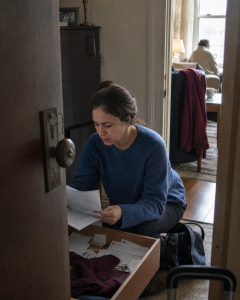
The old hospital discharge summary lay crumpled in my shaking hands. My fingers, still stained with the lingering scent of disinfectant from my father’s hospice, traced the faded ink. It was for Mark, dated just days after his birth, with the stark, chilling phrase “adoption processed” stamped at the bottom.
My mind reeled, trying to grasp the impossible. Mark, my Mark, adopted?
Every memory of Carol, of her possessive love for her son, of the almost suffocating way she’d clung to his memory, suddenly twisted into something dark and unfamiliar. This wasn’t just about reclaiming my apartment; this was about the very foundation of my late husband’s life.
I stared at the address listed for the issuing hospital, a facility in Evanston, a suburb I knew well. The next morning, fueled by a mixture of shock and fierce determination, I started making calls. Navigating the labyrinthine corridors of medical records and privacy laws felt like an impossible task.
Each automated menu was a new hurdle, each transferred call a fresh test of my dwindling patience. A particularly brusque woman in the hospital’s records department, her voice tinny over the phone, made it clear I was an inconvenience.
“We can’t just hand out sensitive information on a whim, ma’am,” she stated flatly, as if I were asking for a celebrity’s autograph.
I explained my connection, Mark’s death, the discharge summary I held. She remained unmoved, her tone clipped and dismissive.
“Unless you’re next of kin with explicit legal authority, or the patient himself, we require a formal request through proper channels,” she insisted, ending the call with a curt “Have a good day” before I could argue further.
The dismissiveness was a petty cruelty, making me feel like an outsider in my own late husband’s life story. It underscored how deeply this secret had been buried, protected by layers of bureaucratic red tape.
I refused to give up. I spent the next two days meticulously researching privacy laws, writing formal letters, and seeking advice from a sympathetic online forum for navigating medical records. I learned that as Mark’s widow, I had a pathway, albeit a convoluted one, to request records relevant to his medical history, especially if fraud was suspected.
Finally, after several emotionally draining days, an email arrived. It was from the hospital, acknowledging my formal request for Mark’s adoption records, citing the specific case number from the discharge summary I had provided.
They informed me that due to the sensitive nature of the information, they would provide a redacted copy, verified by a notarized letter, within five to seven business days. The waiting was agony, each passing hour a slow burn of anticipation and dread.
The week that followed was a blur of sleepless nights and anxious days, every creak of the floorboards in the apartment now grating on my nerves. I was living in a limbo, unable to fully grieve my father or comprehend Carol’s betrayal.
My phone rang with an unfamiliar number a few days later. It was a representative from the hospital, confirming they had sent the documents via secure email.
I hurried to my laptop, my hands trembling as I clicked open the attachment. There it was, stark and undeniable, laid out in formal legal language. It was Mark’s official adoption record.
The document confirmed that Mark Jenkins, born fifty-five years ago, had been adopted by Carol and Thomas Jenkins when he was just five days old. All mentions of his birth parents were heavily redacted, blacked out with thick, unforgiving lines. The formal, impersonal phrasing made the profound shift in Mark’s identity feel disturbingly clinical.
The paper confirmed my deepest fears, yet somehow intensified the mystery. The specific date, the names of the adopting parents – Carol and Thomas Jenkins – everything matched. It was irrefutable.
A wave of profound sadness washed over me. Mark had lived his entire life never knowing this truth, or perhaps, he had suspected it. The idea that Carol had withheld this from him, denying him his own history, was a cruel, silent act of possessiveness.
The weight of this knowledge was staggering. This wasn’t just about property anymore; it was about a lifetime of secrets. Carol hadn’t just tried to steal my home; she had built her entire life, and Mark’s, on a colossal lie.
The apartment, once a sanctuary, now felt suffocating, filled with the ghosts of unspoken truths. The smell of fresh paint, which Carol had applied, now seemed to mock me, covering up not just the walls, but decades of calculated deception.
I held the printout of the adoption record, the crisp paper a tangible piece of a shattered reality. It felt heavy, a burden of truth I hadn’t asked for, but now couldn’t ignore. What would Mark have felt if he had known? What did this mean for everything I thought I knew about him, about us?
The implications were dizzying. Carol’s frantic attempts to seize the apartment, to erase me, suddenly made a twisted kind of sense. She wasn’t just grieving a son; she was protecting a secret, one so deeply buried it threatened to unravel her entire constructed world.
This document was more than just a piece of paper. It was a key, unlocking a door to a past that was far more complex and painful than I could have ever imagined. It was a secret that Mark had carried, unknowingly, his entire life, and now, it was mine to bear.
The silence in the apartment pressed in on me, broken only by my own ragged breathing. My grief for Mark, for my father, now merged with a new, burning anger. I knew, with absolute certainty, that I had to confront Carol with this. I had to know why.
But how do you confront someone who has built their life on a lie, who has already shown such callous disregard for truth and human connection? The answer eluded me, but the resolve to try solidified in my gut.
More Stories












+ There are no comments
Add yours