
At a high-society wedding, a bride exposes her new husband's family's deep fraud after he gives their shared home to his mother.


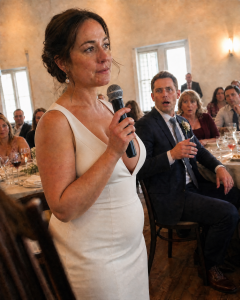
The hushed silence in my small, rented apartment felt less like peace and more like a void. Two weeks had passed since the wedding reception, two weeks since I’d detonated the Albright family’s carefully constructed façade.
My phone, lying face down on the scarred coffee table, vibrated with another forgotten work notification.
I stared at it.
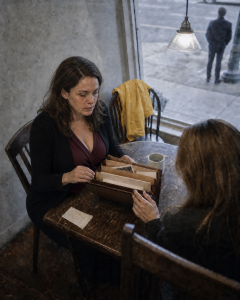
“You really should pick that up, Elara,” Chloe said softly from the armchair, her brow furrowed with concern.
She was sorting through a stack of design magazines, a futile attempt at normalcy.
“It’s probably another cancellation,” I said, my voice flat.
“Or a rejection disguised as a polite ‘we’ll be in touch’.”
The “unstable bride” narrative, meticulously crafted by Genevieve and Julian, had spread through the high-society design world like wildfire. Initially, it had been subtle. A delayed email response here, a vague excuse there. Then it sharpened.
My calls to prospective clients, once met with eagerness, were now met with polite but firm rejections.
“We admire your work, Elara, truly,” one gallery owner had said, his voice dripping with faux sympathy. “But this project requires someone… with a very steady hand. No distractions.”
The implication hung heavy in the air, thick with Genevieve’s whispers of “delusional paranoia” and “exacerbated wedding stress.” I could almost hear her haughty laugh.
Chloe tossed a glossy magazine onto the table. It landed with a soft thud.
“They’re really going for it,” she muttered.
“The Albright damage control is impressive, I’ll give them that.”
I pushed myself up, moving to the tiny kitchenette. The smell of stale coffee clung to the air. My own design studio, a passion project only a few months old, felt like a distant dream. The elaborate plans I’d made, the networking events I’d attended, all dissolved into the ether of high society’s fickle memory.
“It’s not just the gossip blogs anymore,” I said, pouring myself a glass of water.
“A few of my old colleagues have stopped responding to my emails altogether. The ones who do are wary.”
Chloe watched me, her gaze unblinking.
“This is Genevieve’s doing. She’s systematically cutting you off.”
“I know.”
I felt the walls closing in, the professional world I’d worked so hard to build crumbling around me. It was a suffocating sensation, a slow, quiet suffocation that was almost worse than the initial public humiliation. The feeling of being erased.
Across town, in a plush, temporary suite at The Plaza, Genevieve Albright reviewed a list of contacts on her gilded phone. Bart Croft, the family lawyer, sat opposite her, his expression impassive as he sipped his tea.
“Serena is proving surprisingly useful,” Genevieve purred, a cruel satisfaction in her voice.
“A little flattery, a reminder of her precarious social standing, and she’s eager to oblige.”
Bart Croft nodded, a slight, almost imperceptible tilt of his head.
“Her reach among the younger, more impressionable socialites is advantageous. They transmit information and disseminate rumors with remarkable efficiency.”
Serena Albright, Julian’s cousin, had been tasked with a very specific role: to subtly reinforce the narrative of my instability among the very circles where I once hoped to thrive. She wasn’t just spreading gossip; she was subtly poisoning the well, twisting every past interaction, every professional ambition I’d ever shared, into a sign of my alleged “fragility.”
“Make sure she emphasizes the financial recklessness,” Genevieve continued, a glint in her eye.
“How Elara, in her ‘delusions,’ nearly bankrupted Julian with outlandish designs for the penthouse. That will resonate with anyone considering her for future commissions.”
“Understood,” Bart Croft affirmed, making a note on a discreet tablet.
“The objective is not just social ostracization, but professional incapacitation.”
Genevieve smiled, a predator’s baring of teeth.
“Precisely.”
Meanwhile, in the bustling newsroom of the *New York Chronicle*, Marcus Holloway hunched over his computer, a half-eaten sandwich forgotten beside his keyboard. The anonymous tip about the Albright wedding had initially felt like just another society scandal, ripe for a gossip column. But something about it gnawed at him.
“You really going down that rabbit hole, Marcus?” his cubicle mate, Sarah, called out, not looking up from her own screen.
“Rich people problems, right?”
“Maybe,” Marcus murmured, his fingers flying across the keyboard.
He’d started by cross-referencing public records for the penthouse Elara had mentioned. The state lien was real, if discreetly filed. But what truly intrigued him were the entities tied to the Albright Family Trust.
He pulled up a complex diagram of interconnected shell corporations. Delaware LLCs, offshore holdings in the Cayman Islands, trusts with convoluted beneficiary structures. Names he’d seen before, in other, unrelated investigations into old money families skirting tax laws.
“Look at this,” he said, gesturing vaguely at his screen without looking up.
“The Albright Trust, supposedly a bastion of old New York wealth, has more layers than an onion. And half of them lead to companies registered in places where the sun shines bright, but the tax laws are conveniently opaque.”
Sarah finally looked over, adjusting her glasses.
“Standard practice for the ultra-rich, isn’t it? Tax avoidance.”
“Avoidance, yes,” Marcus countered, scrolling through bank statements and corporate filings.
“But this feels… different. Aggressive. There are some unusually large transfers between these shell companies, just before and after periods of declared losses.”
He highlighted a series of transactions, his brow furrowed in concentration. The sheer volume and frequency struck him as more than mere legal maneuvering. It hinted at something systematic, something designed to deliberately obscure wealth rather than just minimize tax burdens.
“And then there’s the timing,” he mused, leaning back in his chair.
“This particular series of transfers picked up about fifteen years ago, after a period where the Albright’s primary family business, a discreet investment firm, seemed to hit a rough patch.”
He clicked through more old news articles, searching for any whispers of financial trouble for the Albrights from that era. Nothing overt, but a few mentions of “strategic restructuring” and “diversification” that now sounded like code.
“A family that boasts about generations of ‘quiet wealth’ doesn’t usually resort to this level of corporate gymnastics unless there’s something significant to hide,” Marcus thought aloud.
“The bride’s claim might be just the tip of a very, very old iceberg.”
He opened a new file on his computer, labeling it “Albright – Mirage.” The “delusional paranoia” narrative hadn’t swayed him. If anything, it made him more suspicious. Why go to such lengths to discredit someone, unless there was a deeper truth to bury? The family’s frantic PR offensive felt like an overreaction, disproportionate to a simple marital spat.
Back in my apartment, I stared at my reflection in the dark glass of the window. The city lights blurred outside, a stark contrast to the sharp focus of my own unraveling. My hands felt cold. My head throbbed. I closed my eyes, picturing Genevieve’s sneer, Julian’s weak smile.
“What am I going to do, Chloe?” I asked, my voice barely a whisper.
Chloe walked over, placing a reassuring hand on my shoulder.
“We figure it out. One step at a time.”
But the path ahead felt obscured, deliberately so, by a fog of carefully constructed lies and the chilling effectiveness of their campaign to isolate me completely from the world I knew. The quiet hum of my empty apartment was a stark reminder of the professional silence that had fallen, a silence Genevieve had orchestrated with masterful precision.
The phone vibrated again. This time, I didn’t even flinch. I knew what it meant.
More Stories














+ There are no comments
Add yours