
After 62 Years, I Learned My Lost Love Didn't Die in War — His Father Forced Him to Disappear for a "Better" Life


The smell of old paper and dust hung heavy in the air of the government archive. I watched Imani, my daughter, hunched over a large table, her fingers tracing lines on a heavily redacted document. She had been relentless since Michael’s visit, digging into Eli’s military file, a task I hadn’t dared to undertake in all these years.
Every page she turned felt like a step into a past I thought was sealed shut.
She pulled a magnifying glass from her bag, her brow furrowed in concentration. The official “Missing In Action” report for Eli was a stark, impersonal declaration, a bureaucratic shrug for a life lost. Most of the meaningful details were blacked out, large, rectangular blocks of ink obliterating any real insight.
“This is infuriating,” Imani muttered, her voice tight with frustration. “They’ve redacted almost everything that matters.”
She slid a page across the table, revealing Eli’s name, rank, and date of reported disappearance, all surrounded by a sea of black. It felt like they were trying to erase him all over again, stripping away even the ghost of his official existence. The sheer indifference of the redactions, the way they made Eli into nothing more than a case number, felt like a deliberate act of disrespect against the man I loved.
Suddenly, her hand stopped. She looked closer at the stack of papers, then pulled a single, creased piece of paper from between two stiff, official forms. It was smaller, thinner, and clearly unofficial, almost hidden.
“What’s this?” she whispered, her eyes widening.
I leaned closer, my heart pounding a rhythm against my ribs. It looked like a handwritten note, faded with time, scrawled on what appeared to be a standard memo pad. This wasn’t part of the official record; it was a ghost of a whisper tucked away.
Imani carefully unfolded the memo, her fingers surprisingly gentle. The paper felt fragile, as if it might crumble into dust at any moment. Her gaze scanned the lines, her breathing growing shallow.
“It’s from a clerk,” she said, her voice barely audible. “A low-level clerk, it looks like. Dated a week after Eli was reported MIA.”
She held it up, and I could just make out the faded blue ink. The clerk had detailed an anomaly, a discrepancy that went against every official record. Eli Washington, the memo stated, had been seen.
“Eli was seen by two nurses,” Imani read aloud, her voice trembling slightly. “At a civilian rehabilitation center in North Carolina.”
My breath hitched in my throat. North Carolina. Not a military hospital. Not a battlefield. A civilian facility, far from the front lines, and a full week *after* he was declared missing in action. It was a direct, irrefutable contradiction to the official narrative, a sharp, cruel knife through the decades of quiet grief I’d carried.
“A civilian rehab center?” I asked, my voice thin and reedy. “What would he be doing there?”
The note didn’t specify his condition, only his presence, witnessed by two specific nurses, their names listed clearly. This single, unofficial memo suggested a deliberate detour, a hidden path for a soldier who was supposed to be gone. It ripped open the wound of his supposed death, revealing something far more sinister than battlefield casualty.
“And it says ‘not a military hospital,'” Imani added, her eyes flashing. “That’s the key part, Mama. Why wasn’t he at a military facility if he was injured?”
The implication hung heavy in the silence of the archive. A civilian center, away from military oversight, screamed of a cover-up. It pointed to someone with enough power to reroute a soldier, to erase his official tracks, and to place him in a private facility that wouldn’t be scrutinized.
“Someone didn’t want him found,” I murmured, the words feeling foreign and cold on my tongue.
The idea that Eli might have been alive, but intentionally hidden, for those first crucial days and weeks, was a profound and unsettling twist. It implied a conspiracy, a careful manipulation of records, a powerful hand pulling strings behind the scenes. The cruelest part was not just the deception, but the calculated way it was done, the quiet act of stealing a life and rewriting a story.
Imani carefully folded the memo, tucking it inside a clear plastic sleeve. “This changes everything, Mama.”
“It does,” I agreed, my hand going to my chest. “It means someone decided Eli’s fate for him. Someone powerful.”
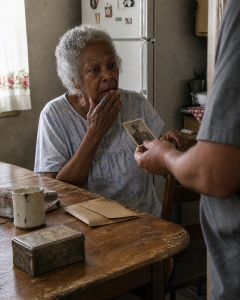
The memory of Eli’s faded photograph that Michael had shown me, the one with his other family, flashed in my mind. The coded diary, the hints of coercion. This unofficial memo was the first concrete piece of evidence that his disappearance was not an accident of war, but a deliberate act. It was a personal betrayal, not a national tragedy.
The implications were chilling. If Eli was alive and moved to a civilian facility, then his “MIA” status was a lie. A manufactured narrative to explain away his sudden absence, orchestrated by someone who had the authority and the motive to disappear a man. The thought of Eli being somewhere, possibly confused and alone, while I grieved his presumed death, felt like a fresh wound.
“We need to find out more about these ‘civilian rehabilitation centers’ from that era,” Imani said, her journalistic instincts kicking in. “And why a military-declared MIA would end up in one, instead of a military hospital.”
She packed up the redacted file, the flimsy memo feeling heavier than all the official documents combined. The journey to the archives had started with a hope for answers, but now it had delivered a shocking, painful secret. The ghost of Eli was not just alive in memory, but actively suppressed.
“This Sterling Washington,” I said, my voice firmer than I expected. “He was powerful, wasn’t he? Even back then.”
Imani nodded, her lips pressed into a thin line. “One of the most powerful Black businessmen in Montgomery. His company was already huge.”
The connection was clear, though still unproven. Sterling Washington, the man who had made the suspicious donation, was also the man with the power and influence to orchestrate such a cover-up. The casual cruelty of erasing a man’s life, simply because he was deemed inconvenient, was starting to take shape. It wasn’t about the war; it was about control.
As we walked out of the archive into the bright Alabama afternoon, the mundane world felt strangely indifferent to the bombshell we had just uncovered. The sun shone, birds sang, but inside me, a quiet storm was gathering. Eli hadn’t just disappeared; he had been taken.
And someone had gone to great lengths to make sure I never knew.
This unofficial memo, a forgotten scrap of paper, held more truth than all the official reports combined. It was a silent testament to a betrayal that spanned decades, a quiet act of sabotage against love and a future. My heart ached not just for Eli, but for the years stolen, the life unlived, the deliberate cruelty of a father who would rather erase his son than allow him a life of his own choosing.
“We won’t stop until we get to the bottom of this, Mama,” Imani promised, placing a hand on my arm. “Not now.”
I looked at her, my determined daughter, and a flicker of hope mixed with the rising tide of anger. For 62 years, I had waited for a ghost. Now, it seemed, I was hunting a very real villain. The fight for justice had truly begun.
More Stories
















+ There are no comments
Add yours