
The Blizzard's Bargain: How a Desperate Surgeon Traded Her Freedom for Truth in a Forsaken Hospital Lab


My blood ran cold as the automated message flashed across the digital information board near the staff entrance: “Ward 4B – Neurological Research Unit – Strict Biohazard Protocol – No Unauthorized Access.” Below it, a familiar name: Patient 3B.
It was Boone’s doing.
He knew.
My heart hammered against my ribs, a frantic rhythm matching the blizzard’s roar outside.
Patient 3B was the key, the clearest example of the escalating neurological anomalies linked to Boone’s experimental protocol.
I had to see them.
I hurried towards Ward 4B, the empty corridors amplifying the panic rising in my chest. The hospital felt like a tomb, sealed off from the world.
A harried-looking resident, Dr. Lee, blocked the entrance.
“Clarissa, you can’t go in there,” he said, his voice strained. “Dr. Boone issued a direct order. Full quarantine. Suspected highly contagious pathogen.”
“A pathogen?” I felt a surge of adrenaline-fueled disbelief. “No tests confirmed anything like that. Patient 3B has an unusual neurological presentation, nothing infectious.”
“Boone’s orders are absolute,” Dr. Lee insisted, his gaze darting nervously around. “He’s very explicit. No exceptions. Not even for you, Clarissa.”
The subtle threat in his words was clear. Boone wasn’t just shutting down access; he was sending a message.
I knew it was a lie, a fabricated excuse to isolate my most critical patient. Boone was silencing my investigation before it even officially began. He was tightening the noose.
My mind raced. How could I prove anything if I couldn’t even see the evidence?
My phone was dead, no signal reaching the sub-basement. The blizzard had knocked out most external communications, leaving us isolated, trapped.
I remembered Finch’s offer, his chilling bargain. *Your autonomy will be my collateral.*
A bitter taste filled my mouth, but what choice did I have?
I retreated to Finch’s hidden lab, the metallic tang of fear sharp in my throat. He was hunched over a bank of monitors, his profile illuminated by the pale green glow.
“Boone’s locked down Patient 3B,” I stated, my voice raw.
Finch didn’t look up. “Predictable.”
“Predictable?” I scoffed. “He’s making it impossible to expose him. He’s using a fake pathogen scare.”
He finally turned, his eyes piercing. “Did you sign the contract, Dr. Sorenson?”
I hadn’t. Not yet. The physical document lay on a side table, a stark reminder of my looming sacrifice.
“I need access to Patient 3B. And their full medical records,” I said, ignoring his question. “The official channels are blocked.”
Finch leaned back, a faint, knowing smile playing on his lips. “That, Dr. Sorenson, is precisely why you came to me. Official channels are for those who play by the rules. We, however, are now outside those rules.”
He gestured towards a heavy, reinforced door built into the far wall, almost hidden by a movable workbench. It was an old-fashioned, thick steel door, painted to blend with the sterile concrete.
“This hospital is a relic,” he explained, his voice low. “Built over a century ago. A labyrinth of service tunnels, forgotten utility shafts, and disused wings.”
He stood, his gaze intense. “My predecessors, they called it the ‘Veins of St. Jude’s.’ A network known only to a select few. It offers… clandestine pathways.”
“To Ward 4B?” I asked, a sliver of hope cutting through my despair.
“And beyond,” Finch confirmed. “But it comes with a cost. You are officially my research assistant for the evening. Every move you make, every piece of data you acquire, is under my direct supervision. And, for the record, this access *will* be explicitly tied to your agreement.”
His words were a blunt instrument. He wasn’t just offering a way in; he was reiterating his terms, making sure I understood the depth of my commitment.
“What about the blizzard?” I asked, trying to buy time, to find another way out. “The hospital is barely functioning. Power’s flickering.”
“The blizzard is our cloak, Dr. Sorenson,” Finch countered. “Chaos creates opportunity. Fewer eyes, fewer questions. Most staff are either trapped or focused on emergency protocols.”
He pulled a heavy ring of old-fashioned brass keys from his pocket. The keys looked ancient, worn smooth with age.
“Patient 3B’s records are digital, Clarissa. Boone will have restricted access. He may even be altering them now. You need physical records, the original intake forms. They are kept in the Ward 4B administrator’s office, locked file cabinets.”
The thought that Boone might be actively tampering with evidence made my stomach clench. This wasn’t just about negligence; it was an active cover-up.
“And the patient?” I pressed. “How do I examine them without triggering an alarm?”
“My tools,” Finch said, sweeping his hand towards a nearby cart laden with advanced, compact neuro-imaging devices. “Portable, non-invasive, and completely off the hospital’s internal network. Untraceable. But you will use them precisely as I instruct.”
He handed me a small, heavy device, cool metal against my palm. “This is a neural resonance scanner. It detects subtle discrepancies in neural pathways. Highly experimental. Highly effective.”
I looked at the scanner, then at Finch. His methods were unsettling, his demands absolute. But his equipment was cutting-edge, far beyond anything Boone allowed his junior surgeons to use.
This was my only chance.
“Show me the way,” I said, my voice barely a whisper. The decision was made. My autonomy was already forfeit.
Finch led me to the heavy steel door. He unlocked it with a key from his ancient ring, the mechanism groaning in protest. Beyond it, a narrow, dimly lit corridor stretched into darkness. The air was cold, dusty, smelling of old concrete and forgotten things.
“These tunnels are not for the faint of heart, Dr. Sorenson,” he warned. “They are unmaintained. Uneven floors. Obscured pathways. And no one knows you are down here but me.”
“I understand,” I replied, forcing a steady breath. The tunnel felt like a passage into another world, a forgotten layer of the hospital where rules didn’t apply.
We navigated the winding, oppressive corridors in silence. Finch moved with a practiced ease, his flashlight cutting through the gloom, illuminating crumbling plaster and rusted pipes. The blizzard’s howl was muffled here, replaced by the distant groans and creaks of the old building.
After what felt like an eternity, we reached another heavy, unmarked door. This one had a modern keycard reader, but Finch simply bypassed it with a small electronic device he produced from his lab coat.
“An old maintenance entrance into the restricted zone of Ward 4B,” he explained. “Completely off the main grid. No camera coverage here.”
He opened the door a crack. Beyond it, the sterile, hushed silence of Ward 4B was almost deafening after the echoing tunnels.
“You have forty-five minutes, Clarissa,” Finch whispered. “Find Patient 3B. Use the scanner. Locate the original intake forms. I will be monitoring from here. Do not engage with anyone. Do not be seen.”
I nodded, my heart pounding. This was it. The true test of my desperation.
I slipped through the door, closing it softly behind me. The ward was eerily quiet. Most of the lights were dimmed due to the power fluctuations. I moved quickly, checking patient room numbers.
Patient 3B was in the last room on the corridor, a small, isolated corner. I saw a nurse’s cart outside, empty. The room itself was dark, the door slightly ajar.
I paused, listening. Only the hum of life support machines.
Taking a deep breath, I pushed the door open. Inside, Patient 3B lay still, a frail figure hooked up to numerous monitors. The neural resonance scanner in my hand felt suddenly heavy.
I set to work, carefully attaching the scanner’s probes to Patient 3B’s head, following Finch’s quick instructions. The device hummed to life, displaying complex neural patterns on a small screen. My eidetic memory immediately began to search for patterns, for anomalies that correlated with Boone’s protocol.
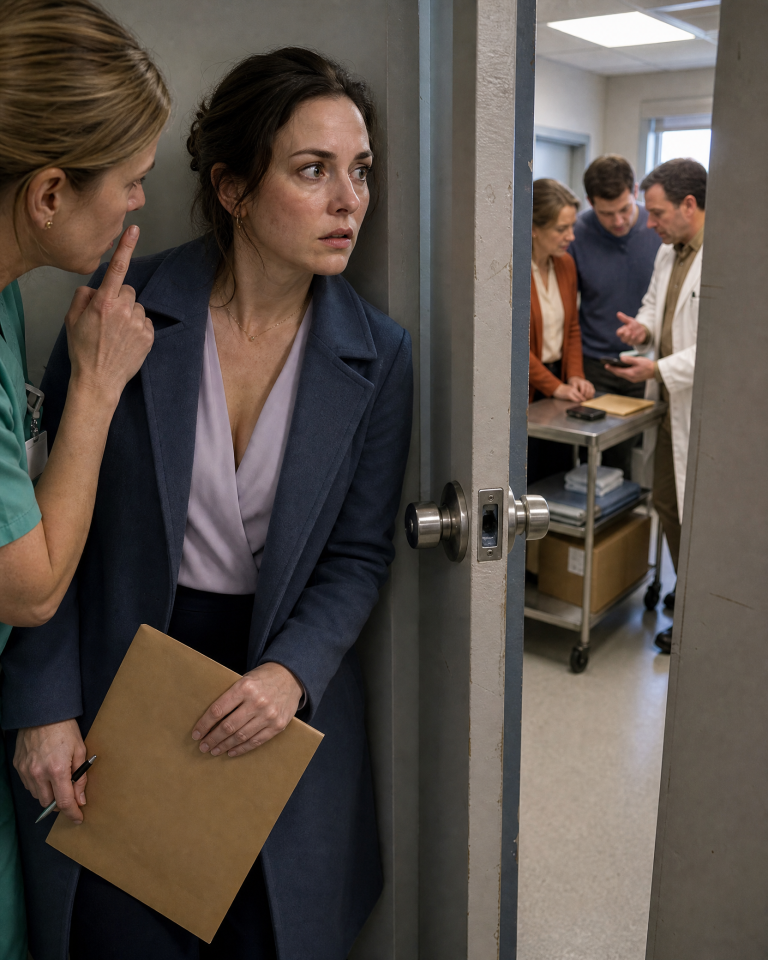
Meanwhile, a floor above, in the administrative offices of Ward 4B, Nurse Anya Sharma felt a growing unease. She was covering an emergency shift, the blizzard having kept most of the night staff at home.
The ward was almost empty. The silence was unnerving.
She had just finished checking on a stable patient when she saw Dr. Boone enter the ward administrator’s office, a place he rarely visited personally. He was carrying a small, zippered leather case.
Anya hesitated. Boone was usually so meticulous about delegating. Why was he here, now, in the middle of a blizzard, in this quiet office?
Curiosity, mixed with a nascent dread, drew her closer. She pretended to be straightening charts at a nearby nursing station, her ears straining.
She heard the soft click of a lock, then the rustle of papers. Boone wasn’t just browsing; he was searching for something specific.
Minutes later, he emerged. His face was unreadable, but Anya noticed a subtle, almost imperceptible shift in his posture. He carried nothing visibly, but she caught a fleeting glimpse of a small stack of papers in his left hand, tucked just inside his lab coat pocket as he adjusted it.
He walked past her, his gaze sweeping the corridor. Anya kept her head down, feigning intense concentration on her charts.
As he passed, a faint, almost antiseptic scent, mixed with something metallic, reached her. It was the smell of a specialized cleaning solution.
Boone disappeared around the corner. Anya waited a moment, then cautiously approached the administrator’s office. The door was slightly ajar, just as Boone had left it.
She peered inside. The room looked normal, but a small, distinct spray mark on the top of an open metal file cabinet caught her eye. It was near the ‘P’ section, where Patient 3B’s physical files would be stored.
It was the same cleaning solution she recognized from the sterile processing unit, typically used for instrument sanitization, not general office cleaning.
Why would Dr. Boone be sanitizing a file cabinet? And why in such a specific spot?
Anya felt a cold knot form in her stomach. He had been meticulously sanitizing Patient 3B’s original intake forms. He wasn’t just looking for something; he was *erasing* something.
Anya knew Boone’s ruthlessness. She had seen it before, in subtle ways, in veiled threats to nurses who questioned his methods. But this was different. This was overt, deliberate tampering with a patient’s historical data.
The seed of doubt, planted by Clarissa’s earlier, hushed warnings about Boone’s trial, began to sprout into a tendril of fear and suspicion. This was not the act of a brilliant, confident surgeon. This was the act of a man desperate to hide something.
In the sub-basement, I continued my scan of Patient 3B. The neural patterns shifted and pulsed on the scanner screen. My mind worked frantically, recalling every obscure neurological paper, every anomalous case study.
The images on the screen were stark, confirming my initial fears. Finch was right; his scanner was revealing patterns I’d only hypothesized.
This was more than a complication. This was a catastrophe in the making.
I still needed the original intake forms, the definitive proof of Boone’s deliberate oversight. I checked my watch. Time was running out.
I quietly exited Patient 3B’s room and made my way to the administrator’s office. It was locked. Boone was thorough.
But Finch had given me instructions for this too. He’d prepared for every contingency.
I found the small, inconspicuous service panel hidden behind a wall calendar. Following Finch’s remote guidance through a tiny earpiece he’d provided, I carefully bypassed the old electronic lock, the subtle click echoing in the silent ward.
Inside, the office was neat, almost too neat. My eyes went straight to the file cabinets. The ‘P’ section.
I opened it, sifting through the files. Patient 3B. I pulled the file out, my hands trembling slightly.
The original intake forms. I scanned them quickly, my eidetic memory absorbing every detail.
There it was. A specific blood test result. A subtle but distinct marker for a rare genetic predisposition. A marker that Boone’s trial protocol, if followed correctly, should have flagged immediately for exclusion.
But it hadn’t been flagged. It had been ignored. Deliberately.
A cold rage, sharper than the blizzard outside, ignited within me. Boone hadn’t just made a mistake. He had knowingly put this patient at grave risk.
I heard a faint creak from the hallway. My blood ran cold.
I had to get out.
More Stories


+ There are no comments
Add yours