
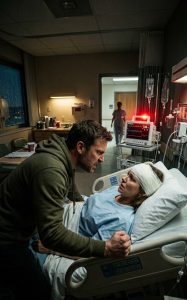
A husband tried to kill his wife's career, and nearly her, while she lay injured in a hospital bed.


The silence of my home office felt less like peace and more like a cage. My ribs ached with every deep breath, a constant reminder of the accident and David’s subsequent visit. I was supposed to be recovering, not plotting.
A courier delivered a heavy, cream-colored envelope. It bore the Caldwell & Associates logo, pristine and official.
Inside, David’s familiar, precise script filled a letter, supposedly an expression of concern.
“My dearest Eliza,” it began.
I could almost hear his voice, smooth and practiced.
He wrote about his profound relief at my recovery.
Then, the shift.
“However,” the letter continued, “your extended absence, while entirely understandable given the circumstances, has unfortunately created unforeseen complexities regarding the Lumina Tower’s critical path.”
My jaw tightened. Unforeseen complexities? He had been the one demanding I sign away my role in that hospital bed.
He went on to mention “minor adjustments” to the project schedule to “mitigate reputational risk” and “ensure investor confidence.”
My fingers trembled slightly as I scanned the corporate platitudes. The language was meticulously neutral, yet it stung like acid. It was an executive dismissal wrapped in a silk scarf.
I tried to log into the firm’s secure network from my personal laptop, a habit of years. The system bounced me out. “Access Restricted: Partner on Extended Leave.”
A cold wave washed over me. This wasn’t just David being a typical, overbearing husband. This was calculated.
Later that week, a cryptic email landed in my personal inbox. The sender was anonymous, but the subject line read: “Lumina Update.”
I hesitated, my heart pounding a frantic rhythm against my bruised ribs. This could be a trap.
But my professional integrity wouldn’t let me ignore it. I opened the attachment.
It was a project schedule, dated just days after my accident. Not the official one, but an internal version.
It laid out revised timelines for key design milestones. Under my name, red asterisks marked “critical delays” and “unforeseen resource reallocation due to lead architect’s unavailability.”
The dates had been subtly pushed back, attributing every slip to my “incapacity.” The document explicitly implied I had *caused* the delays, rather than simply being unable to work.
My hands clenched into fists, a sharp pain reminding me of my physical limits.
I remembered a junior architect, Maria, who sometimes helped with Lumina. She was meticulous, almost to a fault.
I found her number and called. It rang for a long time before she answered, her voice tight and hushed.
“Eliza? Is that really you?” Maria whispered.
“Yes, it’s me,” I said, trying to keep my voice steady. “I’m recovering. I just saw a revised Lumina schedule, and I have some questions.”
There was a long silence on the other end, punctuated by a faint rustling sound.
“Eliza, I… I can’t talk about that,” Maria finally said, her voice barely audible. “They said you need complete rest. David said no one should bother you with firm matters.”
“David said that?” I asked, a bitter taste filling my mouth. “He’s making it sound like I’m completely out of commission.”
“It’s just how the memos read,” Maria replied, her voice now barely a breath. “Like… there’s been a shift in leadership on the project. It’s all very quiet, but everyone’s noticed.”
“What memos?” I pressed.
“Internal ones. From David’s office,” she said quickly, then there was another rustle. “Look, I really have to go, Eliza. I’m sorry.”
The line went dead.
My mind raced. David wasn’t just trying to get me to sign papers; he was systematically eroding my professional standing within Caldwell & Associates. He was painting me as a liability, someone who couldn’t handle the pressure, whose accident was a convenient excuse for incompetence.
I tried calling Alex Chen, the junior associate who had witnessed David in the hospital room. His phone went straight to voicemail. I left a message, careful not to sound too accusatory.
“Alex, it’s Eliza. I just wanted to check in. Hope you’re doing well. Give me a call back when you can, if you have a moment.”
He never called back. The silence was deafening.
The days blurred into a pattern of painful physical therapy sessions and agonizing stretches of forced rest at home. My phone, once a constant source of professional updates and urgent calls, now remained quiet. My work email, tied to the Caldwell & Associates server, stopped receiving internal communications. It was as if I’d been edited out of the firm’s collective consciousness.
I felt a simmering rage building inside me, a stark contrast to the weakness in my body. This wasn’t just about the Lumina Tower anymore. This was about my reputation, my integrity, the years I’d poured into my craft.
One evening, I received an anonymous text message. It was a screenshot of an internal firm newsletter. Buried deep within, under “Firm Updates,” was a small paragraph about David Caldwell stepping in to “provide interim leadership” for the Lumina Tower project “during Eliza Rollins’s extended leave of absence.”
It spoke of his “unwavering commitment” and “steadfast vision” to keep the project on track.
My name was there, but it was just a placeholder, a ghost. My absence wasn’t being managed; it was being exploited. The newsletter was dated the day after Maria’s hushed phone call.
I stared at the screen, a cold certainty settling in. David wasn’t just ambitious; he was insidious. He was dismantling my career piece by piece, blaming me for the very circumstances he had exacerbated.
The firm itself felt like a viper’s nest, and I was on the outside, weak and isolated, wondering how deeply the poison ran.
More Stories













+ There are no comments
Add yours