
After My Wife Fed My Disabled Brother Our Father's Ashes as a 'Cure,' I Knew I Had to Expose Her Delusions to Our Small Town


The quiet hum of the refrigerator in the kitchen felt oppressive, a constant reminder of the unsettling calm that had fallen over the house. I stood by the window, staring out at the familiar oak tree in our front yard, its leaves just beginning to turn. The conversation at the general store still echoed in my ears, the thinly veiled pity in Mrs. Henderson’s voice as she talked about “poor Leo.”
Bethany’s planted story about my grief-induced paranoia had taken root faster than kudzu, choking any possibility of a rational conversation with anyone in Havenwood. I couldn’t go to Sheriff Brody. My own mother, Clara, saw only my grief, not Bethany’s delusion. I was utterly alone in this.
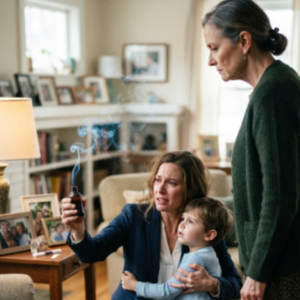
A bitter taste filled my mouth. Daniel depended on me, and I couldn’t let him down. The image of Bethany calmly spooning those ashes into his mouth, her serene smile, haunted my every waking moment. This wasn’t just about saving face; it was about protecting Daniel from a twisted belief that could actively harm him.
My mind, usually so orderly, felt like a chaotic storm. I needed a plan, something concrete to anchor myself to. Official help wasn’t an option right now. I had to create my own path forward.
That’s when a forgotten part of myself stirred. Before I’d settled into this quiet life, I’d briefly pursued forensic pathology in college, drawn to the quiet certainty of facts. I never finished the degree, but the meticulous process, the search for truth in cold, hard data, had always fascinated me. It was a strange, almost morbid interest, but now, it felt like the only weapon I had.
Public records. That was my starting point. Dad’s death certificate.
Bethany’s whole twisted “cure” rested on the idea that Dad’s “essence” held some spiritual power to heal Daniel, that his passing was somehow tied to a metaphysical shift she could harness. The scientific part of my brain screamed in protest. I needed to see what the official record said, to find the objective truth.
The Havenwood County Clerk’s office was a small, brick building next to the old post office. It smelled faintly of old paper and dust. I walked in, trying to appear as normal as possible, even as my stomach churned with anxiety. I could feel the invisible eyes of the town on me, judging every move.
Behind the counter, Mrs. Gable, a woman who had known my family my entire life, looked up from her computer. Her smile was polite, but her eyes held that familiar flicker of concern, the same kind I’d seen in Mrs. Henderson’s. It was confirmation that Bethany’s narrative had permeated even the most official corners of our small town.
“Leo,” she said, her voice soft, “how are you holding up, dear? It’s been a tough time.”
I forced a smile, a practiced mask I was becoming increasingly adept at wearing. “I’m doing my best, Mrs. Gable. Thank you. I actually need to request a copy of my father’s death certificate, if possible.”
She nodded, her expression shifting to one of mild curiosity, perhaps wondering why I needed another copy so soon after the funeral. She didn’t ask, though. In Havenwood, people often just assumed they knew the answers.
“Of course,” she replied, her fingers clicking on the keyboard. “Just a moment. You need the certified copy, I presume?”
“Yes, please,” I said, trying to keep my voice even. Every mundane interaction felt like walking on eggshells. I imagined her going home that night, telling her husband about Leo Albright, still so “unsettled” by his father’s death, poking around in official documents. The thought stung, a small, personal humiliation.
She typed for a few more minutes, then turned to a printer that whirred to life. The sound was surprisingly loud in the quiet office. She pulled a crisp white sheet from the tray.
“Here you go, Leo. That’ll be ten dollars.”
I handed over a ten-dollar bill, my fingers brushing against hers. She avoided my gaze, focusing instead on counting out imaginary change before pushing the certificate across the counter. It was a small act, but it spoke volumes. She was uncomfortable, unwilling to meet my eye, reinforcing the idea that I was someone to be handled with caution.
I took the document, my hand trembling slightly, despite my best efforts to appear calm. “Thank you, Mrs. Gable,” I managed, turning to leave.
I didn’t open it in the office. I couldn’t. I needed privacy, away from the watchful eyes and the unspoken judgments. I walked out into the cool autumn air, the paper clutched tightly in my hand. The street was quiet, a few cars parked along Main Street, but no one was outside. It felt like the perfect tableau of a town that looked peaceful on the surface, but harbored a thousand secrets beneath.
I got into my car, the worn leather seat feeling strangely cold against my leg. I took a deep breath, the scent of fallen leaves and distant woodsmoke filling my nostrils. Then, with deliberate care, I unfolded the death certificate.
My father’s full name, Arthur Albright, was printed clearly at the top. Below it, dates, places, all the standard information. My eyes scanned quickly, skipping past the familiar details of his life and death, heading straight for the section I needed.
Cause of Death.
The words jumped out at me, stark and unambiguous: “Severe Cardiomyopathy.”
Not spiritual depletion. Not a cosmic realignment. Not an “essence” that could be harvested. A diseased heart muscle. A purely physical, medical condition that had slowly and steadily taken his life.
The twist of it hit me with the force of a physical blow. Bethany’s entire, elaborate delusion, built on a foundation of pseudo-science and twisted grief, crumbled in that single, objective medical fact. There was no room for interpretation, no spiritual ambiguity. Just a doctor’s concise, factual diagnosis.
I read the words again, tracing them with my finger. “Severe Cardiomyopathy.” It was a cold, hard truth, unyielding and undeniable. The paper itself felt substantial, heavy with the weight of its authority. This wasn’t a rumor, or a whisper, or a manufactured narrative. This was a document, officially filed and verifiable.
Bethany had used our father’s passing, a moment of profound family grief, and twisted it into something grotesque and dangerous. She’d convinced herself that his very being, reduced to ash, could somehow fix Daniel. But the paper in my hand said otherwise. It said his body had simply failed, like any other human body, without any mystical intervention.
A wave of something akin to grim satisfaction washed over me, quickly followed by the crushing weight of reality. This was evidence, yes. Concrete, irrefutable. But how do you fight delusion with a death certificate? How do you argue against a belief that had clearly consumed someone entirely?
I refolded the certificate carefully, slipping it into my jacket pocket. It felt like a small, sharp weapon. My father, even in death, was still helping me. His medical reality, so ordinary and tragic, was now the first piece in dismantling Bethany’s extraordinary and dangerous fantasy.
The isolation hadn’t lifted, but now I had a tangible truth to hold onto. The pitying glances and the whispers didn’t sting as much anymore. They were simply noise, easily drowned out by the quiet certainty of the facts I now possessed. This was just the beginning. I knew I needed more, but at least now I wasn’t fighting shadows. I was fighting a concrete lie, backed by a very specific, mundane medical truth.
I started the car, the engine rumbling to life, and drove home. The certificate was a heavy presence in my pocket, a silent promise to Daniel.
More Stories



+ There are no comments
Add yours