
My Mother Covered Up My Sister's Abuse for Her Husband, and I Paid the Price for Exposing Her Decades Later.


The aroma of freshly brewed coffee hung heavy in the air, a stark contrast to the tension that crackled between us. I sat across from Deborah in her meticulously tidy living room, the small, leather-bound diary resting on the coffee table between us like a ticking bomb.
I’d called her, requesting a private meeting, my voice carefully neutral. She’d agreed, but her polite tone held a subtle edge, a pre-emptive defensiveness I knew all too well.
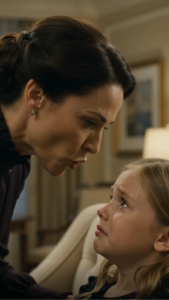
“Ellie, darling, what’s so urgent?” she asked, her smile a little too bright, a little too fixed. She placed a delicate ceramic mug in front of me, its warmth doing little to thaw the chill I felt.
“It’s about Chloe,” I began, my voice trembling despite my best efforts to keep it steady. “And Arthur.”
Deborah’s smile faltered, just for a second, before snapping back into place. Her eyes, usually so warm, grew cold and watchful.
“Chloe is fine,” she said, her voice even. “Just clumsy, as always. You know how she is.”
That familiar narrative. It struck me with fresh fury now, knowing its true origins.
“Mom, I found something,” I pushed, picking up the diary. My hand shook as I presented it, opened to the entries about the broken vase and the sprained wrist. “This is Chloe’s diary from when she was twelve. It talks about Arthur pushing her, about how her wrist was injured.”
Deborah barely glanced at the faded pages. Her eyes flickered over the small book, then back to my face. A dismissive wave of her hand followed, a gesture I remembered so clearly from my own childhood, used to brush away any uncomfortable truth.
“Oh, that old thing,” she said, a light, airy laugh escaping her lips. It sounded hollow, like breaking glass. “Chloe was such an imaginative child, always making up stories. You know, she used to tell me her dolls talked to her.”
I stared at her, dumbfounded. My jaw tightened.
“Mom, this isn’t about imaginary friends,” I insisted, my voice rising slightly. “This is about a physical injury. A sprain. From when Arthur pushed her.”
Deborah sighed, a long, put-upon sound. She reached for her coffee cup, taking a slow sip, as if I were merely inconveniencing her with trivial gossip.
“Ellie, honestly,” she said, her tone laced with exasperation. “Chloe was a sensitive girl. Prone to dramatizing. You remember how she’d cry for hours over a scraped knee? Everything was amplified with her.”
She was twisting the narrative, just as she always had. Blaming Chloe, painting her as overly sensitive, dramatic, unreliable.
“This matches what happened now,” I argued, leaning forward, my voice urgent. “The same injury. The same story you gave me. Don’t you see the pattern?”
Deborah’s gaze hardened. She set down her cup with a gentle clink, her fingers smoothing the fabric of her skirt. Her composure was unnerving, a shield against any truth she didn’t want to acknowledge.
“The pattern I see, Eleanor, is you trying to stir up trouble,” she said, her voice suddenly sharp, devoid of its previous airy quality. “Always looking for something wrong, something to criticize. My marriage to Arthur is a happy one. We have a peaceful home.”
“Peaceful?” I scoffed, unable to contain my disbelief. “At what cost? At Chloe’s cost?”
“Chloe is a grown woman,” Deborah stated, her eyes narrowing. “She’s perfectly capable of speaking for herself. She told you it was an accident, didn’t she? A slip. She was tired, she missed a step.”
“She was coached to say that, Mom!” I burst out, the words escaping before I could rein them in.
A flicker of something—fear? panic?—crossed Deborah’s face, quickly replaced by indignation.
“Coached?” she repeated, her voice rising now, echoing my own frustration. “What on earth are you suggesting? That I would lie about my own daughter’s well-being?”
“You did before,” I said, pointing to the diary. “It’s right here. You dismissed it as a fall then, too.”
Deborah stood up, moving away from the coffee table, creating physical distance between us. She walked over to the window, her back to me, looking out at her perfectly manicured garden.
“You’re being hysterical, Eleanor,” she said, her voice regaining its calm, albeit icy, tone. “You always were so dramatic. Just like Chloe. It’s exhausting, really. Trying to find fault where there is none.”
She turned back to me, her expression one of weary disappointment. “Are you happy now? Are you happy trying to ruin our peace? To sow discord in our family simply because you’re bored or looking for drama?”
The accusation stung, cutting deeper than I expected. She wasn’t just denying the truth; she was attacking my motives, twisting my concern into a malicious act. She was making me the villain, and herself the long-suffering victim of my meddling.
“I’m trying to protect Chloe,” I whispered, the fight draining from me, leaving behind a hollow ache.
“Chloe doesn’t need protecting from me or Arthur,” Deborah retorted. “She needs to learn to be more careful. And she certainly doesn’t need you filling her head with these old, childish fantasies.”
She gestured vaguely at the diary on the table. “I suggest you put that away, Eleanor. And perhaps focus on your own life. We’re doing just fine here.”
The finality in her voice, the complete brick wall of her denial, was crushing. There was no breaking through. No matter the evidence, no matter the pain, she was unyielding. Her reality was absolute, and any challenge to it was an attack she would deflect without a second thought.
I stood up slowly, the diary still on the table. I realized I couldn’t leave it there, not for a moment. It was Chloe’s truth, and Deborah would likely destroy it without a qualm.
“I can’t just ‘put it away,’ Mom,” I said, picking up the small book, its weight familiar now. “This isn’t going away.”
Deborah simply sighed again, a dismissive sound that was far more potent than any shouted word. She refused to meet my gaze, turning back to the window. It was a clear signal: the conversation was over. The subject was closed.
I walked out of her immaculate home, the diary clutched tightly in my hand, leaving behind the scent of coffee and an unshakeable feeling of profound disappointment. I had hoped for a glimmer of understanding, a crack in her denial. Instead, I had found only a reinforced wall, solid and impenetrable. The realization that my own mother would rather brand her daughter as imaginative and her other daughter as dramatic than face the truth about her husband was a bitter pill to swallow. I felt a cold dread about what would come next.
More Stories







+ There are no comments
Add yours