
Factory Worker Discovers Wife's Deceit After She Frames His Mother For Child Abuse With A Secret Camera In 1940s Home


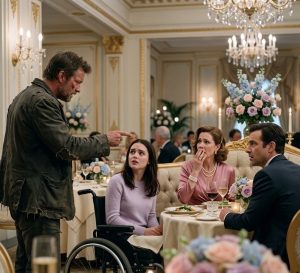
Sunday dinner at Aunt Beatrice’s house usually meant laughter, loud conversations, and the clatter of plates. Today, however, a subtle undercurrent of tension hummed beneath the surface, making Arthur feel like a stranger in his own family. He watched Tommy chase a ball around the small yard outside, a desperate longing for normalcy twisting in his gut.
Aunt Beatrice, Eleanor’s older sister, had a perpetually worried expression, her brows furrowed even when she smiled. She was known for her bustling hospitality and her insatiable appetite for gossip. Eleanor sat beside her, radiating a quiet, martyred grace that Arthur now found increasingly unsettling.
The conversation started innocently enough, revolving around rationing and the latest news from the war front. Arthur forced a smile, making small talk about his shifts at the munitions factory, all the while feeling the wooden bird in his pocket pressing against his thigh. He felt exposed, fragile.
Then, Eleanor steered the conversation with a practiced ease, her voice low and sympathetic.
“Mother Caldwell has been a bit… particular lately,” she began, her eyes cast down as if sharing a painful secret.
“With Robert gone, it’s just been so hard on her.”
Aunt Beatrice leaned in, her eyes wide with concern.
“Oh, Eleanor, dear, I noticed it too,” she said, her voice dropping to a theatrical whisper.
“Just last week, she swore she saw a squirrel trying to steal her knitting needles from the porch!”
Arthur felt a knot tighten in his stomach. Martha was many things—stoic, traditional, sometimes even a little sharp-tongued—but she was hardly senile. She was sharp as a tack, keenly observant, though often choosing to remain silent.
Another cousin, Clara, chimed in, recalling a time Martha had forgotten where she put her spectacles.
“She accused Uncle Fred of hiding them!” Clara said, letting out a small, nervous giggle.
“Of course, they were on her head the whole time.”
The room chuckled politely, but Arthur felt a cold dread begin to spread through him. These were isolated incidents, typical forgetfulness, exaggerated and presented as evidence of a deteriorating mind. He remembered Martha’s quiet dignity, her steadfast presence.
Eleanor sighed, a long, weary sound, and patted Aunt Beatrice’s hand.
“It’s just the stress of everything, I suppose,” she said, her voice laced with what sounded like genuine compassion.
“And Arthur, dear, he’s been so distant since Robert’s news. I worry for his nerves.”
Arthur felt every eye in the room turn to him. He could feel the judgment, the pity, the subtle shift in their regard. His grief, a raw and private wound, was being weaponized, twisted into a narrative of instability.
He cleared his throat, trying to find his voice.
“I’m fine, Eleanor,” he said, perhaps a little too sharply.
“Just tired from the factory.”
Eleanor gave him a small, sad smile, a gesture that only reinforced her portrayal of the suffering wife. Aunt Beatrice reached across the table to pat his arm, her expression a mix of sympathy and concern.
“We all understand, Arthur,” she said, her voice dripping with false understanding.
“The war takes its toll on everyone.”
He wanted to shout, to explain, to rail against the subtle injustice unfolding before him. But what could he say? The film, in his mind, still showed Martha’s culpability. His own outburst, fueled by grief, only reinforced their perception of his instability.
He felt the family’s distance growing, a chasm slowly opening between them and his mother. Martha sat quietly at the far end of the table, her gaze fixed on her plate, seemingly impervious to the whispers. But Arthur knew her too well. He saw the faint tremor in her hand as she lifted her fork.
Later, as they were clearing the plates, Aunt Beatrice pulled Arthur aside, her voice hushed.
“Eleanor is truly a saint, Arthur,” she whispered, her eyes wide.
“Handling so much. Your mother’s… condition. Your own grief.”
She paused, then lowered her voice further.
“And dear Tommy, bless his heart, he’s such a sensitive boy. All this tension can’t be good for him.”
Arthur felt a surge of cold fury. This was Eleanor’s doing, this slow, insidious poisoning of his family’s minds. She was painting him as unhinged, Martha as senile, and herself as the long-suffering heroine.
“My mother is not senile,” Arthur said, his voice low and tight.
“And my nerves are fine.”
Aunt Beatrice patted his arm again, a gesture of condescending comfort.
“Of course, dear,” she said, her eyes betraying her true thoughts.
“We all have our struggles. Just take care of Eleanor. She’s doing her best.”
He watched Eleanor from across the room, smiling sweetly as she helped clear the table, her demeanor utterly composed. She caught his eye and offered a small, reassuring smile that sent a shiver down his spine. It was a perfect performance.
The isolation was palpable. His own family, swayed by Eleanor’s quiet machinations, was slowly turning against his mother and, by extension, against him. He felt trapped, caught between the damning evidence of the film and the growing certainty that Eleanor was not who he thought she was.
He saw Martha get up to help with the dishes, her back ramrod straight. No one offered to help her. They simply watched, their faces a mixture of pity and vague discomfort. The distance Eleanor had carefully cultivated had already begun to take root.
Arthur longed to tell Martha everything, to warn her, but the unspoken accusation of the film still hung heavy between them. He felt a profound sense of loneliness, a growing certainty that he was navigating this treacherous terrain alone. His trust had been shattered, first by the belief in his mother’s cruelty, and now, more terrifyingly, by the dawning realization of his wife’s deceit.
More Stories














+ There are no comments
Add yours