
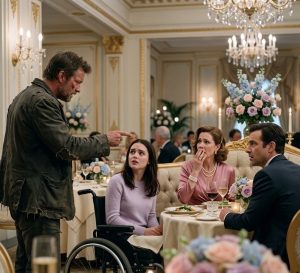
The CEO sister shamed me for my wheelchair at her gala, then I found a microfiche revealing our family's darkest secret.


Elara’s voice was barely a whisper as she continued to read, each word from Marcus Thorne’s journal carving a fresh wound into my heart. The cold dread that had settled in my chest hardened into a knot of icy fury. My vision blurred not from tears, but from the intensity of the emotions churning within me.
“8:06 AM,” Elara read. “Senior Researcher E.R. exhibited immediate and severe neurological compromise. Witnessed motor control degradation, slurred speech, acute disorientation, and ocular nystagmus. Assisted her to emergency decontamination. Her condition deteriorated rapidly within minutes of exposure.”
My breath hitched. The clinical detachment of Thorne’s words did nothing to soften the brutal reality they conveyed. I remembered the headache, a splitting pain behind my eyes, the sudden weakness in my limbs, the world tilting precariously. But those memories had always been attributed to the shock, the trauma of the incident itself, never to direct neurotoxin exposure. The doctors, my family, everyone had echoed the same comforting, insidious lie.
“Subsequent entries describe your hospital admission,” Elara continued, her voice trembling slightly now. “Thorne meticulously documented your initial prognosis: ‘high probability of permanent neurological sequelae due to significant TX-9 absorption.’ He noted the unusual speed and severity of the symptoms, consistent with a direct, concentrated exposure.”
My hands clenched the tablet, my knuckles white. Thorne had known. He had meticulously recorded the truth. He had seen my sacrifice, witnessed my immediate decline, understood its cause. And yet, this journal was hidden, buried, a ghost of truth no one was meant to find.
“Then… then what happened?” I demanded, my voice raw. “Why was it never reported as such? Why did everyone tell me it was something else?”
Elara scrolled, her eyes scanning the faded script. “Here it is. Dated two days after the incident. ‘Hospital administration issued preliminary findings: Senior Researcher E.R.’s symptoms attributed to an unrelated, previously undiagnosed autoimmune disorder, exacerbated by the stress of the incident. All evidence of direct TX-9 exposure dismissed. Junior Researcher S.R.’s involvement in the containment breach omitted entirely from the official incident report. A gross miscarriage of scientific integrity.'”
A guttural cry escaped me, a sound I barely recognized as my own. Unrelated autoimmune disorder. That had been the official diagnosis. The one that explained my gradual decline, the one that eased everyone’s conscience. It was a convenient fiction, designed to protect reputations, to preserve an image. And I, in my confusion, my pain, my unwavering trust in my family and my institution, had believed it.
“They lied,” I whispered, the words tasting like ash in my mouth. “They all lied. My own family. My colleagues. They let me believe… for twenty-five years.” The weight of those years pressed down on me, the lost career, the chronic pain, the increasing dependency, all under the shadow of a lie.
Elara looked up, her eyes wide with a shared horror. “Dr. Reed, this is… it’s beyond belief.”
“Beyond belief, but true,” I said, a bitter laugh escaping me. “Sarah’s career. My father’s legacy. It was all more important than the truth. More important than my life.” My mind replayed Sarah’s subtle digs at the gala, her insinuation that my memory was failing. It wasn’t just gaslighting in the present; it was a sustained, decades-long campaign. They had gaslit me into believing my own body was betraying me naturally, when in fact it was a living monument to their betrayal.
I remembered the quiet hospital room, the soft-spoken doctors, my parents’ grave faces. They had seemed so concerned, so sympathetic. But it was all a performance, a carefully orchestrated deceit. My father, the esteemed Dr. Alistair Reed, former Dean of Medicine, pillar of the community, had overseen the cover-up. My mother, the brilliant Dr. Eleanor Reed, a renowned researcher, had remained silent.
“What else does he say?” I asked, my voice now steady, a cold determination replacing the initial shock. “Does he explain why?”
Elara continued, her finger tracing the screen. “Thorne writes about his profound ethical dilemma. He states he was pressured to ‘revise’ his initial assessment. He hints at ‘considerations beyond scientific accuracy’ influencing the final report. He expresses regret, a deep sense of moral compromise.”
“Considerations beyond scientific accuracy,” I repeated, the phrase dripping with venom. It was the elegant way of saying, “We buried the truth to save Sarah’s career and protect the family name.”
The image of Sarah at the gala, radiant and confident, accepting accolades, swam before my eyes. All built on my sacrifice. All built on a lie. And the very chair I sat in, the body that ached and failed me every day, was a constant, living testament to that lie. Thorne’s journal was not just a record; it was an accusation. And for the first time in twenty-five years, I felt a spark of something other than despair: a fierce, burning need for justice.
More Stories






+ There are no comments
Add yours