
His Sister's Kindness Uncovered My Boss's Eleven-Year Cover-Up After My Father's Death, Shattering Our Small Town's Illusion


The drive from the archives to the small office of Mr. Harrison, a forensic document examiner on the outskirts of Harmony Creek, felt interminable. Arthur clutched a photocopy of the suspicious annex page, the original document still safely returned to the archives. He knew the photocopy wouldn’t be definitive, but it was enough for an initial consultation.
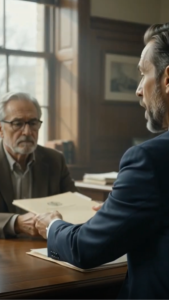
Mr. Harrison’s office was cramped, filled with specialized equipment: microscopes, UV lights, and shelves overflowing with samples of old inks and papers. Mr. Harrison himself was a wiry man with a neatly trimmed beard and sharp, patient eyes that seemed to miss nothing.
Arthur laid the photocopy on the counter, explaining his concerns carefully, omitting the more dramatic elements for now. “I’m looking into this old partnership agreement,” he began. “My father was a partner. I noticed what seems to be a discrepancy in the initials on this annex.”
Mr. Harrison picked up the photocopy, placing it under a magnifying glass. He studied the “M.J.” initials and the surrounding text for a long moment, humming softly to himself.
“Hmm,” he murmured. “Interesting. Even on a photocopy, the ink saturation here is slightly different. And the pressure points of the pen stroke… definitely not consistent with the rest of the document’s original hand.”
Arthur felt a flicker of triumph, quickly doused by a deeper sense of dread. This was real.
“I have access to the original document, if you need it for a full analysis,” Arthur offered, trying to keep his voice even.
“That would be ideal, Mr. Bellamy,” Harrison replied, looking up. “With the original, I can use infrared spectroscopy and micro-densitometry to analyze ink composition and age. And a microscopic examination of the paper fibers could tell us if there’s been any erasure.”
A week later, Arthur returned to Mr. Harrison’s office, this time with the original, heavy Harmony Creek Land Partnership Agreement carefully checked out from the archives. The formal process of obtaining it had been tedious, requiring multiple forms and a supervisor’s approval, but Arthur was relentless. Brenda at the archive had given him a weary, suspicious look, but hadn’t stopped him.
Mr. Harrison spent two full days with the document, Arthur waiting anxiously for his call. When it finally came, Arthur felt his hand tremble as he picked up the phone.
“Mr. Bellamy,” Harrison’s voice was calm, professional. “I have my findings. Can you come in?”
Arthur arrived within minutes. Mr. Harrison had the document open on his examination table, under a powerful light.
“As suspected from the photocopy,” he began, gesturing to the annex with a gloved hand, “the initials ‘M.J.’ were indeed added after the original signing of this annex. The ink, while similar in color, has a distinct chemical composition. My analysis indicates it’s from a different batch, likely a different manufacturer, and was applied approximately five to eight years after the primary document was penned. This doesn’t match the dating of the original document, which would place your father’s signature as contemporary with the main body.”
Arthur stared at the initials, now starkly highlighted under the light. Five to eight years *after* his father’s death. This meant Marcus had altered it, not his father. This was not a “misunderstanding.” This was cold, calculated fraud. The casual, almost sloppy nature of the initialing, as if done without fear of discovery, felt like a fresh insult to his father’s memory.
“The signature itself,” Harrison continued, zooming in with a small, handheld digital microscope and displaying the image on a monitor. “The pen pressure, the unique flourishes—these are consistent with other known signatures of Marcus Jensen, which I cross-referenced from public records. It is, beyond a reasonable doubt, Marcus Jensen’s initial, not your father’s.”
A wave of shock washed over Arthur, immediately followed by a chilling certainty. His suspicions were not paranoid fantasies. They were horrifyingly real. Marcus, his charismatic boss, the pillar of the community, had actively defrauded his own business partner, Arthur’s father.
“But there’s more,” Mr. Harrison said, his voice dropping slightly. He carefully turned a few pages back, pointing to the barely perceptible indentation Arthur had noticed earlier. “On this preceding page, outlining the original, more favorable terms for your father’s share…”
He switched on a UV light, and suddenly, a faint, ghostly outline appeared where Arthur had only seen an indentation. It was a partial signature, and some faint, almost invisible letters.
“I found traces of chemical erasures here,” Harrison explained. “Someone meticulously removed a section of text. The UV light reveals residual ink from what appears to be your father’s full signature, and some wording detailing a more significant equity stake.”
He pointed to a specific, faint imprint. “It looks like an original clause that would have granted your father a more substantial percentage of future profits, likely tied to specific development milestones. It was carefully, almost professionally, removed. This kind of erasure is typically done to obscure original terms that are disadvantageous to the party performing the alteration.”
Arthur felt the blood drain from his face. This wasn’t just an alteration of an initial on an annex. This was a deliberate, sophisticated act of stripping his father of his rightful, more substantial share, erasing it from the primary document, and then clumsily initialing a less favorable annex years later. The scale of the deceit was staggering. It confirmed his worst fears. His father hadn’t just been “cornered” into a bad deal. He had been systematically fleeced, his legacy deliberately sabotaged.
The erased clause, the hidden signature, the altered initial – it all painted a picture of Marcus Jensen systematically dismantling his father’s claim. It was an act of profound disrespect, stripping away his father’s work and trust and replacing it with a lie.
“So,” Arthur managed, his voice hoarse, “Marcus Jensen changed the original agreement and then altered the annex to reflect a reduced share, well after my father would have been able to dispute it.”
Mr. Harrison nodded gravely. “That is the professional conclusion based on the evidence, Mr. Bellamy. It’s a clear case of document tampering, designed to alter the original terms of a binding agreement.”
Arthur stood there, reeling. The air in the small office felt heavy, suffocating. The meticulous, almost invisible erasure of his father’s original, more favorable terms felt like a personal attack, a deliberate attempt to make his father’s contribution disappear into thin air. It was a calculated insult, a statement of power and contempt, far more insidious than a simple forged signature. His father’s “lost legacy” wasn’t merely lost; it had been stolen, systematically and with cold precision.
He thanked Mr. Harrison, his mind already racing. He held the document, no longer seeing just paper and ink, but a roadmap of betrayal. The realization solidified: Marcus was not just a greedy businessman. He was a fraudster, and he had stolen from Arthur’s father. The weight of this truth settled on Arthur’s shoulders, heavy and cold. He had the proof, but what could he do with it? This was Harmony Creek, where Marcus Jensen was king. Arthur knew he had to tread carefully.
More Stories





+ There are no comments
Add yours