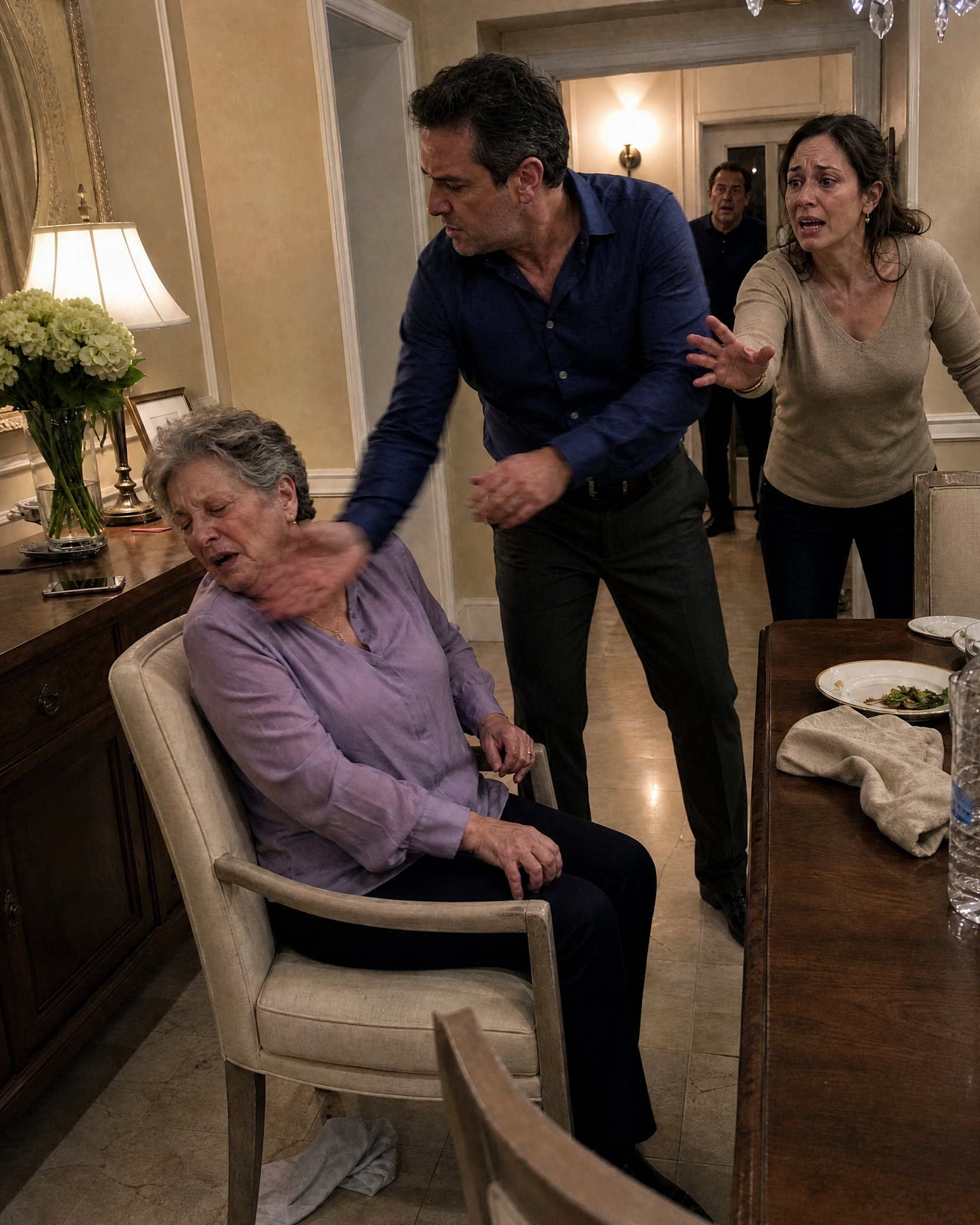
My Son Struck Me 30 Times, So I Sold the Family Estate He Thought Was His Birthright


The following Tuesday, I arrived at the Hawthorne Club, a bastion of old-money tradition, for my weekly bridge game. The ornate chandeliers, the hushed conversations, the familiar scent of polished wood and expensive perfume – it was a world I had inhabited my entire life, a world where unspoken rules held more power than any written law. Today, however, those rules felt different, bent, and stretched by Serena’s insidious campaign.
I walked to our usual table, Clara Beaumont already seated, her shrewd eyes meeting mine with a knowing glint. Mrs. Albright and Mrs. Henderson, our other regular partners, were arranging their cards, their backs rigid. The silence that greeted me was not one of welcome, but of deliberate avoidance. It was as palpable as a physical blow.
“Evelyn,” Clara said, her voice unwavering, a small act of defiance. “You’re just in time for the rubber.”
Mrs. Albright cleared her throat, her gaze fixed intently on her cards. She didn’t look up, didn’t offer her usual polite pleasantry. Mrs. Henderson simply gave a curt nod, her lips pressed into a thin line. This was the first wave, the subtle ostracization Serena had engineered.
As we began to play, the usual lighthearted banter was absent. Every card laid down, every bid, felt charged with unspoken tension. Then, Mrs. Albright spoke, her voice clear and carrying, though ostensibly directed at no one in particular.
“It truly is a tragedy,” she mused, adjusting her spectacles, “when families allow themselves to be fractured. Such a delicate balance, is it not? Especially when dealing with… legacies. One must always consider the importance of familial unity above all else, for the sake of the children.”
She paused, her eyes finally flicking to mine for a fraction of a second, a thinly veiled jab that was anything but subtle. It was a perfectly pitched social cruelty, delivered with the outward politeness of their class, yet designed to wound. Her words were a judgment, a public condemnation wrapped in the guise of a philosophical observation. It echoed Serena’s insinuations, reinforcing the narrative that I was destabilizing the family.
My fingers, usually nimble, felt momentarily clumsy as I picked up my cards. I arranged them with deliberate slowness. To respond would be to acknowledge the attack, to descend into the petty bickering she clearly sought to provoke. That was Serena’s game, not mine.
“Indeed, Mrs. Albright,” I replied, my voice calm, betraying none of the cold fury that churned within me. “Unity is paramount, provided it is built on a foundation of respect. Without that, it is merely an illusion.”
Mrs. Henderson shifted uncomfortably in her seat, her gaze darting between us. Clara, however, gave a almost imperceptible nod of approval. She understood that sometimes, the most powerful response was to remain composed, to refuse to be drawn into the mud-slinging.
Throughout the afternoon, the coldness persisted. Conversations would halt as I approached, only to resume in hushed tones after I passed. Some acquaintances offered strained smiles, their eyes betraying a mixture of curiosity and judgment. Others, like Mrs. Albright, maintained a deliberate distance, their body language a clear message of disapproval. Each glance, each averted gaze, each hushed whisper felt like a deliberate chip at my dignity, another layer of Serena’s social warfare.
This was a different kind of pain than Marcus’s physical assault. This was the slow, agonizing burn of social exclusion, designed to isolate me, to make me feel an outcast in my own world. Serena understood that for women of our generation and standing, social capital was as valuable as financial capital. To be cast out, even subtly, was a profound punishment.
I played my cards with precision, winning more often than not, a small, internal victory. My mind, however, was not entirely on the game. I was observing, calculating. I recognized the effectiveness of Serena’s strategy. She wasn’t just spreading rumors; she was leveraging the established hierarchy, turning my peers into unwitting accomplices in her gaslighting campaign.
As the bridge game concluded, Mrs. Albright and Mrs. Henderson quickly made their excuses, avoiding my eye as they gathered their things. Clara, however, lingered.
“Evelyn,” she said, her voice low once the others were out of earshot. “That was quite the performance from Mrs. Albright. Serena’s been busy.”
“Indeed,” I replied, meeting her gaze. “She plays a dangerous game.”
“And you handled it beautifully,” Clara added, a genuine admiration in her tone. “To respond with such grace, in the face of such calculated rudeness… many would have buckled.”
“Buckling would only confirm their suspicions,” I said, a wry smile touching my lips. “And I refuse to give her that satisfaction.”
I knew this was just the beginning. Serena would continue to chip away at my social standing, to reinforce the narrative of my instability. But as I left the Hawthorne Club, the cool autumn air a refreshing balm, I carried with me a quiet resolve. I would not be drawn into her public spat. I would meet her quiet cruelty with quiet dignity, allowing her venom to curdle on its own without the satisfaction of my overt distress. This was a battle of wills, and I was prepared for the long, silent fight ahead.
More Stories
















+ There are no comments
Add yours