The chill from Mr. Cao’s office followed me home, settling in my bones. His threats, thinly veiled but potent, replayed in my mind like a sinister loop. I tried to shake them off, to focus on the day-to-day operations of Phở Quê Hương, but an invisible hand seemed to be squeezing the life out of everything.
The first sign came subtly. Mrs. Le, who had eaten phở at our restaurant every Tuesday for fifteen years, walked past our storefront without so much as a glance. She then entered “Noodle House 88,” a new, brightly lit place two blocks down that offered a more modern, fusion menu. It was a minor incident, but it pricked me.
The next day, Mr. Hai, a retired tailor who always ordered our bún chả giò, came in, but instead of his usual warm greeting, he averted his gaze. He ordered quickly, his voice clipped, then left with his takeout, not lingering for the customary chat. His usual five-dollar tip for the counter staff was replaced by exact change.
“Did I say something wrong?” I asked the young woman at the counter, Linh’s cousin, Huong.
Huong shrugged, looking down. “He didn’t seem happy, Auntie Hoa. But he didn’t say why.”
The trickle of lost customers slowly turned into a stream. Conversations I overheard in the market grew hushed when I approached. My quiet presence, once seen as respectful, was now whispered about as “secretive” or “unfriendly.” Mr. Cao’s subtle campaign of whispers was taking root.
One afternoon, Uncle Thien arrived at the restaurant, his face etched with a familiar mixture of anxiety and self-importance. He rarely came in unless he had “important news” from Mr. Cao.
“Hoa,” he began, without preamble, “I’ve been speaking with Mr. Cao. He’s very concerned about your resistance.”
I put down the cleaver I was using to slice herbs, wiping my hands on my apron. “Concerned about his own scheme, you mean.”
Uncle Thien bristled. “He is looking out for our family, Hoa! He cares about our financial future, unlike you, stuck in the past.” He paused, lowering his voice conspiratorially. “He says people are talking. About your ‘stubbornness.’ About your ‘disrespect for the community’s progress.'”
“Mr. Cao is manufacturing those talks,” I said, my voice tight. “He is destroying our reputation and turning our own neighbors against us.”
Uncle Thien scoffed, waving his hand dismissively. “Nonsense. He’s a respected elder. He has only the best intentions. He told me he’s even heard from the city council. They’re very interested in the ‘revitalization’ he’s proposing for this block.”
He leaned in, his voice hushed. “He mentioned something about inspections. Just a standard check-up, he said, but you know how these things can go if you’re not cooperative.”
He didn’t mention the threats to our licenses or immigration, but the implication was clear. He had been thoroughly swayed, not just by financial anxiety, but by Mr. Cao’s insidious hints of official scrutiny. The mention of “inspections” was a cruel echo of Mr. Cao’s direct threat.
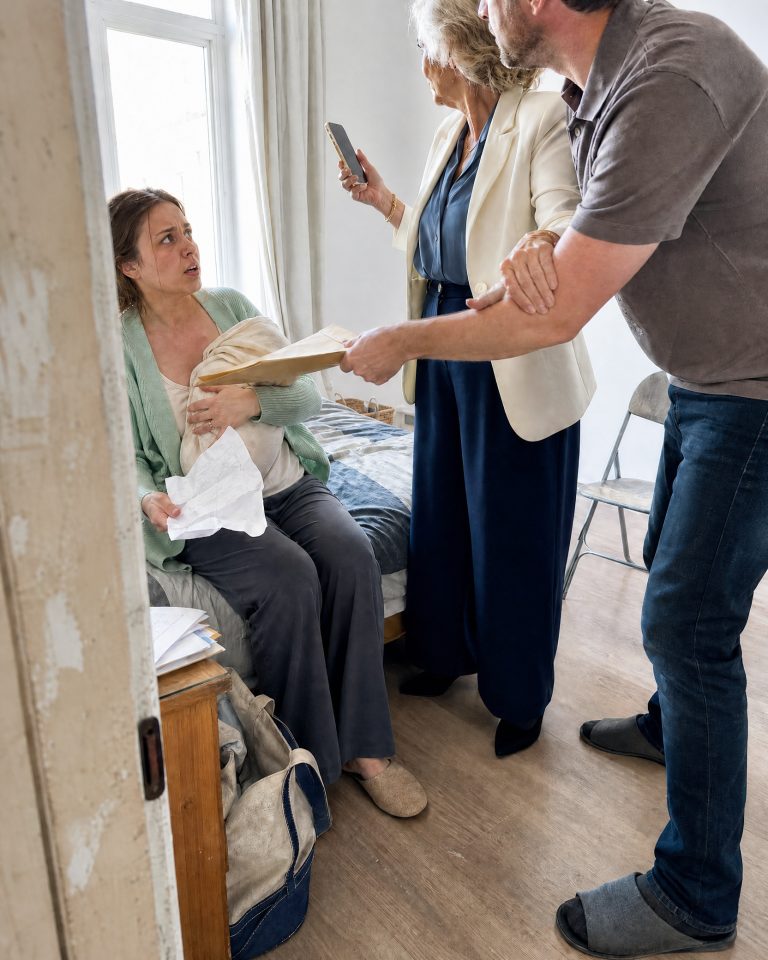
Later that week, Cousin Mai arrived. She usually only showed up to complain about the restaurant’s “lack of modernity.” Today, her expression was unusually severe.
“Hoa, we need to talk,” she said, crossing her arms. “Seriously. Uncle Thien told me everything.”
“Everything?” I asked, already bracing myself.
“Yes, about how you’re holding up this entire development,” she snapped. “Mr. Cao explained it to me. He said your refusal is directly impacting the whole community’s chance for real prosperity.”
“He’s lying, Mai,” I said, trying to keep my voice even. “He’s doing this for his own gain, using his nephew to front a shell company.”
Mai laughed, a sharp, dismissive sound. “A shell company? Please, Hoa. You’re getting paranoid. Mr. Cao is a pillar of this community. He’s trying to help us sell this outdated building for a fortune, and you’re making up conspiracy theories.”
She gestured around the restaurant, her eyes filled with thinly veiled contempt. “Look at this place! It’s old, it’s tired. We could be sitting on a goldmine. Imagine the money! You could finally do something with your life, something modern.”
Her words were a direct assault on my parents’ legacy, echoing Mr. Cao’s own contempt. She saw the restaurant not as a cultural anchor but as a financial burden, a symbol of stagnation. Her modern ambitions had completely blinded her to Mr. Cao’s manipulation.
“This restaurant is our history, Mai,” I said, my voice heavy with emotion. “It’s more than money.”
“It’s just an old building, Hoa!” she retorted, exasperated. “Get over it. Mr. Cao is right. You’re stuck in the past, and you’re dragging us all down with you.”
She shook her head, turning to leave. “Think about it. Think about the family. We all want this. Why are you the only one who can’t see it?”
She walked out, leaving me alone in the suddenly too-quiet restaurant. The air felt thick with resentment, not just from my family, but from the community itself. Mr. Cao was expertly isolating me, turning my loved ones and my neighbors into instruments of his will. The cracks in the community were widening, and I felt myself slipping into a deeper, colder solitude.
The bell above the door chimed softly, but no one entered. The silence was deafening, a testament to the success of Mr. Cao’s subtle campaign. I looked around at the empty tables, the chairs neatly stacked, the vibrant murals depicting Vietnamese village life now seeming faded and forlorn. He was not just targeting my business; he was targeting my connections, my reputation, my very place within the community. He was succeeding. And I didn’t know how to stop the bleeding.




+ There are no comments
Add yours