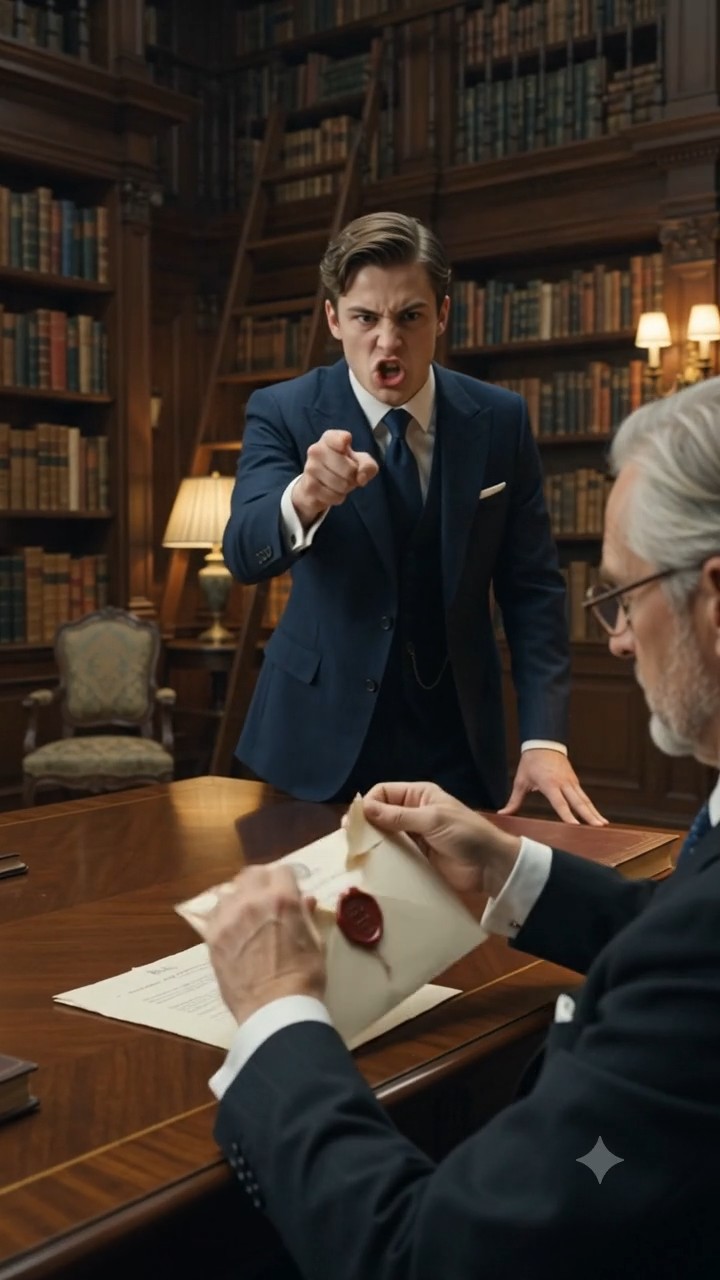
You're nothing but an eighteen-year-old leech who enticed an eighty-year-old dying woman for her forty-million-dollar estate, my closest friend Carter shouted at me across the mahogany funeral re...


While I delved into old family whispers, Carter Pendelton was making his own moves. He wasted no time exercising his “right” to have Dupont Manor appraised, even with the seven-day stay. He insisted it was merely due diligence, but I knew it was a thinly veiled attempt to intimidate me and gather ammunition for his legal battle.
His chosen appraiser was Genevieve Vance. I saw her walking the grounds, a woman in her mid-thirties with a no-nonsense demeanor, her hair pulled back tightly in a severe bun. She carried a clipboard and a laser measuring device, moving with a professional detachment that felt chilling.
I watched her from a distance as she meticulously documented every room, every fixture. She made notes, took photos, and frequently referred to a thick file she carried. Her presence felt like a violation, a silent invasion of Victoria’s sacred space.
A few days into her assessment, I overheard her speaking on the phone from the veranda, her voice low and sharp.
“Yes, Mr. Pendelton, I assure you I’m being thorough,” she said, a hint of strain in her voice. “The square footage is clear, but the… historical markers… are not aligning.”
She paused, listening intently. “No, there’s no evidence of a recent full-scale renovation in the west wing. Not anything that would justify a sudden spike in valuation for structural improvements.”
My ears perked up. The west wing. The same section of the house where Lily and I had found the discrepancy on the blueprint.
“The permits on record simply don’t match the current structural configuration,” Genevieve continued, her voice dropping even further, almost a whisper. “Specifically, the 1995 annex permit shows a different interior layout. There’s a section, a significant area, not accounted for on the city’s updated plans.”
She was talking about a missing room. The hidden room Lily had pointed out.
“It’s like this section of the house just… vanished from the official records after that specific year,” Genevieve muttered, more to herself than to the person on the other end.
A sudden, sharp burst of static cut her off, and she pulled the phone away from her ear, frowning. She glanced around, as if sensing she was being watched. Her eyes briefly met mine across the lawn, and she quickly looked away, a flicker of something unreadable in her gaze.
Later that afternoon, I saw her poring over large, rolled-up maps in Victoria’s dusty study, comparing them to her own notes. She pulled out a magnifying glass, tracing lines on a faded county plat map.
She shook her head, muttering. “This isn’t right. The original markers, the boundary lines… they suggest a different ownership history, or at least a contested one, that isn’t publicly recorded.”
She was clearly frustrated. The property’s recorded history, as far as I could tell from her snippets, seemed to diverge from the physical reality of the manor and the city’s official records. Carter’s projected appraisal, I suspected, relied on a clean, modern history, free of any encumbrances or historical anomalies.
But Genevieve Vance, it seemed, was discovering that Dupont Manor was far from clean. The discrepancies she was finding didn’t just affect the valuation; they hinted at a much deeper, more complicated secret embedded in the very foundations of the estate.
More Stories

















+ There are no comments
Add yours