
Her Old Money "Friend" Used My Baby To Boost His Image.


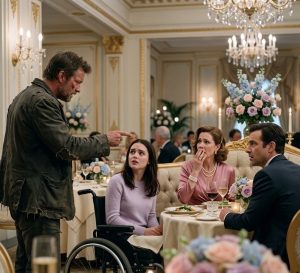
My new “promotion” to Aunt Beatrice’s assistant was exactly as I had feared. My days were a blur of social obligations: charity luncheons, gallery openings, foundation dinners. I learned the precise art of holding a tray of champagne flutes while simultaneously pretending not to hear the subtle snubs aimed at me.
Aunt Beatrice was a formidable taskmaster. Her demands were endless, her critiques cutting. She ensured I was always impeccably dressed, always quiet, always available, yet always subtly reminded of my place. I was her shadow, her silent prop, always under her watchful eye.
She introduced me to her friends as “Julian’s latest philanthropic success story, Elara. A truly resilient young woman.” Her words, meant to praise, felt like a public branding, a badge of my status as a “beneficiary object.” Every elegant smile from Aunt Beatrice felt like a barb.
I knew this was Julian’s doing, a calculated move to keep me both visible and utterly controlled. He had understood my attempt to gather evidence, and he was now ensuring I had no further opportunities, no privacy, and no contact with anyone who might help me.
Then, the articles started appearing.
First, it was a small blurb in a local society column, tucked away near the fashion pages. It spoke of Julian’s unparalleled generosity. “The Caldwell Foundation,” it gushed, “continues its selfless work, extending a benevolent hand to those in genuine need, transforming lives with quiet compassion.”
Nothing unusual, Julian always orchestrated glowing press. But a few days later, a longer piece emerged in a rival, slightly more salacious gossip column. This one hit me like a physical blow.
The headline screamed: “Caldwell Charity Case Accused of Ungrateful Exploitation: Is Julian’s Kindness Being Abused?”
My blood ran cold. The article detailed a fabricated narrative, painting me as an opportunistic single mother who was taking advantage of the Caldwells’ profound generosity. It described my supposed “demands” for a larger apartment, my “unprofessional conduct” at foundation events, and my “entitled attitude” toward my “benefactors.”
It was a blatant smear campaign.
The article quoted “anonymous foundation insiders,” whose words echoed Aunt Beatrice’s earlier whispers, and even Cousin Richard’s nervous evasiveness. “Some beneficiaries mistake kindness for weakness,” one anonymous source was quoted as saying. “They become accustomed to the gilded life, forgetting the true meaning of gratitude.”
Another quote, attributed to a “prominent board member,” lamented, “It’s disheartening when our efforts to uplift are met with such… disregard for protocol.” I knew, with a sickening certainty, that this was Julian. He was orchestrating this, silencing me by ruining my reputation. He was doing to me exactly what Marcus Hayes had detailed in his journal.
I dropped the newspaper onto my small kitchen table, my hands trembling. Leo, thankfully, was asleep. The words swam before my eyes, each one a poisoned arrow. *Ungrateful. Opportunistic. Exploiting.* It was a deliberate, brutal assault on my character, designed to discredit me entirely.
My phone rang. It was one of the other mothers, a woman I had tried to befriend weeks ago, before Aunt Beatrice’s subtle sabotage.
“Elara,” her voice was hesitant, almost apologetic. “I… I just read the article. I’m so sorry. I didn’t want to believe it, but…”
“But what?” I asked, my voice raw.
“It’s just… with everything I’ve heard,” she stammered, “and Julian has been so good to us. The Foundation really helps.”
She was retracting. Distancing herself. Julian’s campaign was working. She, like so many others, would choose to believe the narrative of the generous benefactor over the struggling, “ungrateful” recipient.
“I understand,” I said, a bitter taste in my mouth. “Don’t worry about it.”
I hung up, feeling a fresh wave of despair wash over me. Julian wasn’t just controlling my movements; he was controlling my story. He was poisoning the well, ensuring that anyone who might have offered me genuine support would now view me with suspicion or contempt.
The next few days were a living hell. At Aunt Beatrice’s events, I noticed the subtle shifts in conversation. Whispers died down as I approached. Eyes glanced at me with a mixture of pity and disdain. Society matrons who had once offered polite, if distant, greetings now averted their gazes entirely.
Aunt Beatrice, of course, was unfazed. She moved through these circles with supreme confidence, occasionally making a pointed comment about “certain individuals who struggle with appreciation” within my hearing, a thinly veiled reference to the article.
“It is a shame,” she remarked to a group of ladies at a tea party, her voice carefully modulated for maximum effect, “when generosity is misunderstood. Some people simply lack the grace to accept charity without demanding more.”
Her eyes flickered to me, a cold, knowing glint. I kept my face blank, my hands steady as I poured tea. But inside, I felt a scream building.
Julian, meanwhile, was nowhere to be seen at these minor functions. He was too important for them. But his influence was everywhere. His ghost, his words, permeated every interaction.
The isolation became absolute. My phone, which had once received nervous calls from fellow beneficiaries, now remained silent. The few friends I had from outside the Caldwell orbit, sensing the social contagion, slowly drifted away. Who wanted to be associated with someone branded as an “ungrateful charity case” by one of the city’s most powerful families?
I spent my evenings poring over Marcus Hayes’s journal again, finding grim solace in his words. He had detailed similar experiences: the fabricated stories, the subtle social ostracization, the feeling of being gaslit by the entire community.
*He makes you question your own sanity,* Marcus had written. *He isolates you so effectively that you begin to wonder if you truly are the villain he paints you to be.*
His words resonated with a painful truth. I felt a profound sense of despair. Julian had systematically stripped away my dignity, my credibility, and my social support network. He had proven that he could control not just my life, but my narrative, ensuring that anyone who heard my side of the story would immediately dismiss it as the bitter complaints of an ungrateful recipient.
One evening, unable to sleep, I sat by Leo’s crib, watching his innocent face. The thought of him growing up in the shadow of this smear, branded by Julian’s cruelty, filled me with a fresh surge of quiet fury. I had to fight back. Not just for myself, but for Leo. He deserved better than to have his mother’s name dragged through the mud by a narcissistic manipulator.
But how? Julian controlled the narrative. He controlled the media. He controlled the people around him. My tiny voice recorder had been useless. My attempts to connect with others had been thwarted. What else could I do?
The despair was overwhelming, a heavy blanket threatening to suffocate me. I was trapped, wounded, and utterly alone against a man who wielded immense power with ruthless precision. He had demonstrated his ability to crush any resistance, not with overt aggression, but with insidious, reputation-destroying tactics.
The fear was potent, but underneath it, a stubborn flicker of defiance refused to be extinguished. I might be down, but I wasn’t out. The article had revealed the depth of his cruelty, but it had also clarified the battleground. This wasn’t a game of polite society anymore. It was a fight for survival, a fight for my truth against his manufactured lies.
I knew that a direct confrontation was suicide. Julian thrived on power imbalances, on controlling the stage. I needed to find a different path, an indirect route. Something that would bypass his carefully constructed defenses.
My mind, though weary, began to churn. I looked at the old, worn journal lying on my table. Marcus Hayes had been defeated, but he had left a message. He had believed someone would eventually see through Julian’s facade. Maybe, just maybe, that someone was still out there.
The silence of the apartment pressed in on me, heavy with the weight of my shame and Julian’s triumph. But in that silence, a seed of resolve began to sprout. I was an ungrateful, opportunistic single mother in their eyes. Fine. Let them think that. It meant they wouldn’t see what was coming next.
He had painted me as a villain in his story. Now, I would start writing my own. And in my story, villains eventually faced justice.
More Stories









+ There are no comments
Add yours