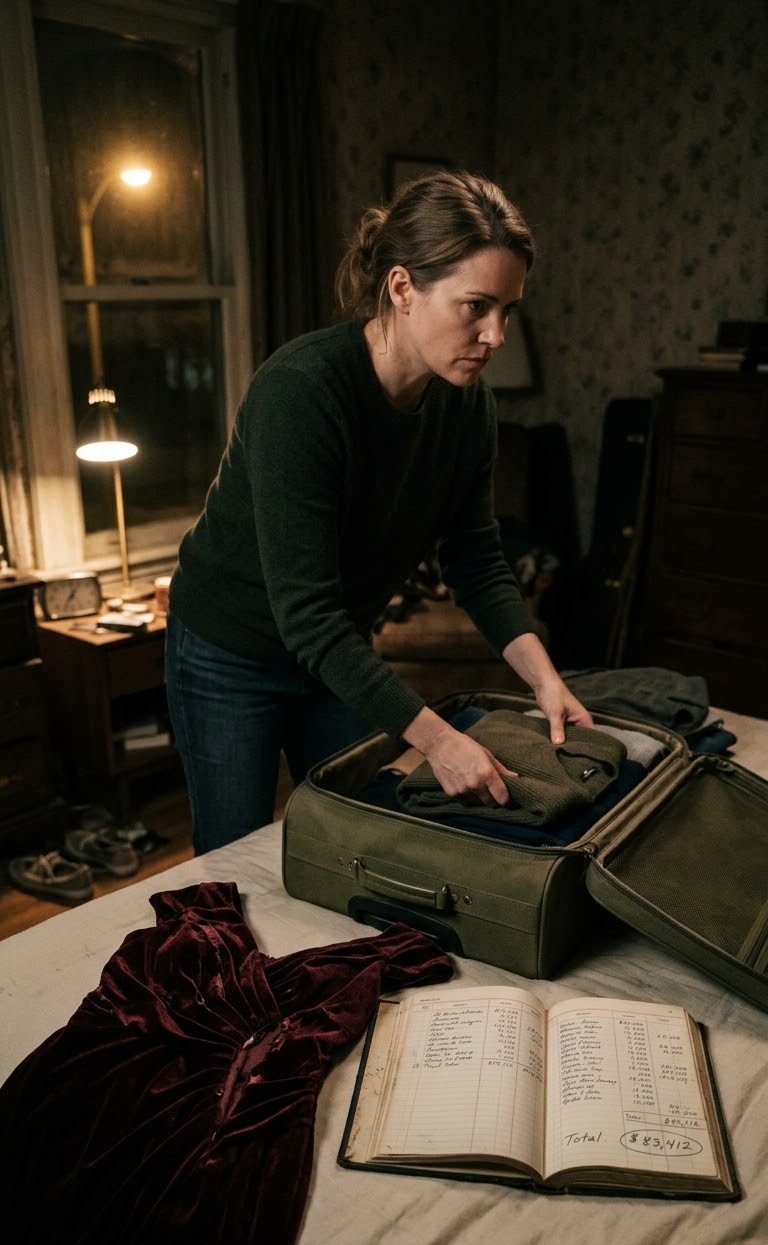
The Ashworth Family's Dark Debt: Daughter Betrayed by Stepmother's Occult Plot, Forced to Flee for Her Life


The knowledge that Seraphina was not just ill but possessed twisted something deep inside me. It transformed my research from an academic pursuit into a desperate race against time, not just for her, but for myself. If the entity was claiming Ashworth women, I was undeniably next.
My focus narrowed to the specific details of her strange symptoms. The cold burns, the specific way her words would sometimes scramble or reverse, the sudden, almost catatonic paralysis that would overcome her when shadows fell across her face. These were not generic signs of madness. They were too specific, too consistent.
I recalled the old family diaries, the references to “melancholia” and “strange fits” among past Ashworth women who seemed to coincide with periods of renewed family prosperity. My great-aunt Eleanor had been committed to Oakhaven Sanatorium, a name that always came up in hushed whispers.
Oakhaven Sanatorium. It had closed down decades ago, its reputation marred by rumors of unorthodox treatments and patient neglect. Retrieving records from such a place would be a monumental task, but my skills as an archivist were precisely for such challenges. I spent weeks contacting old historical societies, obscure medical libraries, and even disgruntled former employees, weaving a fabricated tale about genealogical research.
After countless dead ends, I finally caught a break. A retired medical archivist, whose own family had connections to Oakhaven, remembered a Dr. Alistair Finch. “He was a strange one,” she’d told me over the phone, her voice raspy. “Obsessed with his own theories, kept his own separate records for certain… peculiar cases.”
My heart pounded as I managed to track down Dr. Finch’s personal archives, now housed in a forgotten corner of a regional historical society. I spent an entire day sifting through faded folders, my hands gloved, my breath held. The air was thick with the scent of mold and decay.
And then, I found it. A meticulously kept medical log for “Eleanor Ashworth,” dated from 1965 to 1968. The very years my great-aunt had been confined. The pages were filled with elegant, precise script, detailing her “mental decline.”
I devoured the entries. “Patient exhibits periods of profound aphasia, speech reversing, often uttering nonsense syllables that, upon closer inspection, bear striking resemblance to archaic dialects.” I froze. Seraphina had done this. Just last week, she’d called my father “rethaf” before collapsing in a heap.
Another entry: “Unexplained epidermal lesions, patient complains of ‘cold burns’ emanating from the very shadows in her room.” I remembered Marcus’s recoil. The red mark on his hand. The melted locket.
“Periods of cataleptic stupor, triggered specifically by rapid shifts in ambient light, shadows seeming to ‘clutch’ at her limbs.” This, too, was Seraphina. The way she would freeze, eyes wide with terror, when a cloud passed overhead, plunging her into sudden gloom.
Dr. Finch’s notes continued, filled with clinical detachment, yet describing a horror that chilled me to the bone. He meticulously recorded Eleanor’s “delusions” of an invisible entity draining her vitality, of whispers from the walls, of a creeping cold that settled deep into her bones. He documented her progressive physical wasting, her aversion to reflective surfaces, her sudden bursts of uncharacteristic strength followed by profound weakness.
My fingers traced the elegant script. No known psychiatric diagnosis of the era, or even today, perfectly matched this constellation of symptoms. Schizophrenia, hysteria, catatonia – they might cover some elements, but not the specific aphasia, the cold burns, the shadow-induced paralysis, the physical drain without a clear medical cause.
But these symptoms matched something else entirely. They aligned almost perfectly with the descriptions of demonic oppression and possession I had found in the oldest, most obscure texts of my own private library. The subtle, insidious infiltration of an entity that began by mimicking illness, only to steadily assert its full, terrifying control.
Eleanor Ashworth hadn’t been mad. She had been haunted. She had been possessed. Just like Seraphina.
A wave of profound sadness washed over me, mingling with a burgeoning terror. The family’s “curse” was not a metaphor for bad luck or poor choices. It was a living, breathing thing, an entity that had targeted the Ashworth women for generations, slowly consuming them. My great-aunt Eleanor was merely one casualty in a long line, a precursor to Seraphina. And now, I held the key, a grim medical record, to understanding the true nature of this family horror. The true horror wasn’t the illness; it was the unseen hand pulling the strings.
More Stories













+ There are no comments
Add yours