
Returning from Overseas, I Found My Mother and Sister Living Lavishly While My Son Suffered Irreversible Damage in Their Cult's Care


Clara’s silence forced me to look for answers elsewhere, to dig into the past. I started thinking about Bethany, my younger sister. She had always been competitive, especially with me. But her resentment of Clara had always felt different, sharper.
I remembered Clara’s first Christmas with our family, years ago. She had brought a handmade quilt, a beautiful, vibrant piece of folk art. Eleanor had praised it politely, but Bethany had made a point of showing off a store-bought, mass-produced sweater she’d knitted, commenting on how much “neater” machine-made things were. It was a small incident, but telling.
Clara, an artist at heart, was always a free spirit. She loved brightly colored clothes, spent hours painting, and cherished her independence. Eleanor, even before the Assembly, had always been more conservative, valuing order and tradition. She never outright disapproved of Clara, but there was always a subtle tension, a sense that Clara wasn’t quite “fitting in” to Eleanor’s vision of a proper family.
I recalled a conversation years ago, before my deployment. Clara had mentioned Eleanor gently urging her to attend some of the Assembly’s introductory classes, to “find her spiritual center.” Clara had politely declined, saying her art was her spiritual practice. I hadn’t thought much of it then, dismissing it as Eleanor’s usual mild evangelism. Now, it resonated with a sinister undertone.
Bethany’s resentment was more overt. She’d always chafed under Eleanor’s subtle control but found a new sense of purpose within the Assembly. It gave her structure, a hierarchy she could climb, and an approved outlet for her competitive nature. She became one of Eleanor’s most devoted disciples, her enforcer. This gave her power, a commodity she had always craved.
The Assembly had a particular disdain for “worldly attachments” and “individualistic pursuits.” Clara’s art, her free spirit, her gentle but firm refusal to conform, made her a prime target. She was everything the cult sought to suppress. My money, sent home faithfully, fueled the very institution that demonized her.
This wasn’t just about my money, or even just about Eleanor’s faith. It was about Bethany’s deep-seated envy, inflamed by the cult’s teachings. Clara, with her quiet strength and my love, had always been a perceived threat to Bethany’s position in the family, especially in Eleanor’s eyes. The cult merely provided the framework, the doctrine, to turn that quiet resentment into active persecution.
I remembered Bethany once casually remarking that Clara’s favorite paintbrushes, a set I had given her, “looked like they could use a good cleansing.” At the time, I thought it was a strange comment. Now, I saw it as a precursor to the “purification” that had stripped Clara of everything. It was a petty, personal cruelty, foreshadowing the grander, devastating cruelty to come. The brushes were more than just tools; they were an extension of Clara’s identity, her freedom, and Bethany, with the cult’s backing, had sought to metaphorically destroy them.
The hidden connection became sickeningly clear: Eleanor and Bethany’s resentment towards Clara was a pre-existing fault line. Elder Malachi hadn’t created it, but he had expertly widened it, weaponizing it with the Assembly’s doctrine. Clara, as an “outsider” not fully committed to their family or faith, became the perfect scapegoat, the embodiment of “worldly impurity” that needed “cleansing.” My own mother and sister had exploited her vulnerability, using the cult’s twisted beliefs to justify their long-simmering animosity. It was a profound, personal betrayal, turning family ties into instruments of torture.
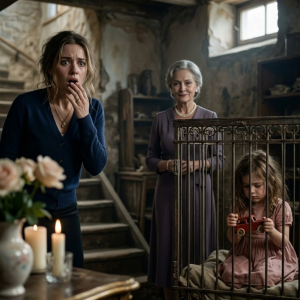
This wasn’t just abstract religious fanaticism; it was deeply personal, rooted in years of unresolved family dynamics. The cult simply gave them permission, even encouragement, to act on their darkest impulses. It amplified their existing flaws, turning jealousy and disapproval into justification for abuse. The thought made my skin crawl. The “penance cell” wasn’t just a general cult practice; it was specifically applied to Clara and Finn because of who they were, and who my mother and sister believed them to be. My own family had been both the victims and the executioners of a cruel ideological agenda.
The realization settled on me like a shroud. This wasn’t just an external battle against a cult; it was an internal war against the distorted shadows of my own family. The personal animosity, once just a faint hum, had been amplified into a roaring furnace, burning away any last vestiges of the family I thought I knew. I had to fight not just for justice, but to understand how such personal malice could fester and then explode with such devastating consequences.
More Stories
















+ There are no comments
Add yours