
My husband canceled our 25th anniversary, saying "work." I found him with my sister, her husband, and a stranger discussing our ancestral land.


The air in the courtroom was thick with unspoken tension, heavy with the weight of shattered family bonds. Judge Elena Rodriguez, a woman whose stern gaze seemed to see straight through any pretense, presided from her high bench. The proceedings, stretching over two days, felt like an eternity, each minute a slow turn of the knife in my heart.
Amara Das was a formidable presence, presenting our case with meticulous detail and unwavering conviction. She began by laying out the property deeds and my father’s will, highlighting the century-old clauses detailing the mandatory annual pujas and charitable endowments for the village well and schoolhouse. She painted a vivid picture of a heritage, not a burden, explaining the cultural significance that transcended mere financial value.
Raj and Priya, seated at the defense table with their lawyer, Mr. Henderson, looked increasingly uncomfortable as Amara systematically dismantled their arguments. Raj fidgeted, his usual smooth composure replaced by a pale, anxious expression. Priya, for once, was silent, her sharp-tongued confidence visibly deflating. Vikram sat beside her, barely visible, a ghost of a man.
Then came the testimonies. I spoke first, my voice trembling initially, but growing stronger as I recounted the evening at The Grand Taj, Raj’s twisted narrative of “protection,” and the profound sense of betrayal that followed. I described my father’s love for the land, his quiet dedication to its upkeep, and how he never once considered its obligations a burden.
Amara then called Meena Singh. Meena, though visibly nervous, spoke with unwavering conviction, her voice steady as she recounted Raj’s strikingly similar scheme decades ago, attempting to convince his own ailing father to sell their ancestral home in Gujarat, using the exact same arguments of “burden of tradition.” She detailed his persistence, his manipulative tactics, and his father’s steadfast refusal. Raj flinched, his face paling further, as Meena’s words laid bare his long-standing, calculating nature. Her testimony was a devastating blow, shattering his “protective husband” façade completely.
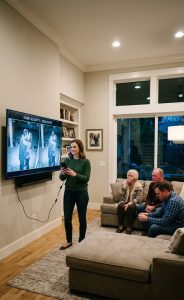
Next, a pre-recorded video testimony from Aunt Shanti was played for the court. Amara had arranged for a local legal professional in India to record her, to spare her the trauma of travel. On the large screen, Aunt Shanti, frail and tearful, recounted Priya’s visit, her charming deception, and the exploitation of her financial distress after the failed monsoon. Her voice, choked with shame and sorrow, brought a palpable hush to the courtroom as she confessed to signing documents she didn’t understand, believing she was helping her family, only to realize she had been coerced into undermining my rightful claim. Priya stared at the screen, her face utterly devoid of expression, but I saw a flicker of something in her eyes — perhaps not regret, but certainly recognition of the damage done.
Amara then presented the evidence against Elara Thorne, detailing her pattern of unethical practices, including the parallel case of the Kapoor family and the questionable undervaluation of ancestral properties. She argued that Thorne’s involvement was not merely incidental but indicative of a deliberate strategy to exploit cultural disconnect and push through dubious deals for personal gain. The implication was clear: Raj and Priya had knowingly engaged a corrupt enabler.
Mr. Henderson offered a weak defense. He painted Anya as “overly emotional” and “sentimental,” clinging to “outdated traditions” that had no place in modern life. He dismissed Meena Singh as a “disgruntled ex-partner” with a “personal vendetta” and Aunt Shanti as an “elderly woman easily confused by complex legal matters.” He argued that Raj and Priya were simply trying to make “sensible financial decisions” to protect their family’s future, claiming the ancestral property was a “financial drain” that served no practical purpose for assimilated Indian-Americans. He even tried to argue that the cultural obligations were not legally binding in a US court context, nor applicable to modern property ownership.
But his arguments felt hollow against the weight of the evidence. Judge Rodriguez listened impassively, her gaze fixed on each speaker, taking copious notes. The tension in the room grew unbearable as the final arguments were made.
Then came the moment of truth. Judge Elena Rodriguez leaned forward, her voice calm and authoritative, cutting through the silence.
“This court has carefully considered the arguments, evidence, and testimonies presented,” she began, her eyes sweeping across the courtroom, lingering briefly on Raj, then on Priya, and finally resting on me.
“The ancestral property in question is not merely a piece of real estate. It is demonstrably imbued with significant cultural, historical, and religious obligations that have been upheld by the Sharma family for generations.”
My heart pounded against my ribs.
“The court finds that Mr. Raj Sharma and Ms. Priya Patel deliberately attempted to sell this property without the knowledge or consent of Ms. Anya Sharma, a legal heir and stakeholder. Their actions constituted a clear breach of familial trust and a disregard for established property rights and inherited cultural duties.”
A small gasp escaped my lips. This was it. Justice.
“The testimony of Ms. Meena Singh,” the Judge continued, “establishes a concerning pattern of behavior by Mr. Raj Sharma regarding family assets. Furthermore, the video testimony of Aunt Shanti unequivocally demonstrates coercive tactics employed by Ms. Priya Patel to bypass Ms. Anya Sharma’s claim.”
She paused, then delivered the final, crushing blow. “Therefore, this court rules in favor of the plaintiff, Ms. Anya Sharma. Full legal ownership and stewardship of the ancestral property, including the associated ancestral home, temple, and agricultural land in India, is hereby granted to Ms. Anya Sharma.”
A wave of relief, so potent it almost brought me to my knees, washed over me. I had won. I had fought for Papa’s legacy, and I had won. Raj’s and Priya’s faces were stony, their defeat evident. Amara squeezed my arm, a triumphant smile on her face.
But Judge Rodriguez was not finished. Her gaze hardened as she continued, her voice now precise and unyielding.
“However,” she stated, “the court must also address the inherent obligations tied to this unique property. It has been clearly established that this ownership comes with specific, non-negotiable responsibilities. These include, but are not limited to, the mandatory annual performance of religious ceremonies at the on-site temple, the continuous financial support for the local village well and schoolhouse as per historical endowments, and all significant maintenance costs for the ancient structures.”
My breath caught in my throat.
“The court’s judgment is that Ms. Anya Sharma, as the sole legal owner and steward, is now exclusively and solely responsible for upholding these historical debts and cultural obligations,” the Judge declared, her words landing like individual blows. “This includes all financial costs associated with these duties, as well as any and all property taxes, which are henceforth her sole and personal liability.”
My head snapped up, my eyes wide with a dawning horror. Sole responsibility. Sole personal liability.
“Furthermore,” Judge Rodriguez concluded, “as Ms. Anya Sharma has been granted exclusive ownership and responsibility, Mr. Raj Sharma and Ms. Priya Patel are hereby explicitly released from any and all claim or responsibility for these costs, these debts, and these cultural obligations, both present and future. They are absolved of any financial or cultural burden associated with the ancestral property.”
The courtroom went silent. My supposed victory felt like a crushing defeat. Raj and Priya had lost the sale, but they had won their freedom from the very “burden” they had schemed to shed. They had succeeded in divorcing themselves from their heritage, leaving me, the “victor,” isolated with its immense, overwhelming weight.
Raj and Priya exchanged a subtle glance, not of anger, but of something akin to grim satisfaction. They had walked away clean, achieving their desired freedom from the very responsibilities I had fought to reclaim. The judge’s hammer had fallen, and while it had granted me ownership, it had also delivered an ironic, isolating verdict: the true cost of preserving my heritage, I now understood, was mine, and mine alone, to bear. The victory felt hollow, a heavy stone in my hands.
More Stories
















+ There are no comments
Add yours