
Brothers clash when one defends their elderly mother from the other's cruel public humiliation, uncovering a paternity secret that changes everything.


The DNA report lay heavy in my hand, a weapon forged from truth. I folded it carefully, tucking it into a plain, unmarked envelope. The confrontation with Alistair wouldn’t be dramatic. It wouldn’t be an argument. It would be a quiet, unassailable delivery of facts. The facts themselves would be the only necessary force.
I drove to his office early one morning, before his assistant Lena arrived. I knew his routine; he liked to be in his office alone for an hour before the day officially began. The building was quiet, the deserted lobby echoing my footsteps. I found his door ajar.
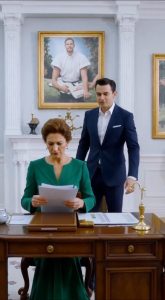
He looked up from his large mahogany desk, his expression shifting from surprise to a familiar, cold irritation when he saw me. “Rhys. What do you want? I thought we made it clear you were to keep your distance.”
I didn’t respond to his usual venom. I simply walked over to his desk, placed the envelope down, and slid it towards him. “This is for you, Alistair,” I said, my voice low and steady. “It explains everything.”
He frowned, picking up the envelope with a dismissive air. He didn’t open it immediately. He simply held it, his gaze narrowing on me. “What is this? Another one of your theatrics?”
“No theatrics,” I replied, meeting his stare. “Just the truth. Everything you’ve been so worried about, all your inherited conditions research. It’s all in there.”
His face went pale. The casual dismissal faded, replaced by a flicker of fear and a dawning comprehension. Lena’s subtle hint about his anxiety over Elias’s medical records had hit its mark. He knew, or at least suspected, what this might contain.
“You’ve been digging,” he stated, his voice tight.
“I’ve been looking for answers,” I corrected him. “Answers for Mama, and for why you treat her the way you do.”
He stared at the envelope, his fingers unconsciously tracing the outline of the sealed flap. He didn’t open it while I was there. He couldn’t. It was a moment of profound vulnerability, and Alistair Croft would never expose that to me.
“Read it,” I said, my voice devoid of emotion. “Then maybe you’ll understand.”
I turned and walked out, leaving him alone in the silent office, the unmarked envelope lying on his desk like a ticking time bomb. I didn’t look back.
The aftermath was not a furious phone call or a dramatic scene. It was a silence that stretched for weeks, thick and unnerving. Alistair simply vanished. His office staff reported he was on an extended, unscheduled leave. Brenda called Elara in a panic, asking if she’d heard from him, her voice laced with a genuine fear I hadn’t expected from her.
“He’s not answering my calls, Elara,” Brenda said, her voice tight with frustration. “He just… left. Didn’t say where.”
Elara, now freed from her heaviest burden, looked at me, a silent question in her eyes. I just shook my head. “He’s processing, Mama,” I told her. “It’s a lot to take in.”
The Croft family, always so keen on appearances, felt the tremors of Alistair’s disappearance. Aunt Carol called, ostensibly to check on Elara, but her questions invariably drifted to Alistair. “Is everything alright with Alistair?” she asked, her voice hushed. “Brenda seems terribly worried. It’s not like him to just… vanish.”
Uncle Robert, too, seemed perturbed. I overheard him speaking to another relative during a brief, accidental encounter at the grocery store. “Alistair always carried the family name with such pride,” he mused, “but lately, I don’t know. Something’s shifted. And Elara, well, she seems almost lighter somehow, despite everything.”
The carefully constructed facade of the Croft family, once reinforced by Alistair’s relentless grip on power and narrative, began to crack. His absence, the stark silence that followed the truth, forced a quiet re-evaluation among the relatives. They couldn’t ignore it. The man who had been the cornerstone of their traditional values, the self-proclaimed standard-bearer of the Croft legacy, had simply disappeared without explanation, leaving a void that was impossible to ignore.
Elara, meanwhile, bloomed in her newfound freedom. She started painting again, watercolors, something she hadn’t touched in decades. She took long walks in the garden, her head held higher. The constant, placating fear that had once shadowed her eyes had begun to recede.
“I still worry about him, Rhys,” she confessed one afternoon, her voice tinged with maternal concern. “He’s still my son.”
“I know, Mama,” I replied, watching her paint a vibrant sunflower. “But he has to find his own way to the truth now. His own peace.”
The lack of a dramatic apology from Alistair, the absence of a direct confrontation, was almost as telling as the truth itself. His withdrawal wasn’t an act of defiance; it felt like a retreat, a desperate attempt to grapple with a reality that had obliterated his entire sense of self. The silence was his way of processing, his way of dismantling the lie he had lived. The other family members, seeing Elara’s quiet resilience and Alistair’s inexplicable absence, began to subtly question their own judgments, their own easy acquiescence to his control. The aftershocks weren’t loud, but they ran deep, quietly reshaping the ground beneath all our feet.
More Stories





+ There are no comments
Add yours