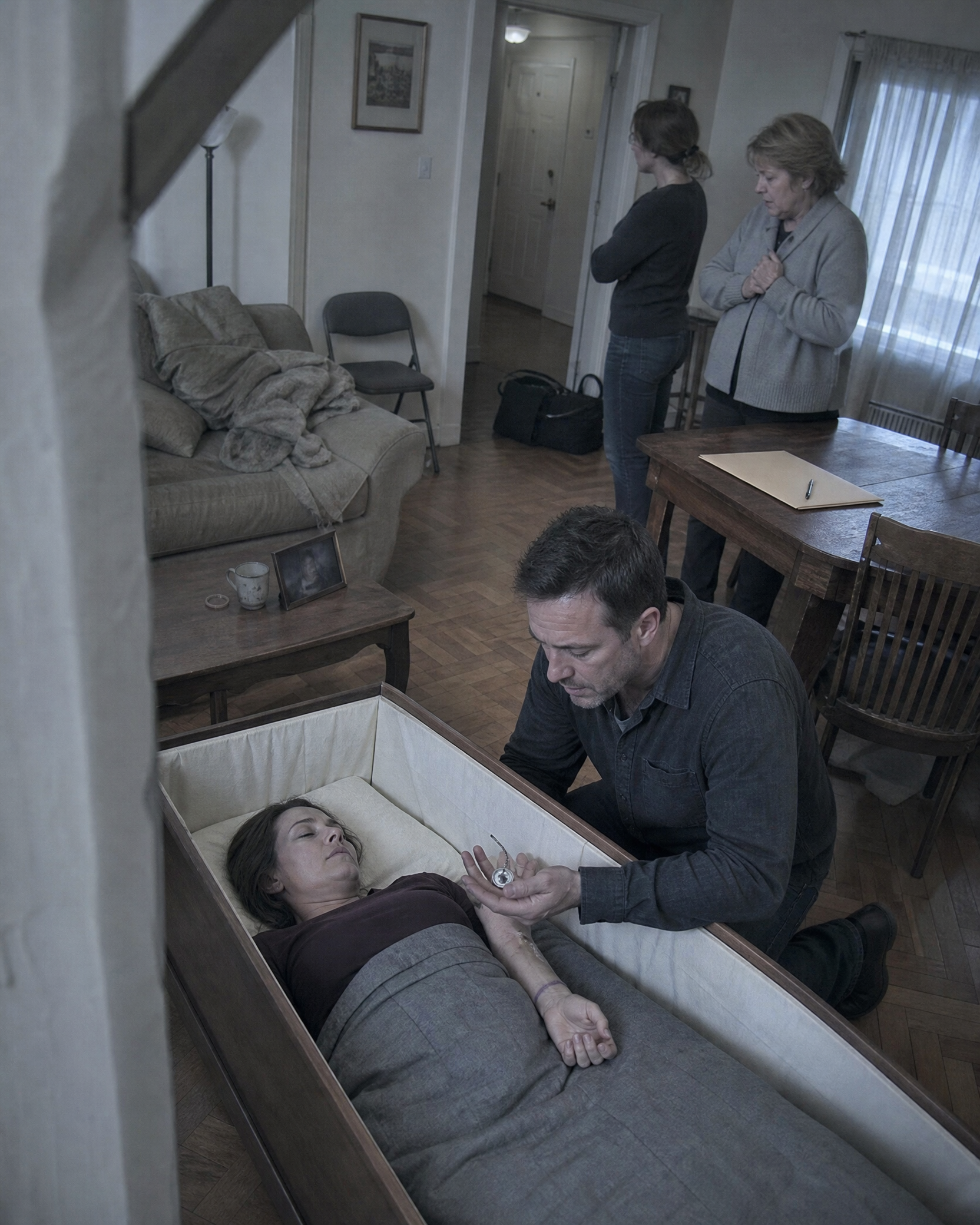
He Came Home to His Pregnant Wife in a Coffin, Declared Dead By His Mother – But One Bruise and a Child's Words Uncovered an Occult Family Horror


Julian’s revelation about his own amulet, a subtle instrument of control from Eleanor, solidified the chilling truth of her manipulative nature. We sat for hours, poring over the journal, cross-referencing entries, trying to piece together the full, terrifying scope of the Sinclair family’s pact.
The journal was a mosaic of cryptic notes, hurried sketches, and meticulous observations. It detailed not just “The Obsidian Veil” and its shadowy rules, but the specific, grotesque mechanics of the “Sinclair Legacy.”
“Look here,” Julian pointed, his finger tracing a faded entry. “Father writes about ‘the confluence of familial essence.’ He theorized that the arboretum isn’t just a place where the entity resides; it’s a living conduit itself. A nexus point.”
He explained that the arboretum, with its ancient, gnarled trees and strangely fertile soil, was where “The Verdant Hunger” lay dormant, feeding. Its existence wasn’t static; it required nourishment, specific and potent.
“The journal makes it clear,” Julian continued, his voice low. “The family’s unusual and sustained prosperity, our wealth, our influence, it was never accidental. It wasn’t just good investments or shrewd business. It was a direct consequence of this Legacy. A trade.”
He flipped to another page, filled with complex diagrams of energy flows and symbols.
“Every generation, a ‘purest offering’ was made,” Julian translated from the fragmented text. “Usually, it was described as nascent life. A new birth. The energy from a fresh, untainted soul.”
My stomach churned. Our unborn child. Elara. They were not just victims of a random act; they were the designated, specific targets of a centuries-old, meticulously planned sacrifice. The sheer, cold-blooded precision of it was a form of personal cruelty, dehumanizing them into mere resources.
“Father speculated that the entity, ‘The Verdant Hunger,’ provided the family with its exceptional fortune in return for these offerings,” Julian explained. “It’s a symbiotic, albeit parasitic, relationship. The journal calls it ‘the price of prosperity’.”
He pointed to a specific passage, highlighted and underlined by our father. “If the offerings cease, the entity starves. And if it starves, the family’s fortunes don’t just dwindle; they reverse. Catastrophically. As if the entity demands its dues in a more direct, devastating way.”
This wasn’t just about maintaining wealth; it was about staving off ruin. Eleanor wasn’t driven solely by ambition, but by a twisted fear of losing everything. It didn’t excuse her actions, but it explained the desperate fanaticism. She was caught in a cycle, bound by a pact she believed protected them, and perhaps even empowered her.
“So the Sinclair Arboretum,” I mused aloud, the name now dripping with menace, “is basically a farm. And we’re the… livestock.”
Julian nodded grimly. “Not just a farm. A battery. The journal suggests the entity isn’t just receiving energy; it’s also growing, adapting. Becoming more powerful with each ‘offering’.”
He then showed me a series of entries that detailed how previous “offerings” had been handled. There were mentions of “unfortunate accidents,” “sudden illnesses,” and “disappearances” from earlier generations. Each case, meticulously recorded by our father, seemed to have been dismissed by the family, hushed up, or explained away with convenient lies.
One entry, particularly chilling, described the disappearance of a distant cousin, a young woman named Clara, in the late 19th century. She had been pregnant, just like Elara, and vanished without a trace, declared to have run off with a suitor. But our father’s notes implied she was an “offering,” her pregnancy mirroring Elara’s. The cold, casual disregard for human life, treated as a simple transaction for the family’s gain, was a profound, historical cruelty.
“Father was deeply disturbed by this,” Julian explained, his voice low. “He spent years trying to find a way out, a way to break the pact, without destroying the family.”
“But he never succeeded,” I said, a bitter taste in my mouth.
“He died before he could,” Julian replied, his gaze distant. “Or, perhaps, he was silenced. The journal suddenly stops mid-sentence, then there’s a different hand, Mother’s, a note about his ‘failing mind’.”
The thought that our father might have been another victim, eliminated when he got too close to the truth, was a sickening possibility. It painted Eleanor’s cruelty as absolute, extending even to her own husband. This was more than just ambition; it was a ruthless preservation of power at any cost.
“And Mother,” I asked, the name now barely recognizable as belonging to the woman I once knew. “She’s not just maintaining this. She’s accelerating it, isn’t she?”
Julian nodded, his face etched with grim certainty. “The current state of ‘The Verdant Hunger’ requires a more potent offering. A purification, the journal calls it. A merger.”
He pointed to the most recent entries, penned by our father in a hurried, almost frantic script. They warned of Eleanor’s growing ambition, her desire to not just feed the entity, but to unite with it, to harness its power directly. To become the ultimate “Shade Weaver.”
“She wants to achieve eternal power,” Julian concluded, his voice barely above a whisper. “By becoming one with the entity. By using Elara’s baby, the ‘purest offering,’ to facilitate that merger.”
The sheer audacity of her plan, the monstrous hubris, was breathtaking. Eleanor wasn’t merely a custodian of an evil legacy; she was attempting to transcend it, to become a living embodiment of the horror, drawing on the life force of her own family to do so. The ancient pact, the family’s prosperity, the arboretum, Elara’s death—it was all a carefully orchestrated crescendo leading to Eleanor’s ultimate, terrifying apotheosis.
My hands clenched into fists. We were not just fighting a woman; we were fighting an ancient evil, empowered and embodied by our own mother. And time was running out.
More Stories











+ There are no comments
Add yours