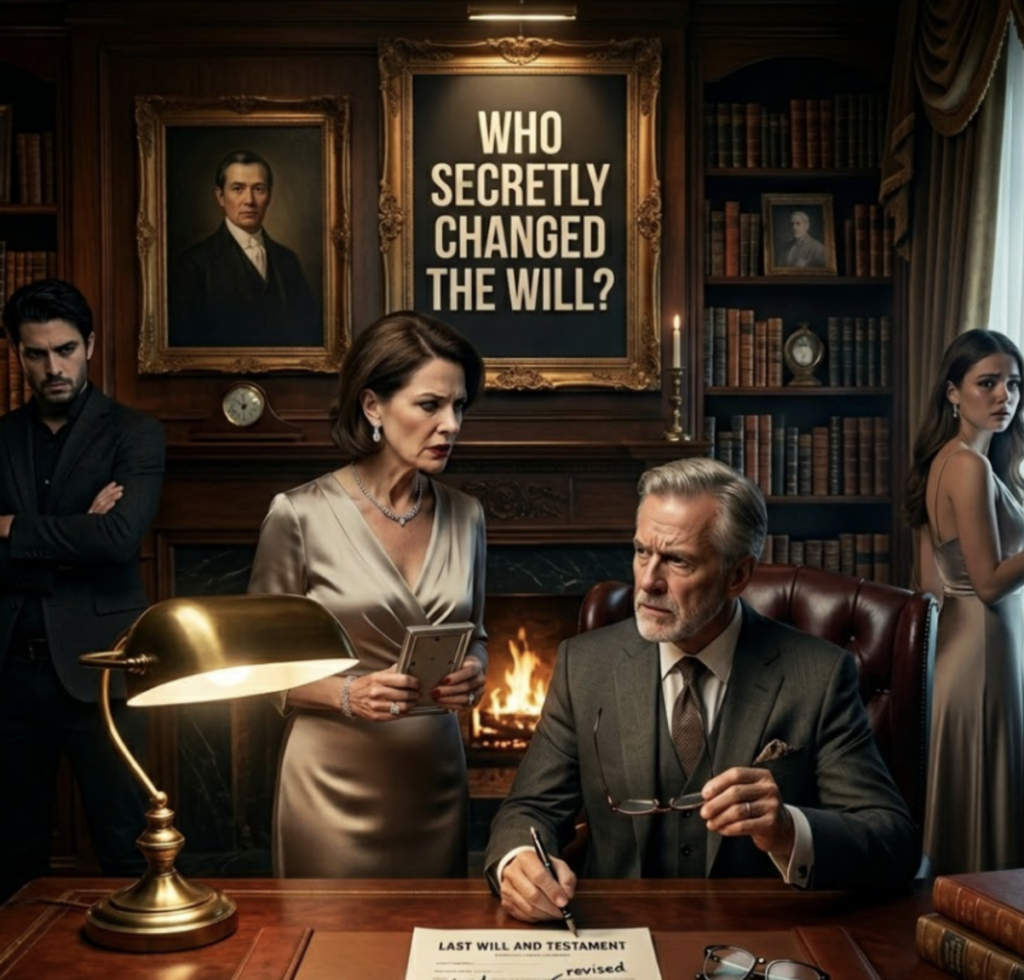
A will was read after the funeral, and every person in the room went silent.
Not because the old man had left behind millions.
But because the document said the one thing he had sworn he would never do.
Someone had changed his final wishes just hours before he died.
And the only question left was simple.
Who did it?
Arthur Whitmore had spent his life building Whitmore Foods from one grocery store into a regional chain worth millions. He was not an easy man, but he was a fair one. For years, he told his four children the same thing: when he died, the estate would be divided equally, and a portion would go to the Eleanor Whitmore Foundation, the charity he created after his wife passed.
“No child of mine will be rewarded for greed,” he used to say. “And your mother’s work will continue after me.”
Everyone knew the plan.
So when Arthur died after a long illness at eighty-two, no one expected drama beyond ordinary grief.
Then the lawyer opened the will.
Arthur’s oldest son, Richard, had been removed entirely.
The charity received nothing.
The largest portion of the estate went to Arthur’s granddaughter, Claire, a twenty-eight-year-old who was secretly drowning in debt.
Richard stood up so quickly his chair fell backward.
“That’s impossible.”
Claire went pale.
“I didn’t ask for anything.”
Arthur’s daughter Linda began crying, not from sadness but rage. “Dad would never cut Richard out. They fought, but he would never do this.”
The lawyer, Martin Hale, adjusted his glasses and said the amendment had been signed at 11:42 p.m., only hours before Arthur died.
That made the room colder.
Arthur had been weak that night. He could barely lift a spoon. He was on medication. He could speak, but only in short sentences.
And yet someone had changed the will.
Only four people had entered Arthur’s study that night.
Richard, the son who had been cut out.
Nora, the private nurse who found the paperwork first.
Claire, the granddaughter now receiving the largest inheritance.
And Martin Hale, the lawyer who arrived unusually early the next morning with the amended document already in his briefcase.
At first, everyone suspected Claire.
She owed nearly $180,000 from failed business ventures and credit cards. Arthur had recently refused to help her again. If anyone needed money, it was her.
But Claire insisted she had only gone into the study to say goodbye. She said Arthur had held her hand and whispered, “I’m sorry they’ll blame you.”
That sentence bothered Linda.
Why would Arthur say that before anyone knew about the will?
Richard became the second suspect. He had argued with Arthur for years about the company. He had also entered the study around 10:30 p.m., less than ninety minutes before the amendment was signed.
But cutting himself out made no sense.
Unless, Linda argued, he had changed the document badly and someone else had changed it again.
Nora, the nurse, looked innocent at first. She had no inheritance, no family connection, no obvious motive. But she was the one who “found” the amended papers on Arthur’s desk at dawn. She also admitted Arthur had asked her to bring his old safe box from the closet.
Then there was Martin Hale.
The lawyer claimed Arthur called him late that night and requested an emergency amendment. But phone records showed no call from Arthur’s landline.
Martin said Arthur used Claire’s phone.
Claire denied it.
The family hired a forensic document examiner.
The signature was Arthur’s.
Shaky, but real.
The timestamp on the digital amendment file also matched 11:42 p.m.
So the question changed.
If Arthur truly signed it, who convinced a dying man to destroy his own estate plan?
The answer came from the old safe box.
Inside was a sealed envelope addressed to Linda.
Arthur had written it three months before he died.
Linda,
If the will is changed near the end, do not assume greed came first.
Look at the birth records.
Ask Martin why Richard’s adoption was never finalized.
Linda read the letter twice before understanding.
Richard was not legally Arthur’s son.
The family knew Richard had been adopted as a baby, but everyone believed the paperwork had been completed. Arthur’s letter revealed the truth: due to an old filing error, the adoption had never been legally finalized. Arthur discovered it only during estate planning.
That meant the original will, which divided assets equally among “my legal children,” could be challenged.
Worse, if Richard inherited under the old structure, the entire estate could be frozen for years. The charity could lose its funding. The company could collapse. Every sibling could end up in court.
Arthur had planned to fix it quietly.
But someone else found out first.
Martin Hale.
The lawyer had known for months and said nothing. Instead, he prepared a late amendment removing Richard entirely and shifting most assets to Claire, because Claire’s debts were tied to a lender connected to Martin’s private investment firm. If Claire inherited, Martin’s associates would be paid first.
But Arthur realized the trap.
That night, he forced Martin to come early.
Nora brought the safe box.
Claire was called in as a witness.
Richard was removed from the will not because Arthur rejected him, but because Arthur had created a separate trust for him under a different legal structure that Martin could not challenge.
The real crime was not changing the will.
It was Martin trying to manipulate the family into believing the change was greed.
Nora had secretly recorded Arthur’s final instructions on her phone.
In the recording, Arthur’s voice was weak but clear.
“Richard is my son. Paperwork does not decide blood. Martin tried to use the error. I changed the will to stop him.”
Martin Hale was arrested for fraud, attempted estate manipulation, and conspiracy tied to Claire’s lender.
Claire received nothing directly. Her portion was placed in a protected trust.
Richard received the separate trust Arthur created for him.
And the Eleanor Whitmore Foundation was restored.
The family never fully recovered from the suspicion that night created, but they did learn one painful truth: sometimes the ugliest change in a will is not betrayal.
Sometimes it is the final move of a dying man trying to protect his family from a criminal sitting beside them in a suit.
The person who secretly changed the will was Martin Hale, the lawyer.
Do you think Arthur was right to hide the truth until the end, or should he have told Richard the adoption secret while he was still alive?


