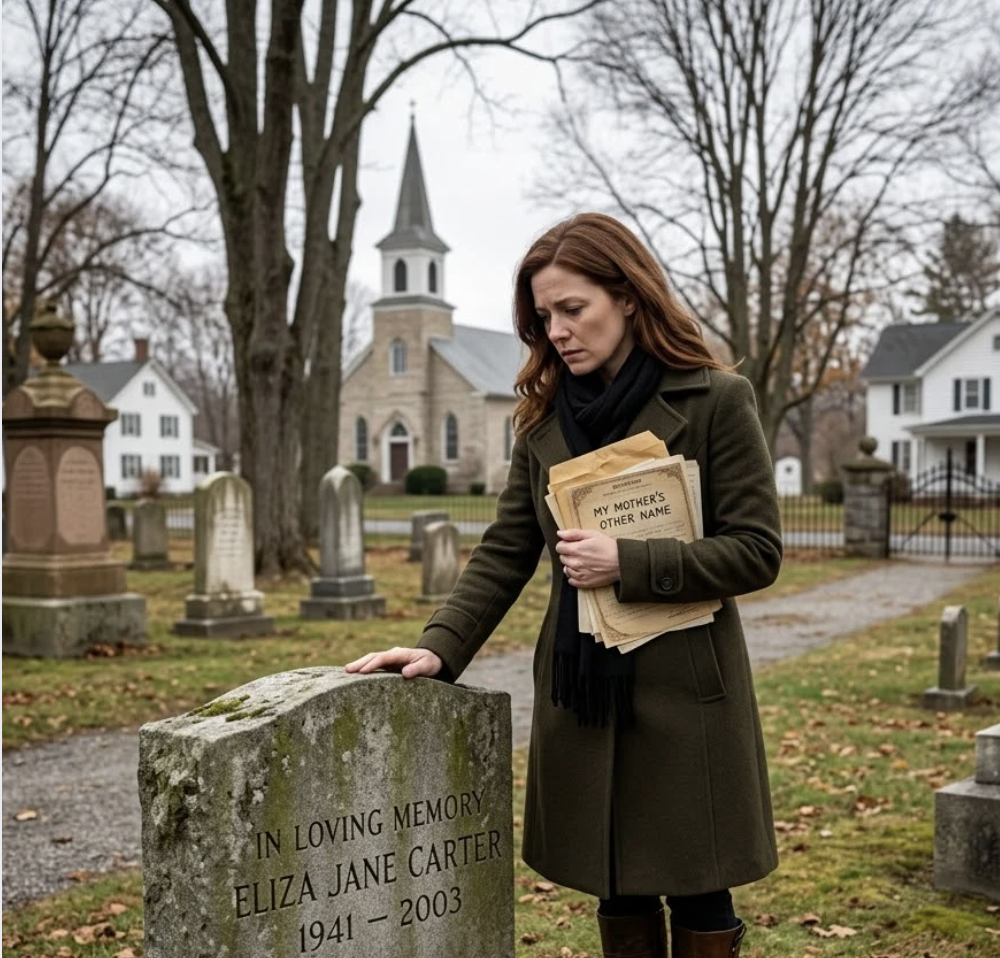
I went to the cemetery expecting to visit a stranger.
My mother’s will had left me only an address, one grave number, and a sentence that made no sense.
You need to know your mother’s real name.
But when I saw the headstone, my legs nearly gave out.
The name carved into the stone belonged to a woman I had never heard of.
The birth date belonged to my mother.
And the grave had been waiting there for forty-two years.
My mother, Helen Whitaker, was the most careful woman I ever knew.
She kept receipts in labeled envelopes.
She locked every window before sunset.
She never gave her full name to telemarketers.
She never appeared in church directories, never joined Facebook, never let anyone take family photos without asking where they would be kept.
When I was younger, I thought she was private.
When I became an adult, I thought she was anxious.
After she died, I learned she had been hiding.
My name is Rachel Whitaker, and I was forty-seven when my mother passed away.
She died quietly in the same little blue house where I grew up, in a town called Ashford, Ohio. Everyone knew her as Helen. Helen who baked lemon pies for funerals. Helen who volunteered at the library. Helen who never missed Sunday service but always sat near the back. Helen who smiled warmly and answered personal questions with a graceful change of subject.
Nobody knew she had once been someone else.
Not even me.
My father died when I was nineteen, so when Mom passed, I became the only person responsible for her belongings. The funeral was small but full. People came with casseroles, flowers, and the kind of stories that make grief both softer and sharper. They told me she was kind. Dependable. Quietly generous. A woman who never wanted attention.
That part was true.
But after the service, the attorney gave me a sealed envelope Mom had left with her will.
Inside was no jewelry.
No family recipe.
No sentimental letter.
Just one folded page.
Rachel,
There is something I should have told you while I was alive.
I was afraid.
That is not an excuse.
It is only the truth.
Go to Maple Ridge Cemetery.
Section C.
Row 14.
Grave 22.
When you see the name, do not leave.
Ask for the records.
You need to know your mother’s real name.
Love,
Mom
I read it three times in the attorney’s office.
Then I looked up and said, “Is this some kind of mistake?”
The attorney, Mr. Bell, looked uncomfortable.
“She instructed me not to explain. She said you had to begin there.”
“Begin what?”
He only shook his head.
That was how I found myself driving two counties away the next morning, still wearing the black dress from the funeral because I had not had the energy to change.
Maple Ridge Cemetery sat outside a small town called Briar Glen. I had never been there before, or at least I thought I had not. The office was old, the kind of place with metal filing cabinets and a woman behind the desk who looked as if she had seen every version of grief.
I gave her the grave number.
She checked the map.
“Older section,” she said. “A lot of families don’t visit that area anymore.”
I walked alone.
Section C.
Row 14.
Grave 22.
The stone was weathered but readable.
MARGARET ELAINE PORTER
Beloved Daughter
Born April 3, 1948
Died October 19, 1981
The world narrowed around those numbers.
April 3, 1948.
My mother’s birthday.
Not close.
Not similar.
Exact.
Below the dates was a carved sentence.
She carried the truth farther than fear.
I had heard those words before.
My mother said them once when I was sixteen. I had come home crying because a teacher accused me of cheating on a test. Mom sat me at the kitchen table, took my hands, and said, “A person has to carry the truth farther than fear, Rachel. Even when fear has a head start.”
At the time, I thought she was giving motherly advice.
Now the same sentence was carved onto a grave belonging to a woman who supposedly died before I was born.
I went back to the cemetery office so fast the woman behind the desk stood up.
“I need the records for that grave.”
She hesitated.
“Are you family?”
“I don’t know.”
That answer confused both of us.
She pulled the file.
The burial record was strange.
There was a death certificate copy, but no funeral home invoice. A plot purchase receipt, but no embalming record. A burial authorization signed by a county official whose name had been crossed out in one place and rewritten in another. The file listed Margaret Elaine Porter as deceased, but the cause of death section was missing from the cemetery copy.
“Where is she buried?” I asked.
The woman frowned.
“In the grave you visited.”
“No. I mean was there an actual burial?”
She looked at the file again.
Then her expression changed.
“There should be a marker here for casket depth, vault type, burial date…” She turned another page. “That’s odd.”
“What?”
“The plot was purchased. The headstone was installed. But I don’t see a completed interment record.”
My mouth went dry.
“So there may be nobody in that grave?”
“I can’t say that.”
“But the record doesn’t prove there is.”
She did not answer.
That silence followed me all the way back to my car.
I sat behind the wheel holding my mother’s note and staring at the name Margaret Elaine Porter.
A dead woman with my mother’s birthday.
A fake grave.
A sentence my mother had spoken.
A name she said I needed to know.
By that evening, I was searching public records online. Margaret Elaine Porter had been born in Briar Glen on April 3, 1948. Parents: Thomas and Louise Porter. High school graduate. Nursing aide. No marriage record. No children. Death recorded October 19, 1981.
My mother, Helen Whitaker, according to every document I had ever seen, had been born April 3, 1948, in Cincinnati. But when I pulled her birth certificate from our family files, I noticed something I had never noticed before.
It was a delayed certificate.
Filed in 1982.
One year after Margaret Porter supposedly died.
I called Mr. Bell the next morning.
“I need to know if my mother changed her name.”
He sighed.
“I can’t disclose anything beyond what she authorized.”
“She’s dead.”
“That doesn’t erase confidentiality.”
“She sent me to a grave with her birthday on it.”
Silence.
Then he said quietly, “Look in the cedar chest.”
The cedar chest sat at the foot of my mother’s bed. I had opened it after the funeral and found quilts, old scarves, and Christmas tablecloths. This time, I emptied everything.
Under the lining was a packet wrapped in wax paper.
Inside were photographs, newspaper clippings, and one small silver key.
The first photograph showed my mother as a young woman.
Only the name written on the back was not Helen.
Maggie Porter, summer 1978.
I sank onto the floor.
Maggie.
Margaret.
My mother.
The newspaper clipping was from 1981.
LOCAL WOMAN EXPECTED TO TESTIFY IN HARRINGTON CASE
The article mentioned Margaret Porter, a nursing aide who had allegedly witnessed events connected to the Harrington family, one of Briar Glen’s wealthiest and most influential families. The article said testimony was expected before a grand jury.
The next clipping was dated three weeks later.
KEY WITNESS PRESUMED DEAD AFTER RIVERBANK DISCOVERY
Margaret Porter was missing.
Blood had been found near her car.
Authorities believed she had fallen or been attacked near the river.
Her body had not been recovered.
Yet a death certificate was issued months later.
Then the fake grave appeared.
My hands were shaking as I unfolded the final paper.
It was a letter from my mother.
Rachel,
If you have reached this point, then you know Helen was not the name I was born with.
I was Margaret Elaine Porter.
Everyone called me Maggie.
I did not change my name because I was ashamed of who I had been.
I changed it because powerful people needed Maggie Porter to disappear.
I kept reading until the words blurred.
My mother had grown up in Briar Glen, a town controlled in quiet ways by the Harrington family. They owned the mill. The bank. Half the downtown storefronts. Their name was on the hospital wing, the high school gym, and the church restoration plaque. People respected them publicly and feared them privately.
In 1981, my mother worked nights as a nursing aide at Briar Glen Memorial.
One night, she overheard something she was never supposed to hear.
A young man named Peter Lang had been brought into the hospital after what police called a hunting accident. He died before dawn. Officially, the shooting was accidental. Unofficially, my mother heard a Harrington son admit in panic that Peter had threatened to expose financial crimes involving the family business.
My mother reported what she heard.
At first, the police took her statement.
Then people began warning her.
A car followed her home.
Her apartment was broken into.
Her parents begged her to stay quiet.
The district attorney promised protection.
Then the district attorney suddenly withdrew from the case.
The Harrington son left town.
Evidence disappeared.
And my mother realized the truth.
If she testified, she might not survive long enough to finish.
But she testified anyway.
Not in open court.
Before a sealed grand jury.
Then someone leaked her name.
A week later, she was attacked near the river.
At least, that was the official story.
The letter continued.
I did not die that night.
A deputy named Samuel Reed found me first.
He had known my father.
He knew if he radioed it in, the wrong people might arrive before an ambulance.
So he made a choice that changed both our lives.
He took me to a doctor he trusted outside the county.
I was injured, frightened, and pregnant.
I stopped reading.
Pregnant.
My mother had been pregnant when she disappeared.
I did the math even though my body already knew.
I was born seven months after Margaret Porter died on paper.
My father, the man who raised me, could not have been part of that first life unless my mother had met him under her new identity.
The next page answered that too.
Your father knew some of this.
Not all.
Enough to love me anyway.
Enough to help me become Helen.
Enough to put his name on your birth certificate and never ask me to dig up what I had barely survived.
I pressed the letter to my chest.
My father had known.
The quiet man who taught me to ride a bike, who made pancakes on Saturdays, who died before I was old enough to ask adult questions—he had helped my mother hide from a town that believed she was dead.
The silver key opened a safe deposit box at a bank in Briar Glen.
I drove there the next morning with my hands gripping the steering wheel so tightly my fingers hurt.
The bank had changed names twice, but the box remained active, paid annually by cashier’s check. When the clerk brought it into the private room, I felt as if someone had placed my mother’s buried life on the table.
Inside were cassette tapes.
A stack of sworn statements.
A list of names.
A photograph of my mother in a hospital bed, bruised but alive.
And one envelope marked:
If the Harringtons still matter.
I opened it first.
Rachel,
If that family still has power when you read this, be careful.
If they are gone, tell the truth anyway.
The dead deserve witnesses.
That was where PART 1 of my mother’s life ended.
And where my search for Maggie Porter began.
The first cassette began with my mother crying.
Not loud.
Not dramatic.
The controlled crying of someone trying to remain useful while falling apart.
A man’s voice asked her to state her name.
She answered, “Margaret Elaine Porter.”
Then he asked her to describe what she heard in Room 214 at Briar Glen Memorial Hospital on the night Peter Lang died.
For the next forty minutes, my mother told the story she had spent the rest of her life hiding.
Peter Lang had not been shot in a hunting accident.
According to my mother, he arrived at the hospital with a gunshot wound, terrified even before pain medication dulled his speech. He kept repeating, “Tell my sister it wasn’t an accident.” Then a young man entered the room with two older men. One was a Harrington. My mother recognized him immediately. Everyone in Briar Glen recognized a Harrington.
She was changing linens behind a curtain when the argument started.
Peter said he had documents.
Bank records.
Payroll ledgers.
Proof that the Harrington mill had been laundering money through fake vendors while underpaying workers and bribing county officials.
The Harrington son panicked.
One of the older men told Peter that nobody would believe him.
Peter said Maggie Porter had heard enough.
That was when the room went silent.
My mother froze behind the curtain.
She had become a witness by accident.
By morning, Peter was dead.
The chart said complications from blood loss.
The whispers said something else.
The second tape was worse.
It recorded my mother speaking with Deputy Samuel Reed, the man who helped her vanish. He sounded exhausted. Angry. Afraid. He told her the grand jury testimony had been compromised. Someone inside the courthouse had leaked her statement. Her apartment was no longer safe. Her parents were being watched.
My mother asked, “What am I supposed to do?”
Deputy Reed answered, “Live long enough for the truth to matter.”
That sentence sat inside me like a stone.
Live long enough for the truth to matter.
My mother had done exactly that.
She had lived.
But she had lived as someone else.
The tapes revealed how the fake death happened. After the attack near the river, Deputy Reed found my mother bleeding beside her car. He called a doctor outside the county instead of dispatch. The riverbank already had enough blood to convince investigators something terrible had happened. Her purse remained in the car. Her coat was found near the water.
People assumed the river took her.
A death certificate followed months later under pressure from officials who wanted the case closed. The headstone was paid for anonymously. Her parents attended a memorial for a daughter they knew might still be alive, because knowing the truth publicly would put everyone in danger.
That detail broke me.
My grandparents had mourned an empty grave while their daughter lived under a different name.
I wondered if they ever saw her again.
The answer was in the letters.
Only once.
My mother met her parents at a roadside motel two years after she became Helen. She brought me, still a baby, wrapped in a yellow blanket. My grandmother held me for twelve minutes. My grandfather stood by the door crying silently.
They never met us again.
Not because they didn’t want to.
Because the Harringtons still had eyes everywhere.
The third tape contained a voice I did not recognize at first.
Then I found the label.
Thomas Harrington Jr.
He was the son my mother had overheard that night.
The recording sounded like it had been made secretly. He was drunk, slurring, angry. He said Peter should have kept his mouth shut. He said his father fixed everything. He said Maggie Porter was “handled.”
Handled.
That single word made me feel sick.
Because my mother had built a life around being handled.
Moved.
Renamed.
Buried.
Silenced.
Protected, yes.
But also erased.
By the end of the week, I had enough material to take to authorities.
But which authorities?
The local police in Briar Glen had failed her once.
The district attorney’s office had folded.
Most of the people involved were old or dead.
The Harrington family, however, still mattered.
Not as much as before, but enough.
Their name remained on buildings. Their descendants sat on boards, foundations, and local committees. The old mill had become luxury apartments called Harrington Lofts. Their crimes, if proven now, would be historical scandal more than prosecutable case.
But the dead deserve witnesses.
So I started with a journalist.
Her name was Dana Wells, an investigative reporter who had written about cold cases and small-town corruption. When I told her I had evidence that Margaret Porter never died, she almost dismissed me. Then I showed her the photograph of my mother in the hospital bed.
Dana stopped talking.
Two weeks later, she met me in person.
We spent ten hours going through tapes, letters, statements, and cemetery records. She verified the cemetery plot had no confirmed burial record. She found archived court dockets showing the Harrington investigation collapsed after Margaret’s presumed death. She found Peter Lang’s sister, now in her seventies, living in a retirement community in Kentucky.
Her name was Alice.
I drove there with Dana.
When Alice saw my mother’s photograph, her hands began shaking.
“She was real,” Alice whispered.
“What do you mean?”
“They told us she made it up. Then they told us she was dead. Then they told us grieving families invent villains.”
Alice had spent forty years believing the only witness who might have helped her brother had vanished into the river. When I told her Maggie Porter became Helen Whitaker and lived until two months ago, Alice cried so hard the nurse came into the room.
“She survived,” Alice said.
“Yes.”
“Then why didn’t she come back?”
I had no answer that did not sound like an excuse.
Fear.
Pregnancy.
Threats.
A new identity.
A family built on silence.
All true.
All insufficient to someone whose brother’s death was never acknowledged honestly.
Alice gave us one more piece.
A letter Peter mailed her the day before he died.
She had never shown it publicly because it named people too powerful to accuse without proof. Inside, Peter wrote that if anything happened to him, “Maggie at the hospital heard enough to know I wasn’t lying.”
That letter connected everything.
Dana’s article took four months.
She did not rush.
She verified.
Questioned.
Chased records.
Tracked retired officials.
Found Deputy Samuel Reed’s son, who still had his father’s old notebook. In it was one entry dated the night my mother disappeared.
M.P. alive. God forgive me for what truth requires.
When the story finally published, Briar Glen split open.
The headline read:
THE WOMAN WHO WAS BURIED ALIVE ON PAPER
My mother’s photograph appeared beside the fake headstone.
Margaret Elaine Porter.
Helen Whitaker.
One woman.
Two lives.
The Harrington family issued a statement denying wrongdoing and expressing sympathy for “all families affected by historic tragedy.” That phrase enraged me.
Historic tragedy.
As if someone had not made choices.
As if Peter had not died.
As if my mother had not hidden for forty-two years.
As if a fake grave carved with her birthday had appeared by weather.
The county opened a review.
Not a full prosecution.
Too much time had passed.
Too many witnesses were dead.
Too many documents gone.
But the death certificate for Margaret Porter was officially challenged. The cemetery placed a note in its records identifying the grave as symbolic, not confirmed. Peter Lang’s death certificate was amended after medical review and new testimony raised serious questions about the original finding.
Small victories.
Painfully small.
But not nothing.
The hardest part came when I found my mother’s parents’ graves.
Thomas and Louise Porter were buried not far from the fake grave of their daughter. Their headstone was simple. Married fifty-three years. Beloved parents.
I stood there for a long time, wondering how often they had visited the grave of a daughter they knew was not there.
Did they resent her for staying away?
Did they understand?
Did they forgive her?
Then I found a small carving on the back of their stone.
Three initials.
M.E.P.
And beneath them:
Still ours.
I sat in the grass and cried.
Because even in silence, they had claimed her.
My mother had not been completely abandoned.
She had been loved from a distance by people who had no safe way to reach her.
Just like she had loved them.
After the article, strangers sent letters.
Some called my mother brave.
Some called her a coward.
Some said she should have exposed the Harringtons publicly.
Others said a pregnant woman had every right to survive.
Alice Lang wrote me one letter that I keep in my nightstand.
I was angry at your mother at first.
Then I remembered she was young, hunted, and carrying you.
My brother deserved justice.
Your mother deserved life.
I am old enough now to know two things can be true and still hurt.
That sentence helped me more than any sympathy card.
Two things can be true.
My mother had hidden.
My mother had survived.
She had denied me her real name.
She had given me a safe childhood.
She had buried Maggie Porter.
She had raised Rachel Whitaker.
She had carried truth farther than fear, but not always out loud.
One year after her death, I returned to Maple Ridge Cemetery.
This time I brought flowers.
Not funeral lilies.
Daisies.
My mother loved daisies but always said roses looked more respectable. I placed them against the fake grave and traced the carved name with my fingers.
Margaret Elaine Porter.
For most of my life, I would not have recognized that name.
Now it felt like the missing first chapter of my own.
I did not remove the headstone.
I thought about it.
For weeks, I wanted it gone.
It felt like a lie carved in stone.
But eventually I understood it differently.
It was a lie, yes.
But it was also evidence.
Evidence of fear.
Evidence of power.
Evidence of a woman the town tried to erase and failed.
So instead of removing it, I paid to add a small plaque beneath the original inscription.
Margaret Elaine Porter lived.
She became Helen Whitaker.
She was a mother, a witness, and a survivor.
The cemetery board resisted at first.
Then Dana’s follow-up article made refusal inconvenient.
The plaque stayed.
Later that afternoon, I drove to Ashford and visited my mother’s real grave beside my father. Helen Whitaker was carved there, the name I had spoken all my life. I placed daisies there too.
Two graves.
Two names.
One mother.
That is the inheritance she left me.
Not money.
Not property.
A divided truth.
I used to think identity was simple. A name. A birth certificate. A story told at family dinners. Now I know identity can be a shelter, a weapon, a disguise, a wound, and a gift all at once.
My mother’s real name was Margaret.
My mother’s chosen name was Helen.
Both belonged to her.
And now both belong to me.
I still hear her voice sometimes, especially when fear makes me want to stay quiet.
A person has to carry the truth farther than fear.
She did.
Not perfectly.
Not publicly enough for everyone.
But far enough that one day, her daughter could finish the walk.
Do you think Margaret was right to bury her old identity to survive and protect her child, or did the people who needed justice deserve the truth sooner?


