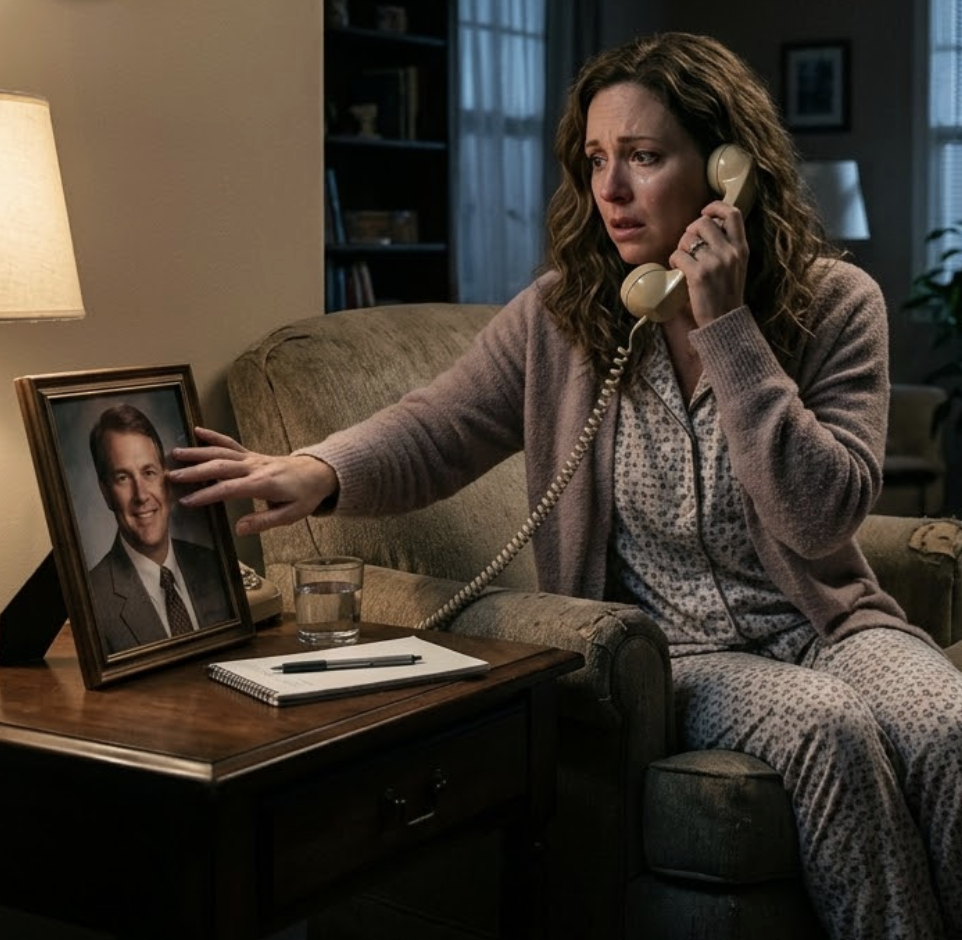
Three months after my father’s funeral, his phone number lit up on my screen.
I almost dropped the phone.
Because the man calling me had been buried in a gray suit, under a maple tree, with half our town standing around his grave.
Then I answered.
And my father’s voice said, “Don’t trust the person holding the will.”
The call lasted nine seconds.
Nine seconds was all it took to turn grief into fear.
My father, Raymond Cole, died on a Tuesday afternoon in March.
The doctors called it a sudden heart attack. He was sixty-nine, still strong enough to mow his own lawn, still stubborn enough to refuse help carrying groceries, still the kind of man who thought aspirin and black coffee could fix most problems. One minute he was in his kitchen making lunch. The next, he was on the floor beside the sink.
My uncle Paul found him.
That fact comforted everyone at first.
Paul was my father’s younger brother, business partner for thirty years, and the man everyone trusted when things became difficult. He handled the ambulance call. He called me. He called the funeral home. He stood beside me at the hospital and said, “Your dad wouldn’t want you worrying about paperwork right now. Let me handle it.”
I believed him.
Why wouldn’t I?
Uncle Paul had always been there.
He was the funny uncle at Thanksgiving, the one who slipped me twenty-dollar bills when I was a kid, the one who helped Dad run Cole Hardware after my mother died. He knew the business accounts, the property documents, the insurance policies. He knew where Dad kept the safe key. He knew the family lawyer. He knew everything.
Too much, I would later realize.
After the funeral, Paul moved quickly.
He said Dad had left him in charge of the estate temporarily. He said the lawyer had the will. He said probate could get messy if I interfered emotionally. He said I needed time to grieve.
“You’re his daughter,” he told me, squeezing my shoulder in the church basement after the service. “You shouldn’t have to carry all this.”
Those words sounded loving then.
Now they sound rehearsed.
For three months, I let him handle everything.
The house. The store. The bank appointments. The insurance calls. The old truck Dad loved more than most people. Every time I asked for copies, Paul said, “Soon.” Every time I asked about the will, he said, “The lawyer is reviewing it.” Every time I asked why things were taking so long, he smiled and told me grief made people impatient.
Then the phone rang.
It was 11:43 p.m.
I was sitting alone at my kitchen table, surrounded by unpaid bills and sympathy cards I still couldn’t throw away. My father’s name appeared on my phone.
Dad.
For a second, my brain refused to understand.
Maybe the number had been reassigned. Maybe it was spam. Maybe grief had finally started playing tricks on me.
Then I answered.
Static crackled.
A breath.
Then his voice.
Weak.
Urgent.
Terrified.
“Anna, listen to me. Don’t trust the person holding the will.”
My entire body went cold.
“Dad?”
There was another burst of static.
“If this message reached you, then I didn’t get time to tell you myself. The real will is not with Paul. It’s in the clock.”
“What clock? Dad?”
“The living room clock. Behind the twelve. Anna, please—”
The call ended.
I sat there with the phone pressed against my ear long after the screen went dark.
The silence in my kitchen felt alive.
I called the number back.
Disconnected.
I called again.
Same automated message.
The number you have dialed is no longer in service.
I did not sleep that night.
By sunrise, I had convinced myself there was a rational explanation. A delayed voicemail. A scheduled recording. Some kind of phone carrier glitch. But no explanation changed what I had heard.
My father’s voice.
The real will.
The clock.
Paul.
At 7:15 a.m., I drove to my father’s house.
The place looked exactly as it had the week after the funeral, except emptier. Paul had already removed several boxes from the office. He said they contained business files. He said the lawyer needed them. He said everything was documented.
The living room clock hung above the fireplace.
It was old, heavy, and ugly in a way only family heirlooms can be. My grandfather had bought it in 1958. It chimed too loudly, ran five minutes slow, and had a scratch across the wood frame from when I hit it with a toy airplane at age seven.
Dad never replaced it.
“Silly thing outlived your mother’s good curtains,” he used to say.
I climbed onto a chair and lifted it from the wall.
The back looked ordinary.
Dusty.
Solid.
I almost laughed at myself.
Then I remembered the voice.
Behind the twelve.
I turned the clock over and examined the face. The glass opened with a tiny latch. The number twelve looked slightly raised compared to the others. I pressed it.
Nothing.
I pressed harder.
A small click.
The number loosened.
Behind it was a narrow slit.
Inside sat a folded envelope wrapped in plastic.
My name was written across the front.
Anna Grace Cole.
My knees weakened.
I climbed down slowly and sat on the floor, holding the envelope in both hands.
Inside was a handwritten note from my father.
Anna,
If you are reading this, then something happened before I could fix the mess I helped create by trusting the wrong person.
I need you to be brave now.
The will Paul has is not the final will.
It is the old one.
He knows that.
The final will is enclosed here, witnessed, signed, and recorded with someone Paul does not know about.
Do not confront him alone.
Do not give him the clock.
And do not believe anything he tells you about the store.
My hands shook so hard the paper bent.
Behind the note was a legal document.
Last Will and Testament of Raymond Thomas Cole.
Signed six weeks before his death.
Witnessed by two names I did not recognize.
Notarized.
There was also a business transfer agreement, a sealed letter, and a small flash drive taped to the inside of the envelope.
The will did not leave everything to Paul.
It left my father’s house to me.
His share of Cole Hardware to me.
A modest trust for the employees.
And one shocking clause.
My brother, Paul Cole, is to receive no ownership interest in Cole Hardware or any related property due to financial misconduct documented separately and known to him.
Financial misconduct.
I read the sentence again.
And again.
My uncle had told everyone he was handling the estate because Dad trusted him most.
Dad had cut him out.
The flash drive contained scanned bank records.
Transfers.
Checks.
Loans against business assets.
Credit lines opened without Dad’s full knowledge.
Payments made to shell companies.
One file was labeled:
Paul — proof.
Another:
If I die suddenly.
That file contained a video.
My father sat at his kitchen table, pale but alive, wearing the same blue cardigan he wore the week before he died.
“Anna,” he said in the recording, “I hope you never have to see this.”
I covered my mouth.
He explained that he had discovered Paul had been draining money from the hardware store for years. At first, small amounts. Then larger. Dad had confronted him privately. Paul cried, begged, said he owed money to dangerous people, promised to repay everything. Dad had tried to protect him.
Because that was who my father was.
Loyal.
Too loyal.
“I was ashamed,” Dad said on the video. “I didn’t want you knowing your uncle could do this. I didn’t want the employees losing faith. I thought I could fix it quietly.”
Then his face hardened.
“But last month, I found out he forged my signature on a loan against the store property. If I had not caught it, we would have lost everything.”
Dad said he had changed the will and hidden the real one because he suspected Paul would try to suppress it. He had also scheduled a delayed voice message through an old phone service his friend used for business reminders.
“If I am wrong about Paul, the message will embarrass me from the grave,” Dad said with a sad smile. “If I am right, it may save you.”
The video ended with him leaning closer to the camera.
“Trust Mr. Alvarez. Not Paul. Alvarez has the duplicate.”
I immediately searched the name.
Samuel Alvarez.
Estate attorney.
Retired.
Two towns over.
Not the lawyer Uncle Paul had been using.
By noon, I was sitting in Alvarez’s office, still wearing the same clothes from the night before.
He was in his late seventies, careful with every word. When I showed him the will, he closed his eyes and exhaled.
“I was afraid this day would come.”
“You knew?”
“I knew your father feared something might happen.”
“Did he think Paul would kill him?”
Alvarez looked at me for a long time.
“He did not use those words.”
That answer frightened me more than yes would have.
Alvarez confirmed the final will was valid. He had a duplicate copy in his files. My father had met with him privately six weeks before dying. He had wanted to remove Paul from control of both the business and estate.
“Why didn’t you come forward after Dad died?”
“Because no one notified me. Your uncle filed documents through another attorney using an older will. I only learned of Raymond’s death from the newspaper after initial filings had begun.”
My stomach turned.
Paul had moved fast because he knew exactly what he was doing.
Alvarez picked up the phone and called a probate attorney he trusted. Then he called a forensic accountant. Then, quietly, he advised me to contact police.
Before I could decide what to do, my phone rang.
Uncle Paul.
I stared at the screen.
Alvarez shook his head.
“Do not answer.”
I let it go to voicemail.
Thirty seconds later, the message arrived.
“Anna, honey, I heard you went by the house this morning. I need you to call me before touching anything else. There are legal issues you don’t understand.”
His voice was calm.
Too calm.
Then came another message.
“I’m not angry. I just need you to bring me whatever you found.”
Whatever you found.
He knew.
By evening, Paul was at my door.
I don’t know how he knew where I was. Maybe he followed me. Maybe someone at Dad’s house saw my car. Maybe he had been watching all along.
He knocked softly.
“Anna?”
I stood frozen in the hallway.
“Open the door. We need to talk.”
I did not move.
His voice changed.
Not louder.
Colder.
“You’re grieving. Your father was confused before he died. Whatever he told you, he didn’t understand what he was doing.”
My heart pounded.
Then he said the sentence that made my blood run cold.
“That clock belongs to the estate.”
He did not ask whether I had found the will.
He mentioned the clock.
I backed away from the door and called 911.
By the time police arrived, Paul was gone.
But he left something on my porch.
A copy of the old will.
And a note.
Your father always trusted me more than you.
For the first time since the phone call, I felt something stronger than fear.
Anger.
The kind that rises when grief realizes it has been used.
My father had not called from beyond the grave.
He had left a warning.
And Paul had been close enough to the truth to be afraid of a dead man’s voice.
The police did not treat it like murder at first.
That was the hardest part.
To them, my father was an older man who died of a heart attack. There was a death certificate. There was a doctor. There was no obvious sign of violence. Family conflict over wills happened every day. Hidden documents, angry relatives, financial disputes—none of it automatically turned a natural death into a crime.
But Mr. Alvarez kept pushing.
So did I.
And once the forensic accountant reviewed the files from the flash drive, the tone changed.
Paul had stolen nearly $380,000 from Cole Hardware over six years.
Not all at once.
Slowly.
Cleverly.
Vendor payments to companies that did not exist.
Repair invoices for equipment never serviced.
Payroll advances to names no one recognized.
Small business owners trust family too easily, and my father had trusted his brother with everything.
The accountant found something else.
Two weeks before Dad died, Paul had tried to transfer majority control of the store property into a new holding company.
My father blocked it.
Three days later, Dad changed his will.
Nine days after that, he died.
Coincidence suddenly felt like an insult.
Detective Marla Quinn was assigned to the case after Alvarez filed a formal complaint regarding suspected elder financial exploitation and estate fraud. She was practical, unsentimental, and impossible to charm. Paul tried anyway.
He arrived at the station wearing a gray suit and grief on his face.
“I loved my brother,” he told Detective Quinn. “Anna is emotional. Raymond had health problems. He was paranoid near the end.”
Detective Quinn asked him how he knew about the clock.
Paul blinked.
“What clock?”
She played my 911 recording.
That clock belongs to the estate.
Paul’s mouth tightened.
“I meant household items generally.”
“Then why say clock?”
No answer.
That was the first crack.
The second came from Dad’s neighbor, Mrs. Donnelly.
She was eighty-one, sharp as a sewing needle, and had disliked Paul for decades.
“I saw him the morning Raymond died,” she told Detective Quinn. “He came out the back door carrying a folder.”
According to Paul, he had arrived after Dad collapsed.
Mrs. Donnelly said otherwise.
She had seen Paul at 11:20 a.m.
The 911 call came at 12:06 p.m.
Forty-six minutes.
Forty-six minutes no one had explained.
Detective Quinn obtained a warrant for Paul’s office at the hardware store.
That search changed everything.
Inside a locked cabinet, investigators found copies of Dad’s medical records. Prescription lists. Notes about his heart condition. A printout explaining how certain medications could interact badly with stress and dehydration. None of that proved murder. But then they found the missing folder Mrs. Donnelly had seen.
Inside were drafts of the final will.
The one Paul claimed not to know existed.
There were also handwritten notes in Paul’s handwriting.
Challenge capacity.
Claim confusion.
Remove Anna from business decisions.
Push old will immediately.
I read those notes in Detective Quinn’s office and felt my stomach twist.
My uncle had not reacted to my father’s death.
He had planned around it.
Then came the toxicology question.
Dad had been cremated after the funeral.
Paul had encouraged it.
“He always wanted to be cremated,” he told me.
That was a lie.
Dad had once told me he wanted to be buried beside my mother.
But after the funeral, Paul insisted cremation was cheaper, simpler, cleaner, and what Dad had requested privately. I had been too numb to fight.
With no body, proving foul play became harder.
Paul knew that too.
But he had made one mistake.
The hospital had kept blood samples from the emergency intake.
Routine storage.
Limited time.
Detective Quinn secured them just before they were due to be discarded.
The toxicology report did not show poison.
Not exactly.
It showed elevated levels of one of Dad’s heart medications—high enough to potentially trigger a dangerous drop in blood pressure, especially combined with another medication he had recently stopped taking.
The medical examiner could not say homicide.
But he changed the manner of death from natural to undetermined pending investigation.
That word—undetermined—felt like a door opening.
Paul’s attorney attacked everything.
He said Dad may have accidentally taken the wrong dosage.
He said older people mix pills all the time.
He said grief made families suspicious.
He said I was being manipulated by lawyers who wanted fees.
Then Detective Quinn found the pharmacy footage.
Three days before Dad died, Paul picked up a refill of Dad’s medication.
Not illegal.
He had done errands for Dad before.
But the prescription bottle found in Dad’s kitchen after death contained more pills missing than expected.
Someone had altered the routine.
Then Mrs. Donnelly remembered another detail.
The morning Dad died, she heard shouting.
Not enough to make out every word.
But she heard my father say one sentence clearly through the open kitchen window.
“You won’t steal from my daughter too.”
Paul had told police Dad was already unconscious when he arrived.
Now there was evidence they argued.
Detective Quinn brought him in again.
This time, Paul’s charm faded.
He said Dad invited him over to discuss the store.
He admitted they argued.
He admitted seeing the final will.
He admitted Dad threatened to go to police.
But he denied harming him.
“He grabbed his chest,” Paul said. “He collapsed. I panicked.”
“Why wait forty-six minutes to call 911?” Detective Quinn asked.
“I didn’t know what to do.”
“You removed documents.”
“I was scared.”
“Of your brother dying?”
Paul looked away.
“Of being blamed.”
That answer told the room more than he meant it to.
The case became public after Paul was arrested—not for murder at first, but for financial fraud, forgery, evidence tampering, and exploitation. Reporters came to the store. Former customers left flowers by the door. Employees cried when they learned Dad had left them money in the real will.
One employee, Martin, told me Dad had been different before he died.
“Nervous,” he said. “But determined. He said he was cleaning house.”
Cleaning house.
That sounded like Dad.
Paul fought the will in probate court.
He claimed Dad lacked capacity.
He claimed I influenced him.
He claimed Alvarez manipulated an old man.
But Dad’s video destroyed that argument. He spoke clearly. Explained specific financial misconduct. Named documents. Named dates. Named accounts. He even joked bitterly that if dying was the only way to make people listen, he hoped at least the video had good lighting.
The judge upheld the final will.
Paul lost control of the estate.
Then the criminal case widened.
Investigators traced money from the stolen business funds to gambling debts and private loans. Paul had been desperate. Not desperate enough to confess. Desperate enough to corner his brother in a kitchen and demand silence.
The prosecutor could not prove Paul intentionally killed Dad by medication.
But they argued he delayed calling emergency services after Dad collapsed because he wanted time to remove documents and secure the old will. That delay, they said, contributed to Dad’s death.
Paul eventually accepted a plea deal.
Fraud.
Forgery.
Evidence tampering.
Criminally negligent homicide.
Not murder.
That word bothered me for a long time.
Murder felt emotionally true.
Negligence felt too small.
But Detective Quinn told me something I never forgot.
“Courts deal in provable truth. Families live with the rest.”
At Paul’s sentencing, I read a statement.
I thought I would rage.
Instead, I spoke quietly.
“My father trusted his brother. That trust was used against him. My father knew he might not survive long enough to tell the truth, so he left his voice behind. You tried to take his business, his wishes, and his dignity. But you failed to take his warning.”
Paul did not look at me.
He stared at the floor.
When the judge sentenced him, I felt no satisfaction.
Only exhaustion.
Afterward, I returned to Dad’s house alone.
The living room clock was still on the table where I had left it after removing the envelope. For weeks, I could not bring myself to hang it back up. It felt less like a clock now and more like a witness.
Finally, I opened the back panel to clean it.
That was when I found the last message.
A tiny folded note tucked behind the pendulum.
I almost missed it.
It was not legal.
Not dramatic.
Just Dad.
Anna,
If you got this far, then you probably know more than I wanted you to carry.
I am sorry.
Parents like to believe they can leave their children peace.
Sometimes all we can leave is truth.
Do not let this make you hard.
Be careful, yes.
Be wise, yes.
But do not become someone who trusts no one.
Your uncle’s betrayal belongs to him.
Do not let it steal your heart too.
I sat on the floor and cried until the room blurred.
That was my father.
Even after being betrayed, he worried about what bitterness might do to me.
Months later, I reopened Cole Hardware.
Not because I knew how to run a hardware store.
I didn’t.
But the employees did.
Dad had left them shares through the trust. Martin became general manager. I kept ownership but learned slowly. Paint inventory. Vendor contracts. Payroll. Customer accounts. The old men who came in every morning for screws they did not need and conversation they did.
On the first anniversary of Dad’s death, I hung the clock back above the fireplace.
It still ran five minutes slow.
I left it that way.
Some things do not need fixing.
The number twelve looked normal again, but I knew what had been hidden behind it. I knew how close Dad had come to having his final wishes buried under fraud and family loyalty. I knew how easily grief can be manipulated by someone who speaks gently while reaching for everything.
People sometimes ask whether I believe my father called me from the dead.
I tell them no.
Then I tell them something stranger.
He knew the living well enough to send his voice after death.
He knew his brother.
He knew me.
He knew I would doubt myself.
He knew I would need proof, not just suspicion.
So he gave me both.
A phone call.
A clock.
A will.
A warning.
And one final lesson.
Death does not always silence people.
Sometimes the truth waits for the right person to answer.
Do you think Raymond should have exposed Paul while he was alive, or was hiding the truth until he had enough proof the only way to protect his daughter and his business?


