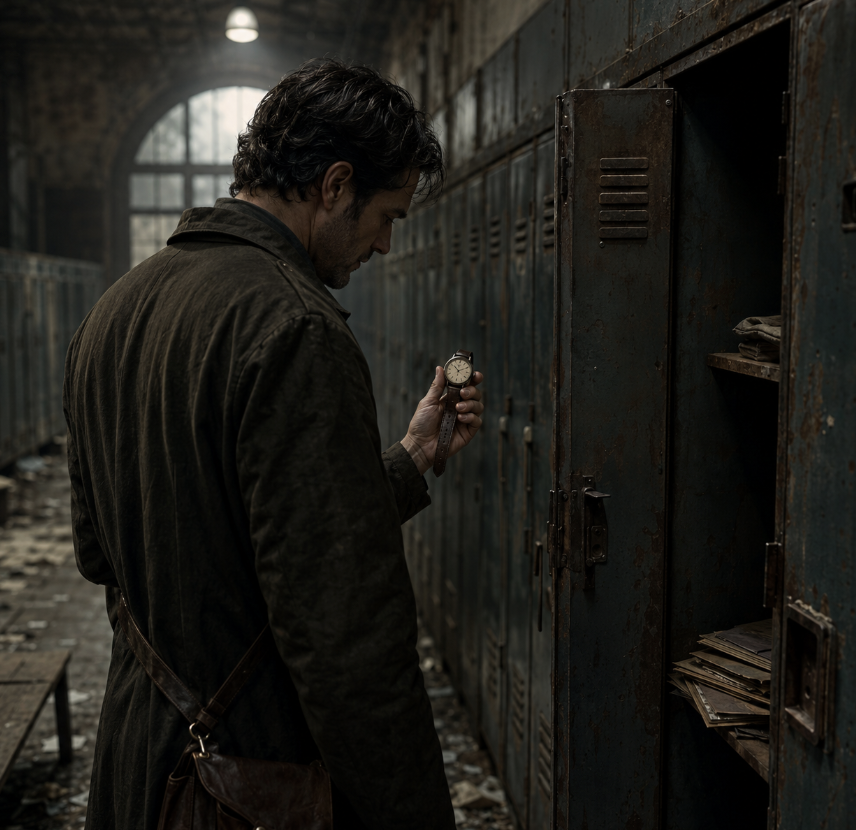
The clock stopped at exactly 3:17.
Not 3:16.
Not 3:18.
For forty years, the hands never moved.
And after my father’s funeral, I finally discovered why.
The answer led me to a forgotten train station, a hidden locker, and a family secret my father had sacrificed his entire life to protect.
My name is Daniel Mercer.
For most of my life, I believed my father was a disappointment.
Not a bad man.
Not a cruel man.
Just a man who never became what everyone thought he should have been.
My father, William Mercer, spent thirty-eight years working as a clerk for the county transportation office.
Same desk.
Same building.
Same routine.
While his friends became executives, attorneys, judges, and business owners, my father stayed exactly where he was.
People often asked why.
He always smiled and changed the subject.
When I was younger, that answer frustrated me.
As I got older, it embarrassed me.
My father was intelligent.
Brilliant, actually.
Teachers used to tell me stories about him.
He graduated near the top of his class.
Won scholarships.
Received job offers from prestigious firms.
Yet somehow he walked away from every opportunity.
Nobody understood why.
Not even my mother.
Especially not me.
The only thing my father treasured more than family was an old silver pocket watch.
He carried it everywhere.
Every day.
Every year.
For four decades.
The watch looked ordinary.
Scratched case.
Faded engraving.
Worn chain.
Nothing special.
Except for one detail.
It never worked.
The hands remained frozen at 3:17.
As a child, I asked about it constantly.
“Why don’t you fix it?”
My father would smile.
“Because it’s already doing its job.”
I never understood what that meant.
Nobody did.
Even my mother laughed about it.
“Your father carries a broken watch because he’s too stubborn to buy a new one.”
My father never corrected her.
Instead, he simply tucked the watch back into his pocket.
And life moved on.
Then came the phone call.
My father died on a Tuesday morning.
Heart failure.
Seventy-eight years old.
Peaceful.
Quick.
Final.
The funeral was larger than I expected.
Hundreds of people attended.
Former coworkers.
Neighbors.
Old friends.
People I had never met.
They all told the same story.
Your father helped me.
Your father saved me.
Your father changed my life.
The stories confused me.
I knew my father as a quiet man who rarely spoke about himself.
Yet strangers described him like a hero.
A mentor.
A protector.
Someone who appeared exactly when needed.
It felt like they were talking about a different person.
After the funeral, I returned to my parents’ house.
My mother had passed away years earlier.
The responsibility of sorting everything fell to me.
For days, I packed boxes.
Old photographs.
Tax records.
Family albums.
The usual things.
Then I found the watch.
It sat inside the top drawer of my father’s nightstand.
Beside it rested a handwritten envelope.
My name appeared on the front.
Daniel.
If you’re reading this, the watch has finally become your responsibility.
I stared at the note for several seconds before opening it.
Inside was a single sheet of paper.
The message contained only two sentences.
The answer is where time stopped.
Locker 317.
Union Station.
Nothing else.
No explanation.
No signature.
Just those words.
Locker 317.
Union Station.
At first I assumed it was nonsense.
Maybe dementia had affected him before his death.
Maybe it was an unfinished thought.
But something about the message bothered me.
The next morning I drove to the old Union Station on the edge of the city.
Most people didn’t even know it still existed.
The building had been largely abandoned after newer transportation hubs opened decades earlier.
Only a few sections remained operational.
Dust covered everything.
The place felt frozen in time.
A maintenance worker pointed me toward the storage lockers.
Most had been removed years ago.
Only a handful remained.
I walked slowly through the corridor.
Then I saw it.
My pulse quickened.
The locker was real.
Still intact.
Still locked.
Attached to the handle was a layer of dust thick enough to suggest nobody had touched it in years.
Possibly decades.
I examined the pocket watch again.
For the first time, I noticed something unusual.
Tiny numbers engraved near the winding stem.
The key.
My father had been carrying the key for forty years.
My hands trembled as I inserted it.
The lock clicked immediately.
The metal door opened.
Inside sat a small leather briefcase.
Nothing else.
No money.
No valuables.
Just a briefcase.
The kind businessmen carried in old movies.
I lifted it carefully.
Surprisingly heavy.
Inside were dozens of documents.
Newspaper clippings.
Photographs.
Legal files.
Audio cassette tapes.
And one sealed letter marked:
Read this first.
The handwriting belonged to my father.
Daniel,
Before you judge what you’re about to learn, understand one thing.
Everything I did was for this family.
Every sacrifice.
Every lie.
Every opportunity I walked away from.
I chose all of it.
I sat down on a nearby bench.
The station suddenly felt colder.
The letter continued.
In 1983, I witnessed something I was never supposed to see.
Something powerful people would have killed to keep hidden.
I felt my stomach tighten.
My father?
The quiet clerk who spent his life behind a desk?
The words made no sense.
Then I kept reading.
On March 17, 1983, at exactly 3:17 p.m., a train arrived carrying evidence connected to one of the largest corruption investigations in state history.
The evidence disappeared before reaching federal authorities.
Officially, nobody knew what happened.
Unofficially, I watched it happen.
I stopped reading.
The date.
The time.
3:17.
The watch.
The locker.
Suddenly everything connected.
The watch had never been broken.
It was a reminder.
A memorial.
A warning.
And according to the next paragraph, my father spent the rest of his life paying the price for what he witnessed.
Then I found the photograph.
And the man standing beside the governor was someone I recognized immediately.
Not because he was famous.
Because he had attended my father’s funeral three days earlier.
For several seconds, I simply stared at the photograph.
The man standing beside the governor was unmistakable.
Silver hair.
Sharp jawline.
Same cold eyes.
The same man who had shaken my hand at my father’s funeral and told me, “Your father was one of the bravest men I ever knew.”
At the time, I assumed he was an old coworker.
Now I wasn’t so sure.
I flipped the photograph over.
A name was written on the back.
Judge Harold Whitmore.
The name meant nothing to me.
But apparently it had meant everything to my father.
My hands shook as I continued reading.
The next folder contained newspaper articles from 1983.
Most of them focused on a massive state infrastructure project.
Billions of dollars.
Railroad expansion.
Construction contracts.
Political promises.
Everything seemed ordinary until I noticed several names repeated throughout the articles.
Developers.
Contractors.
State officials.
Many later became wealthy and influential.
A few eventually went to prison.
Several died under mysterious circumstances.
And almost every article had notes scribbled in my father’s handwriting.
Arrows.
Dates.
Names circled in red ink.
Connections drawn between people who officially had nothing to do with one another.
The deeper I looked, the stranger everything became.
Then I found the cassette tapes.
Six of them.
Each carefully labeled.
March 1983.
April 1983.
May 1983.
And so on.
Beside them sat a small tape recorder.
My father had apparently expected me to listen.
I inserted the first tape.
Static filled the station.
Then a younger version of my father’s voice emerged.
“If you’re hearing this, then I’m gone.”
I nearly dropped the recorder.
Hearing his voice again felt like reopening a wound.
For a moment I considered stopping.
Instead, I kept listening.
My father explained that in 1983 he worked in transportation logistics.
His job involved tracking rail shipments entering and leaving the city.
Nothing glamorous.
Nothing political.
Until one specific train arrived.
March 17.
3:17 p.m.
The exact time frozen on the watch.
According to my father, federal investigators had secretly gathered evidence proving widespread corruption involving government officials and private contractors.
Millions of dollars had been stolen through fraudulent infrastructure contracts.
The evidence was being transported under heavy security.
At least that was the plan.
Something happened before it arrived.
The shipment vanished.
Officially, it was lost.
Unofficially, powerful people intercepted it.
My father happened to witness part of the operation.
Not enough to understand everything.
But enough to recognize several faces.
Enough to know something illegal had occurred.
Enough to become dangerous.
The tape ended abruptly.
I inserted the second one.
This recording was harder to hear.
The emotion in my father’s voice was unmistakable.
He described being contacted two weeks after the incident.
A man approached him in a parking garage.
The stranger knew my mother’s name.
Knew where I attended preschool.
Knew our address.
The message was simple.
Forget what you saw.
My father refused.
At first.
Then things escalated.
Phone calls.
Surveillance.
Threats.
One evening someone smashed every window in our house.
Police never found the culprits.
A month later, my father’s car brakes mysteriously failed.
He survived.
Barely.
The message became impossible to ignore.
Then came the offer.
A promotion.
A six-figure salary.
Relocation.
A chance to disappear quietly.
All he needed to do was sign a statement claiming he had seen nothing unusual.
He refused again.
I sat motionless listening.
This wasn’t the father I knew.
This wasn’t the quiet man who balanced checkbooks and mowed lawns.
This was someone fighting a secret war.
A war he never discussed.
The third tape explained why.
My father met Judge Harold Whitmore.
Back then Whitmore wasn’t a judge.
He was a federal prosecutor.
One of the few people investigating the corruption case.
According to the tape, Whitmore believed my father’s testimony could expose dozens of powerful individuals.
There was only one problem.
Every witness connected to the investigation began disappearing.
Not murdered.
Not publicly harmed.
Just discredited.
Ruined.
Destroyed financially.
One by one.
My father realized the truth.
Winning the case might cost his family everything.
Then came the decision that changed his life.
A secret agreement.
Judge Whitmore proposed a compromise.
The evidence would be preserved.
Hidden.
Protected.
Until a future time when it could safely surface.
My father would walk away.
Publicly.
Completely.
No testimony.
No publicity.
No confrontation.
In return, federal authorities would quietly shield our family.
The arrangement sounded absurd.
Yet according to the documents, it happened.
My father sacrificed his role in the investigation.
Sacrificed his career.
Sacrificed promotions.
Sacrificed wealth.
Everything.
Because remaining invisible became the safest way to protect us.
Suddenly my entire childhood made sense.
The opportunities he declined.
The promotions he rejected.
The strange moves we made.
The jobs he refused.
The investments he avoided.
I spent decades believing he lacked ambition.
In reality, he was avoiding attention.
Attention got people hurt.
The next file hit even harder.
It contained dozens of letters.
Letters my father wrote but never mailed.
Most were addressed to me.
One was dated the day I graduated college.
Daniel,
Today I watched you receive a diploma I once dreamed of earning myself.
You think I settled for less in life.
Maybe one day you’ll understand that some victories never appear on resumes.
I had to stop reading.
Tears blurred the page.
There were dozens more.
Letters written after birthdays.
Letters written after arguments.
Letters written after major moments in my life.
My father never sent them.
Never showed them to me.
Instead, he stored them inside a forgotten locker beneath a train station.
Waiting.
The final folder was labeled:
If anything happens to me.
Inside was the missing evidence.
Copies.
Photographs.
Financial records.
Signed statements.
Everything.
Enough documentation to support much of what he claimed.
Not enough to prosecute everyone involved after forty years.
But enough to reveal the truth.
Enough to preserve history.
Enough to explain his sacrifice.
Then I found the final letter.
The shortest one in the box.
Daniel,
The watch stopped at 3:17 because that’s the moment my old life ended.
Everything afterward belonged to you and your mother.
People will say I wasted my potential.
Let them.
I know what I chose.
I chose my family.
If I had to do it again, I would make the same decision.
Every single time.
Love,
Dad
I sat alone inside the abandoned station for nearly an hour.
The sounds of distant trains echoed through the building.
For the first time in my life, I understood my father.
Not the man I imagined.
The real man.
The man who willingly accepted being misunderstood.
The man who allowed his own son to think he was ordinary.
The man who quietly surrendered success so his family could remain safe.
Weeks later, I met Judge Whitmore.
He was ninety years old.
Fragile.
Near the end of his life.
When I showed him the watch, tears filled his eyes.
“William kept it.”
“He carried it every day.”
Whitmore nodded.
“Most people who call themselves heroes are trying to be noticed.”
Then he smiled sadly.
“Your father spent forty years making sure nobody noticed him.”
I asked the question that had haunted me since opening the locker.
“Was it worth it?”
The old man looked out the window for a long moment.
Then he answered.
“Your father got to watch his son grow up.”
Another pause.
“Several witnesses didn’t.”
That answer stayed with me.
Today, the watch sits on my desk.
Still frozen at 3:17.
I could repair it tomorrow.
Any jeweler could make it work again.
But I never will.
Because the watch was never broken.
It was a reminder.
A reminder that some people sacrifice fame for family.
Some sacrifice fortune for peace.
And some spend their entire lives carrying burdens nobody else ever sees.
For forty years, I believed my father lacked courage.
The truth was exactly the opposite.
He possessed more courage than anyone I have ever known.
And every time I look at that frozen watch, I remember the lesson he left behind.
The greatest sacrifices are often the ones nobody ever applauds.
Do you think William made the right choice by protecting his family instead of exposing the corruption, or should he have risked everything to make sure the guilty were brought to justice?


