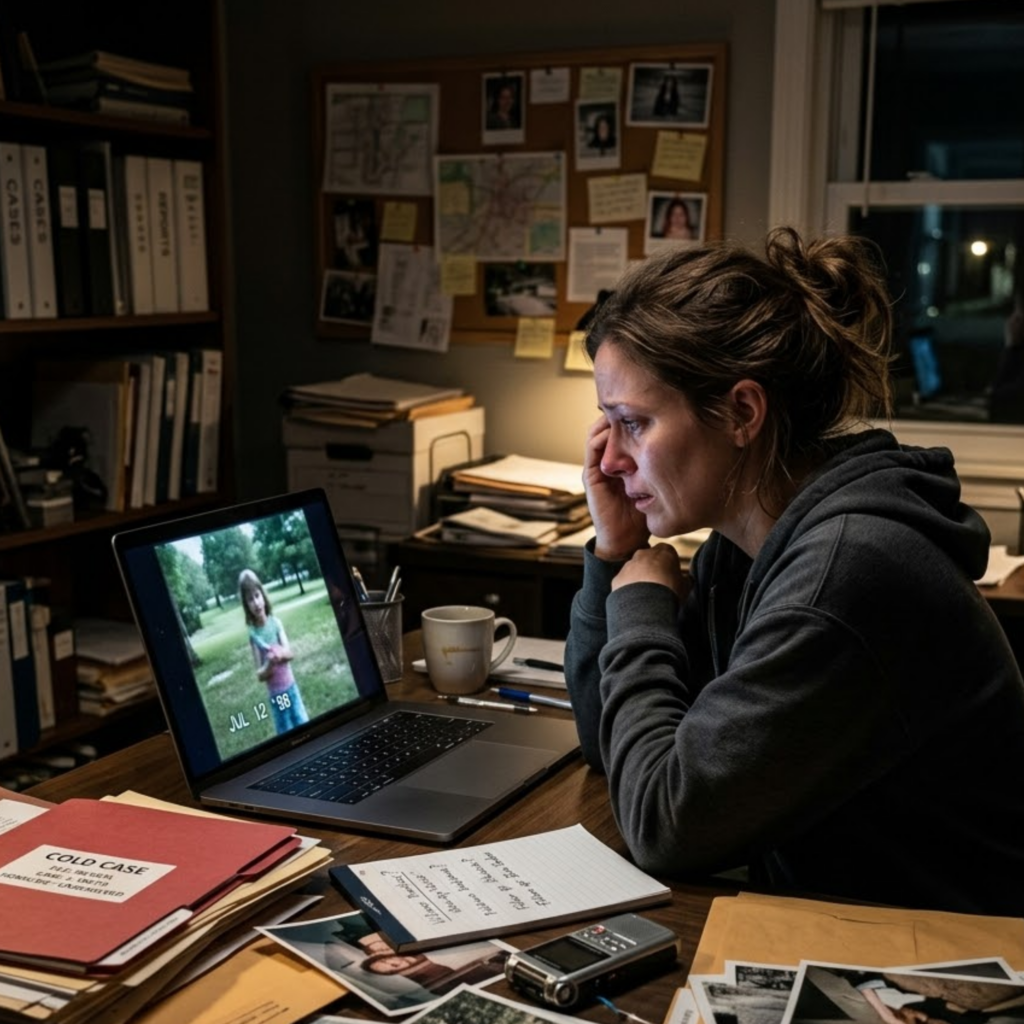
Fifteen years after my sister’s death, a package arrived with no return address.
Inside was a flash drive.
No note.
No explanation.
Just one video file.
And before the night was over, everything my family believed about my sister’s death would begin to unravel.
My sister Emily Harper died during her sophomore year of college.
At least that’s what the official report said.
The police called it a suicide.
The university called it a tragedy.
The case was closed within weeks.
But my family never believed it.
Not for one second.
Emily was twenty years old.
Smart.
Ambitious.
Stubborn.
The kind of person who planned her life five years ahead.
She kept notebooks filled with goals.
Career plans.
Travel dreams.
Lists of things she wanted to accomplish.
Three days before her death, she had called my mother excited about an internship opportunity.
Two days before her death, she had ordered textbooks for the following semester.
The morning before her death, she had emailed a professor asking about graduate school programs.
Nothing about her behavior suggested someone preparing to end her life.
Yet that was exactly what authorities concluded.
According to the police report, Emily was found dead near an abandoned service road behind the university.
No witnesses.
No clear explanation.
No surveillance footage.
Just a conclusion.
Suicide.
The investigation lasted less than a month.
My mother spent years fighting that conclusion.
Writing letters.
Calling detectives.
Requesting records.
Eventually everyone stopped listening.
Time moved on.
The case grew cold.
My father died believing the truth had never been found.
My mother carried the grief until her own death six years later.
And I tried to move forward.
At least until the flash drive arrived.
The package appeared on my doorstep on a rainy Thursday afternoon.
No postage marks.
No sender information.
Nothing.
Just my name written across the front.
I almost threw it away.
Then curiosity won.
That night I inserted the drive into my laptop.
One video file appeared.
Timestamped.
October 17.
Fifteen years earlier.
The night Emily died.
My heart nearly stopped.
The file opened.
At first, the footage looked ordinary.
A dormitory hallway.
Students walking.
People laughing.
Doors opening and closing.
The camera appeared to belong to a student recording random moments.
Then Emily appeared.
She walked into frame carrying a backpack.
I immediately recognized her.
Same dark hair.
Same denim jacket.
Same nervous habit of tucking hair behind her ear.
The timestamp showed 8:42 p.m.
The official report claimed nobody knew where Emily had been during the final hours before her death.
Yet here she was.
Alive.
Recorded.
The video continued.
Emily wasn’t alone.
Three other students followed behind her.
Two men.
One woman.
All roughly the same age.
They seemed familiar.
As if I had seen their faces somewhere before.
Then one of them looked directly toward the camera.
And suddenly I remembered.
The student government president.
A man named Tyler Benson.
His face had appeared repeatedly in newspaper articles after Emily’s death.
At the time, police considered him a witness.
Nothing more.
The footage continued for several minutes.
Then something strange happened.
Emily appeared upset.
Not frightened.
Not yet.
Upset.
She pointed toward Tyler.
The audio was poor.
Most words were impossible to hear.
But one sentence came through clearly.
“You lied to me.”
The hallway suddenly became quiet.
Several students stopped walking.
The atmosphere shifted.
Even fifteen years later, I could feel the tension.
Tyler said something back.
Emily shook her head.
Then she walked away.
Fast.
The others followed.
The video ended.
I immediately watched it again.
And again.
And again.
The footage raised more questions than answers.
But it proved one thing.
Emily had spent part of her final night with people police claimed knew very little about her movements.
The next morning I contacted Detective Alan Price.
Retired now.
He had worked the original investigation.
At first he refused to meet.
Then I mentioned the video.
Silence.
Long silence.
Finally he agreed.
We met at a diner outside town.
Price looked older than I remembered.
Tired.
Worn down by decades of police work.
When I showed him the footage, he stared without speaking.
Then he muttered three words.
“Oh my God.”
I knew immediately.
He had never seen the video before.
That realization terrified me.
Because it meant evidence existed outside the original investigation.
Evidence nobody had turned over.
Evidence hidden for fifteen years.
Price asked where I got it.
I told him the truth.
I had no idea.
Then he said something that changed everything.
“Tyler Benson wasn’t the only student we questioned.”
He leaned forward.
“There were four students together that night.”
Exactly four.
The same number visible in the video.
According to Price, all four claimed Emily left voluntarily around 9 p.m.
Each story matched perfectly.
Almost too perfectly.
At the time, investigators considered that consistency a sign of truthfulness.
Now it looked different.
Now it looked rehearsed.
The retired detective requested a copy immediately.
By the following week, state investigators reopened portions of the case.
Unofficially at first.
Quietly.
Discreetly.
Then another twist arrived.
A forensic analyst enhanced the audio.
Most of the conversation remained unusable.
But one sentence emerged clearly enough to identify.
Emily’s voice.
Scared.
Angry.
Desperate.
And directed toward someone standing beside Tyler.
The words sent chills through everyone involved.
“You promised nobody would find out.”
Suddenly the case wasn’t just about Emily’s death.
It was about a secret.
A secret she apparently believed someone was hiding.
Investigators began tracking the other students from the video.
One lived overseas.
One worked for a major law firm.
And Tyler Benson…
Tyler Benson had become a state senator.
The story was getting bigger.
Much bigger.
Then investigators found something hidden inside the video metadata.
A GPS coordinate.
One final location recorded before the file was copied.
And that location happened to be less than a mile from where Emily’s body was eventually discovered.
The GPS coordinates led investigators to an abandoned maintenance building hidden behind a wooded section of the university property.
Fifteen years earlier, the structure had been used by groundskeeping crews.
Today it sat empty.
Boarded windows.
Collapsed fencing.
Layers of graffiti covering the walls.
At first glance, it seemed insignificant.
But Detective Price immediately recognized the address.
The building had appeared briefly in the original investigation.
Only once.
And then it disappeared from the case file entirely.
That alone raised alarms.
Within days, investigators obtained warrants and reopened archived evidence.
Forensic teams searched the building from top to bottom.
Most expected nothing.
After fifteen years, any useful evidence should have vanished.
Instead, they found something shocking.
Hidden beneath a loose section of flooring was a metal storage box.
Inside were old photographs.
Student records.
A disposable camera.
And a stack of DVDs.
The discovery changed everything.
The disposable camera still contained undeveloped film.
When specialists processed it, several images appeared.
Most showed ordinary college parties.
Dorm gatherings.
Student events.
Nothing remarkable.
Then investigators reached the final roll.
The photographs showed Emily.
Tyler Benson.
The same two students from the hallway video.
And several university administrators.
The setting appeared private.
Almost secretive.
Nobody seemed aware they were being photographed.
One image immediately caught investigators’ attention.
Emily was arguing with Tyler.
The expression on her face wasn’t sadness.
It wasn’t despair.
It was fear.
Real fear.
The kind detectives recognize instantly.
Then investigators examined the DVDs.
Most were damaged.
Some completely unreadable.
But one survived.
The footage appeared to come from a student-operated recording system used by campus journalism volunteers.
The timestamp showed the week before Emily died.
The video revealed something nobody expected.
Emily wasn’t simply a student.
She was investigating something.
The footage showed her interviewing multiple students.
Asking questions.
Taking notes.
Collecting statements.
Several interviews referenced the same issue.
Missing scholarship funds.
At first investigators assumed it was a financial dispute.
Then the interviews became darker.
Students described intimidation.
Threats.
Pressure to remain silent.
Several claimed scholarship money had disappeared while university officials blamed administrative errors.
One student made a statement that stopped everyone cold.
“If Emily keeps digging, she’s going to get herself hurt.”
The interview ended abruptly.
No explanation.
No context.
But the warning suddenly seemed prophetic.
The reopened investigation exploded.
Financial audits began.
Former university employees were interviewed.
Dozens of archived records were subpoenaed.
The deeper investigators dug, the worse things became.
Millions of dollars in student funds appeared unaccounted for.
Records had been altered.
Documents disappeared.
Witness statements conflicted.
And Tyler Benson’s name appeared repeatedly.
At first only peripherally.
Then directly.
Back in college, Tyler wasn’t merely student government president.
He sat on committees overseeing scholarship distributions.
Committees connected to the missing funds.
The coincidence was impossible to ignore.
But investigators still lacked proof connecting Emily’s death to any crime.
Then another witness emerged.
Unexpectedly.
A woman named Sarah Whitman contacted Detective Price.
She had been the fourth student visible in the hallway video.
The only woman walking beside Emily that night.
For fifteen years she had remained silent.
Now she wanted to talk.
Her testimony changed the case forever.
According to Sarah, Emily discovered evidence suggesting multiple individuals were manipulating scholarship funds through fake student accounts.
Money intended for struggling students was being diverted elsewhere.
Emily planned to expose everything.
Not through social media.
Not anonymously.
Officially.
She intended to deliver documentation directly to state investigators.
Three days later, she died.
Sarah admitted something else.
The four students’ statements had been coordinated.
Not by police.
By Tyler.
He convinced everyone the death was a suicide.
He insisted that talking publicly would destroy innocent lives.
At the time, Sarah believed him.
Years later, she wasn’t so sure.
Then came the most devastating revelation.
Sarah wasn’t with Emily during her final hour.
But she knew who was.
Tyler Benson.
The future senator was the last confirmed person seen with Emily alive.
Investigators immediately subpoenaed phone records preserved in archived telecommunications systems.
Technology had improved dramatically since the original case.
Old data once considered useless could now be reconstructed.
The records placed Tyler’s phone exactly where Emily’s phone last transmitted.
Near the abandoned service road.
Near the maintenance building.
Near the place where her body was eventually found.
Publicly, Tyler denied everything.
He agreed to interviews.
Called the accusations ridiculous.
Claimed political enemies were exploiting a tragedy.
For a brief moment, it seemed he might escape scrutiny again.
Then another package arrived.
This time it was sent directly to investigators.
Inside was a second flash drive.
The sender remained anonymous.
The contents were devastating.
Unlike the first video, this footage came from a parking lot security camera.
The timestamp showed 11:18 p.m.
Only hours before Emily died.
The image quality was poor.
But the individuals were identifiable.
Emily appeared on screen.
Running.
Not walking.
Running.
She looked terrified.
She repeatedly glanced behind her.
Seconds later, two figures entered the frame.
One was clearly Tyler.
The second person remained harder to identify.
But investigators no longer cared about theories.
For the first time in fifteen years, they possessed evidence directly contradicting the suicide narrative.
Emily had been fleeing from someone.
The footage spread through investigative circles rapidly.
Detectives reviewed every detail frame by frame.
Then a forensic enhancement specialist isolated a crucial moment.
Emily briefly turned toward the camera.
Her face was visible.
Tears streamed down her cheeks.
And she appeared injured.
The discovery transformed the case.
The official manner of death was no longer accepted.
State authorities formally reclassified the investigation.
No longer a suicide review.
A homicide inquiry.
National media seized the story.
Old classmates came forward.
Former university staff began cooperating.
One retired administrator admitted he had been pressured years earlier to remain silent regarding missing financial records.
Another revealed that documents connected to Emily’s investigation disappeared immediately after her death.
The wall of silence finally cracked.
Then investigators discovered what Emily had been trying to protect.
Among her recovered notes was a folder labeled simply:
Students.
Inside were names.
Dozens of them.
Recipients whose scholarships had vanished.
Students forced to leave school.
Students burdened with debt.
Students whose lives changed because money intended for them disappeared.
Emily wasn’t investigating for personal gain.
She was trying to help people.
Trying to expose corruption.
Trying to do the right thing.
The realization devastated everyone who knew her.
Especially me.
For fifteen years, the world remembered her as a troubled student who took her own life.
In reality, she had been fighting for others.
Months later, a grand jury began hearing evidence.
Tyler Benson resigned from office.
Publicly, he continued denying wrongdoing.
Privately, several former associates began cooperating.
One eventually admitted that key witness statements from the original investigation had been intentionally shaped to support the suicide narrative.
The conspiracy was larger than anyone imagined.
Not dozens of people.
But enough.
Enough to bury the truth.
Enough to destroy a young woman’s reputation.
Enough to delay justice for fifteen years.
The final breakthrough came from the first anonymous sender.
Investigators eventually identified him.
A retired campus technician.
He had preserved copies of surveillance recordings because something about Emily’s death never felt right.
Fear kept him silent.
Age finally changed his mind.
Before turning over the evidence, he wrote a letter.
One sentence stayed with me.
I couldn’t save Emily, but maybe I could save the truth.
The investigation remains one of the largest scandals in the university’s history.
Multiple careers ended.
Settlements followed.
Policies changed.
Scholarship systems were overhauled.
But none of that brought Emily back.
Sometimes I still think about the night she died.
About the hallway video.
About the moment she said:
“You lied to me.”
For years, nobody knew what she meant.
Now we do.
She wasn’t talking about a relationship.
She wasn’t talking about friendship.
She was talking about trust.
She trusted people who ultimately failed her.
People who chose self-preservation over honesty.
People who watched the truth disappear.
Fifteen years after her death, justice arrived too late for Emily.
But it arrived.
And perhaps that’s why the anonymous package appeared.
Someone finally decided the truth mattered more than fear.
Today, the first flash drive sits in a locked drawer.
Not because I want to forget it.
Because I never will.
The footage gave my family something we thought we’d lost forever.
Not answers to every question.
But proof.
Proof that Emily never gave up.
Proof that she wasn’t the person the reports claimed she was.
Proof that during her final hours, she was fighting to expose something bigger than herself.
And sometimes, that’s enough to change history.
Do you think the people who stayed silent for fifteen years were victims of fear, or do they share responsibility for what happened to Emily?


