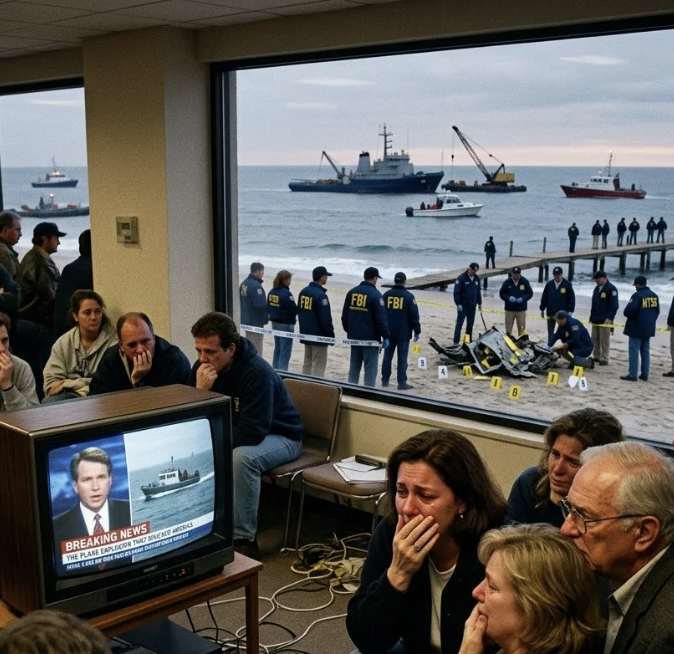
A routine flight carrying families, students, and vacationers vanished in a fireball over the Atlantic Ocean.
Within minutes, 230 people were gone.
And for years afterward, America would ask the same haunting question.
What really happened to TWA Flight 800?
On the evening of July 17, 1996, most passengers boarding Trans World Airlines Flight 800 believed they were beginning an ordinary journey.
Some were traveling to Paris for vacations.
Some were heading overseas for work.
Several teenagers were returning from a school-sponsored trip.
Families carried cameras, souvenirs, and plans for the future.
Nobody boarding the Boeing 747 at New York’s John F. Kennedy International Airport could have imagined that their flight would soon become one of the most investigated aviation disasters in American history.
Flight 800 departed JFK at approximately 8:19 p.m.
The massive aircraft climbed into the summer sky over the Atlantic Ocean.
Air traffic controllers communicated normally with the crew.
Passengers settled into their seats.
Flight attendants continued routine service.
Everything appeared ordinary.
Then, less than twelve minutes later, something catastrophic happened.
At approximately 8:31 p.m., radar contact disappeared.
Witnesses along the coast of Long Island reported seeing a bright flash in the sky.
Others described a fireball.
Some saw burning debris falling toward the ocean.
Within moments, emergency agencies realized a major disaster had occurred.
A fully loaded Boeing 747 carrying 230 people had broken apart over the Atlantic.
No survivors were found.
The tragedy immediately dominated news broadcasts across the United States.
Television networks interrupted programming.
Reporters rushed to Long Island.
Families across the country desperately searched passenger lists.
For many Americans, the disaster felt especially terrifying because it happened so suddenly.
One moment the aircraft was climbing normally.
Minutes later it no longer existed.
Questions emerged almost immediately.
Had there been a mechanical failure?
A bomb?
A missile?
A terrorist attack?
Nobody knew.
And in those first hours, uncertainty only intensified the fear.
The ocean search began immediately.
Coast Guard vessels.
Navy ships.
Divers.
Helicopters.
Hundreds of personnel participated in what became one of the largest recovery operations ever conducted in American waters.
The scale was overwhelming.
The aircraft had shattered into thousands of pieces.
Debris scattered across miles of ocean.
Recovery teams worked day and night.
Each fragment mattered.
Each piece could potentially reveal what happened during those final moments.
As investigators arrived, another challenge emerged.
Witness reports seemed to conflict.
Many people along Long Island’s shoreline claimed they saw a streak of light moving upward before the explosion.
Some believed they had witnessed a missile.
Others described an object racing toward the aircraft.
Television coverage amplified these accounts.
Speculation spread rapidly.
Talk radio programs debated theories.
Newspapers published competing explanations.
America became consumed by the mystery.
At the same time, grief spread through hundreds of homes.
Parents waited for news that never improved.
Spouses received devastating confirmations.
Children learned that mothers and fathers would never come home.
Entire communities mourned.
Among the victims were students from a French Club trip returning from educational travel.
Their deaths shocked schools and neighborhoods across the country.
For investigators, however, emotions had to be balanced with evidence.
The National Transportation Safety Board launched an enormous inquiry.
The Federal Bureau of Investigation became heavily involved.
Given the possibility of criminal activity, the investigation quickly expanded.
Thousands of interviews were conducted.
Witness statements were collected.
Radar data was analyzed.
Military records were reviewed.
Nothing could be ignored.
Then came one of the most ambitious recovery efforts ever attempted.
Investigators decided to recover as much of the aircraft as possible from the ocean floor.
The process took months.
Eventually, thousands of wreckage pieces were brought ashore.
Inside a massive hangar, experts began reconstructing portions of the aircraft.
Piece by piece.
Panel by panel.
Wire by wire.
The reconstructed structure allowed investigators to examine damage patterns in extraordinary detail.
Meanwhile, public speculation continued growing.
Every new report generated more theories.
Some believed terrorism was responsible.
Others pointed to military exercises occurring in the region.
Witness testimony remained a major source of debate.
The mystery deepened because many accounts appeared sincere.
People genuinely believed they saw something unusual in the sky.
Investigators faced an enormous challenge.
They needed to determine not only what happened to the aircraft, but also how eyewitness perceptions aligned with physical evidence.
Months turned into years.
The investigation grew larger.
More expensive.
More detailed.
And still no definitive answer satisfied everyone.
Then investigators began focusing intensely on one specific area of the aircraft.
The center wing fuel tank.
At first, it seemed like an unlikely source of disaster.
Yet evidence increasingly pointed in that direction.
Engineers discovered conditions that could potentially create a devastating explosion.
A combination of fuel vapors, heat, and an ignition source.
If true, it would explain why an aircraft operating normally could suddenly break apart.
But proving it would require years of testing.
Years of analysis.
Years of debate.
And while investigators pursued answers, families of the victims faced a different struggle.
They wanted certainty.
They wanted accountability.
Most of all, they wanted to understand why their loved ones never returned home.
For some, official explanations never felt complete.
For others, the evidence eventually became convincing.
The divide created ongoing controversy.
Even decades later, discussions about Flight 800 continue.
Yet one thing remained beyond dispute.
Two hundred thirty people boarded a flight expecting an ordinary evening.
Instead, they became part of one of the most significant aviation investigations in American history.
And the most surprising discoveries were still ahead.
As investigators reconstructed the wreckage inside a massive hangar, a clearer picture slowly emerged.
The process was unlike anything most Americans had ever seen.
Thousands of recovered pieces were arranged within a giant framework replicating the Boeing 747’s structure.
Sections of fuselage.
Wings.
Interior components.
Electrical systems.
Each fragment told part of the story.
The reconstruction became one of the largest forensic engineering projects in aviation history.
Investigators examined burn patterns.
Metal deformation.
Electrical wiring.
Fuel system components.
Every detail mattered.
Gradually, evidence pointed toward a catastrophic event inside the aircraft itself.
The focus increasingly centered on the center wing fuel tank.
Normally, fuel tanks are not considered especially dangerous.
But under certain circumstances, vapors can accumulate.
If an ignition source appears, the result can be explosive.
Investigators spent years trying to determine whether such a scenario occurred aboard Flight 800.
Extensive testing followed.
Computer simulations.
Laboratory experiments.
Engineering reviews.
The findings suggested that flammable fuel-air vapors inside the center wing tank likely ignited, creating an explosion powerful enough to destroy the aircraft.
Attention then shifted to what might have triggered that ignition.
Investigators ultimately concluded that a short circuit in electrical wiring likely introduced enough energy to ignite the vapors.
The official findings would eventually identify this as the most probable cause.
Yet the story did not end there.
Because Flight 800 had already become more than an aviation accident.
It had become a national mystery.
Many eyewitnesses remained convinced they saw something moving toward the aircraft.
Some former military personnel publicly questioned aspects of the investigation.
Independent researchers proposed alternative theories.
Documentaries explored competing explanations.
Debates continued on television, radio, and later across the internet.
For investigators, however, physical evidence remained central.
Thousands of pieces of wreckage.
Radar data.
Structural analysis.
Laboratory testing.
These formed the basis of official conclusions.
Meanwhile, families of the victims endured years of hearings, reports, updates, and media coverage.
Some accepted the final findings.
Others continued seeking additional answers.
Grief does not always end when an investigation concludes.
For many families, the loss remained just as painful years later.
The disaster also transformed aviation safety.
Investigators and regulators examined how fuel tank explosions could occur.
New requirements were introduced.
Aircraft manufacturers implemented changes.
Systems were redesigned.
Procedures were updated.
Lessons learned from Flight 800 influenced aviation safety standards worldwide.
In that sense, the tragedy left a lasting legacy beyond the investigation itself.
Perhaps the most haunting aspect of the disaster was its suddenness.
Passengers had no warning.
Crew members had no opportunity to save the aircraft.
Families saying goodbye at airports had no reason to suspect anything unusual.
Life appeared completely normal.
Then everything changed in seconds.
That reality resonated deeply with Americans.
The event became one of those moments people remembered exactly where they were when they heard the news.
Television images of search vessels.
Maps showing the crash site.
Interviews with grieving relatives.
The reconstruction hangar.
These images became part of the public memory of the 1990s.
Even today, nearly three decades later, TWA Flight 800 remains one of the most discussed aviation disasters in American history.
Not simply because of the scale of the tragedy.
Not simply because of the investigation.
But because it demonstrated how difficult it can be to answer complex questions when disaster strikes suddenly and publicly.
The official investigation eventually reached its conclusion.
Yet conversations continued.
Theories persisted.
Questions remained in the minds of many.
That ongoing debate became part of the legacy of Flight 800 itself.
Still, behind every report, every theory, and every technical discussion were real people.
Students excited about travel.
Parents returning home.
Couples planning futures.
Friends sitting together on a summer evening flight.
Two hundred thirty lives.
Two hundred thirty stories interrupted.
And perhaps that is why the tragedy continues to resonate.
Because beyond the mystery, beyond the investigation, and beyond the controversy, the disaster serves as a reminder of how fragile ordinary moments can be.
A routine departure from New York became a national tragedy.
A normal summer night became a chapter in American history.
And for the families left behind, the questions that followed would never completely replace the people they lost.
Do you think major disasters like Flight 800 can ever provide complete closure to families, or do unanswered questions inevitably remain no matter how thorough an investigation becomes?


