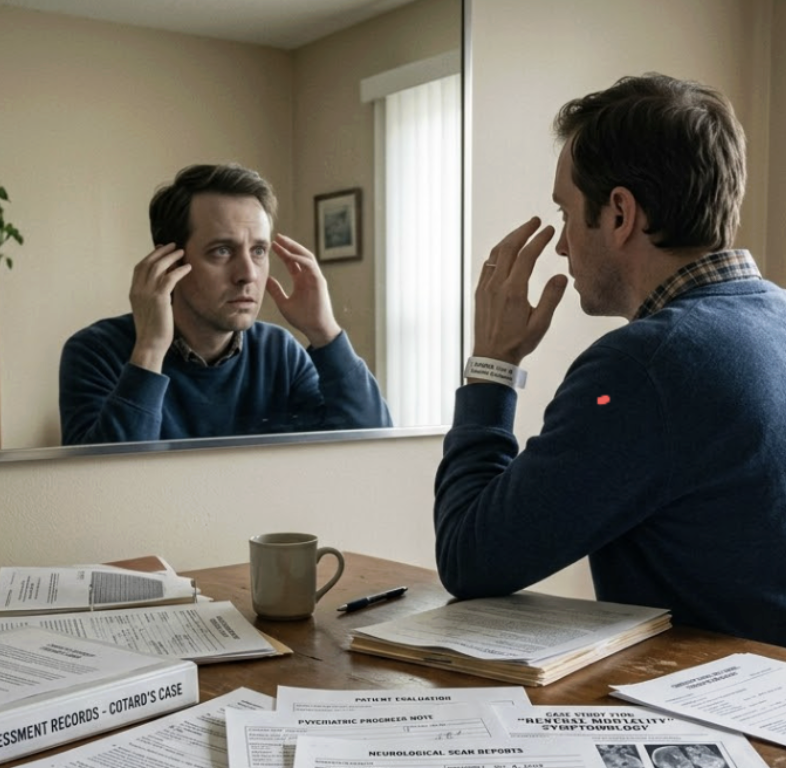
Imagine waking up one morning completely convinced that you no longer exist.
Not as a metaphor.
Not because you’re feeling sad or hopeless.
But because you genuinely believe you have already died.
As strange as it sounds, there is a rare medical condition that can make some people experience exactly that.
And to those living with it, the belief can feel as real as the ground beneath their feet.
The condition is known as Cotard’s Syndrome, sometimes called “Walking Corpse Syndrome.”
It is one of the rarest and most unusual disorders ever documented in medicine.
People affected by Cotard’s Syndrome may believe they are dead, that parts of their body no longer exist, that their organs have stopped functioning, or even that they have lost their soul entirely.
What makes the condition so unsettling is that these beliefs are not simply negative thoughts.
The person often experiences them as undeniable facts.
In documented cases, some patients have insisted they no longer need food because they were already dead.
Others claimed their heart had stopped beating.
Some believed their blood had disappeared.
A few even argued that they no longer belonged in the world of the living.
To family members and doctors, these statements can sound impossible.
Yet for the person experiencing the syndrome, the belief feels completely real.
The condition was first described in the late nineteenth century by French neurologist Jules Cotard.
One of his most famous patients insisted she had no brain, no nerves, no chest, and no internal organs. She believed she was already dead and therefore no longer needed to eat.
Since then, only a relatively small number of cases have been documented worldwide, making the syndrome extremely rare.
Researchers still do not fully understand why it occurs.
However, many experts believe it may be linked to disruptions in how the brain processes identity, self-awareness, and emotional recognition.
In a healthy brain, people continuously receive signals that reinforce the sense of being alive and connected to the world around them.
These signals help create a stable perception of self.
But in certain rare circumstances, that system may become severely disrupted.
When this happens, some individuals may struggle to reconcile what they see, feel, and believe.
Instead of concluding that something is wrong with their perception, the brain may generate an explanation that feels logical to them.
In extreme cases, that explanation becomes:
“I must be dead.”
Cotard’s Syndrome has been associated with several serious medical and psychiatric conditions.
It has been reported in people experiencing severe depression, certain psychotic disorders, neurological diseases, brain injuries, and other conditions affecting cognition and perception.
Not every patient experiences the syndrome in the same way.
Some individuals believe only parts of their body are missing or nonfunctional.
Others develop more elaborate beliefs about their existence.
The severity can vary dramatically from case to case.
One reason the condition attracts so much attention is because it challenges our understanding of consciousness itself.
Most people rarely question whether they are alive.
The feeling seems automatic.
Obvious.
Constant.
Yet Cotard’s Syndrome reveals how dependent that certainty may be on the brain’s ability to correctly interpret reality.
When those processes malfunction, even the most fundamental aspects of identity can become distorted.
Fortunately, treatment is possible in many cases.
Depending on the underlying cause, doctors may use a combination of medications, psychotherapy, and treatment for associated neurological or psychiatric conditions.
Some patients improve significantly once the underlying disorder is addressed.
Others require long-term care and monitoring.
The condition remains extremely rare, and most people will never encounter it personally.
Yet it continues to fascinate scientists because it offers a glimpse into one of the deepest mysteries of human existence:
How does the brain create the feeling of being “you”?
Why do we wake up each morning certain that we exist?
And what happens when that certainty breaks down?
Perhaps the most disturbing aspect of Cotard’s Syndrome is not that people believe they are dead.
It is that their minds can construct a reality so convincing that evidence, logic, and even their own beating heart may fail to change their belief.
The human brain is capable of extraordinary things.
It allows us to remember, imagine, love, create, and dream.
But rare conditions like Cotard’s Syndrome remind us that our perception of reality is more fragile than we often realize.
And sometimes, the most frightening mysteries are not found in haunted houses or ghost stories.
They are found inside the human mind itself.
Have you ever heard of Cotard’s Syndrome before, or is this the strangest medical condition you’ve ever encountered?


