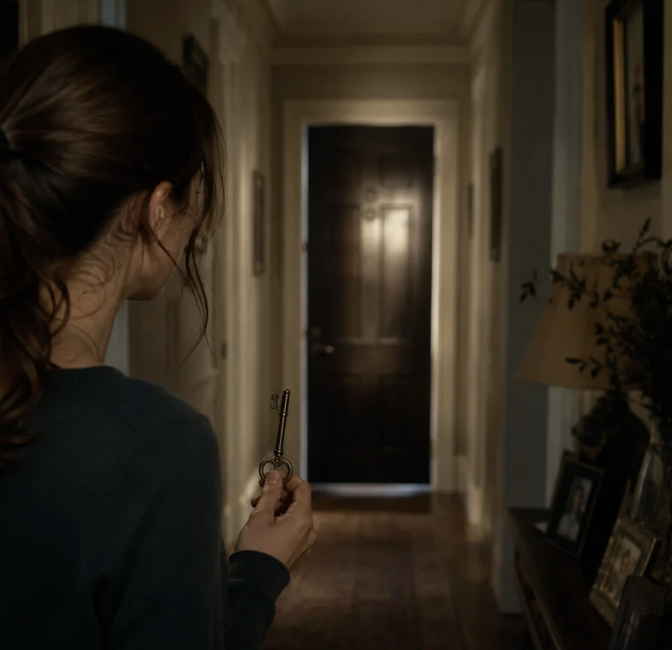
The last door in the hallway was never locked.
At least, not with a key.
It was locked with fear.
For twenty-seven years, my mother gave me the same warning.
Never open that door.
Never ask about that room.
And no matter what happens after I’m gone… stay away from it.
I obeyed her my entire life.
Then she died.
And everything I believed about who I was died with her.
My mother, Eleanor Hart, raised me alone in a large Victorian house on the edge of Willow Creek, a small town where everyone knew everyone else’s business.
Except ours.
People always described my mother the same way.
Quiet.
Kind.
Private.
The kind of woman who baked pies for neighbors but never spoke about herself.
The kind of woman who attended every church fundraiser but left before conversations became personal.
The kind of woman who smiled warmly while keeping everyone at arm’s length.
To me, she was simply Mom.
She never remarried.
Never dated.
Never seemed interested in building a life beyond the two of us.
When I was little, I thought that meant I was special.
When I became older, I wondered if it meant she was lonely.
But there was one thing I never questioned.
The door.
The final room at the end of the upstairs hallway.
Every child becomes curious about forbidden things.
That room became my obsession.
When I was six, I asked what was inside.
Mom’s face changed instantly.
Not angry.
Afraid.
“You don’t need to know.”
“Why?”
“Because some doors stay closed for a reason.”
That answer only made me more curious.
At eight years old, I pressed my ear against the wood.
Silence.
At ten, I peeked through the keyhole.
Darkness.
At twelve, I tried the handle.
Unlocked.
Yet I couldn’t bring myself to enter.
Because by then my mother’s fear had infected me.
Whatever existed inside that room seemed powerful enough to terrify the strongest person I knew.
So I stopped trying.
Years passed.
The room became part of the house like an old scar.
Always there.
Never discussed.
Eventually I left for college.
Then graduate school.
Then work.
I returned home less frequently.
But every visit followed the same pattern.
The room remained closed.
My mother remained silent.
Life moved on.
Or so I believed.
Everything changed when my mother received her diagnosis.
Pancreatic cancer.
Aggressive.
Advanced.
Unforgiving.
The doctors gave her less than a year.
She lasted eight months.
Those months passed in a blur of hospital visits, medications, specialists, hospice consultations, and impossible conversations.
Near the end, I moved back home.
I wanted to care for her.
Truthfully, I also wanted more time.
No matter how old you become, losing a parent feels impossible until it happens.
One evening, three weeks before she died, I found her staring down the hallway toward the forbidden room.
She looked exhausted.
Smaller somehow.
As though illness had already begun pulling her away from the world.
“Mom?”
She didn’t answer immediately.
Finally she whispered something strange.
“I thought I’d have more time.”
I sat beside her.
“For what?”
Her eyes filled with tears.
“For courage.”
I had never seen my mother speak that way.
The sentence unsettled me.
Before I could ask more, she changed the subject.
Three weeks later she was gone.
The funeral drew nearly the entire town.
People brought casseroles.
Flowers.
Stories.
Condolences.
Everyone described my mother as wonderful.
No one described her as happy.
That realization stayed with me.
After the funeral, I remained in the house to settle the estate.
The silence felt unbearable.
Every room contained reminders.
Her reading glasses.
Half-finished crossword puzzles.
A cardigan hanging behind a chair.
Then there was the hallway.
The door.
Still waiting.
Still closed.
For several days I avoided it.
Then came the discovery.
I was sorting jewelry inside her bedroom when I noticed something hidden beneath the false bottom of an antique jewelry box.
A small brass key.
Yellowed with age.
Attached was a handwritten note.
My hands began shaking before I even opened it.
The handwriting was unmistakably hers.
If you found this, I am gone.
I wanted to tell you myself.
I tried many times.
But every version ended with me losing you.
Please forgive me.
The key belongs to the last room.
I sat frozen.
For twenty-seven years that room had ruled part of my life.
Now I finally possessed the key.
Yet I felt no excitement.
Only dread.
The note continued.
You deserve the truth.
Even if the truth makes you hate me.
That sentence terrified me.
My mother had never spoken dramatically.
If she wrote something like that, whatever waited behind the door was worse than I imagined.
I spent two days carrying the key in my pocket.
Unable to use it.
Unable to throw it away.
Finally, on a rainy Thursday evening, I climbed the stairs.
The house felt different.
As if it knew.
The hallway stretched before me.
Long.
Silent.
Familiar.
At the very end stood the door.
For the first time in my life, I inserted the key.
The lock clicked.
A simple sound.
Yet it felt like an explosion.
Slowly I pushed the door open.
Dust floated through pale afternoon light.
The room looked untouched.
Frozen.
Preserved.
A child’s bedroom.
Not a girl’s room.
A boy’s.
Blue wallpaper.
Toy trucks.
Baseball trophies.
Storybooks.
A small bed.
My heart pounded.
I stepped inside.
Confusion turned to disbelief.
Nothing in this room belonged to me.
Nothing.
Then I noticed the photographs.
Hundreds of them.
Covering shelves.
Walls.
Desks.
Frames.
Albums.
Every picture showed the same child.
A little boy.
Brown hair.
Blue eyes.
A bright smile.
Ages changed across the photographs.
Newborn.
Toddler.
Preschooler.
School-age.
The collection seemed to stop around age seven.
I stared at the images.
Who was he?
An older brother?
A cousin?
A child my mother had lost?
Tears blurred my vision.
Because whatever this room represented, my mother had carried it alone.
Then I found the first notebook.
It sat inside the bedside table.
Leather cover.
Dates spanning decades.
I opened to the first page.
The entry was written thirty-one years earlier.
Today I saw him again.
He looks healthy.
Happy.
I hope he never remembers what happened.
Confusion washed over me.
I kept reading.
Every page referred to the same boy.
The child from the photographs.
My mother documented birthdays she did not attend.
School milestones she observed from a distance.
Sporting events.
Graduations.
Even medical updates.
As if she were secretly watching him grow up.
My stomach tightened.
Who was this child?
Why wasn’t she part of his life?
Then I discovered the newspaper clipping.
Folded between pages.
The headline instantly drained the blood from my face.
LOCAL BOY VANISHES WITHOUT A TRACE
The article described a seven-year-old child who disappeared from Willow Creek thirty years earlier.
The photograph accompanying the article showed the exact same boy from the room.
I dropped the paper.
My hands trembled uncontrollably.
I knew this case.
Everyone in town did.
The disappearance of Jacob Mercer.
The mystery that never left Willow Creek.
The missing child nobody found.
The case that haunted the town for decades.
What terrified me was not the article itself.
It was my mother’s connection to it.
Why did she have this room?
Why did she have photographs?
Why did she track his life?
And most importantly…
How could she track the life of a child who supposedly disappeared?
The answer arrived thirty minutes later.
Hidden beneath a loose floorboard.
A second box.
Inside sat dozens of letters.
And at the very bottom…
A birth certificate.
Not mine.
Not Jacob’s.
Mine.
Or rather…
The document I had believed was mine my entire life.
But the name listed on it wasn’t Emily Hart.
It was someone else entirely.
Someone I had never heard of.
My entire body went cold.
Because suddenly one impossible question became unavoidable.
What if I wasn’t my mother’s daughter at all?
And if that was true…
Then who was I?
The birth certificate did not look fake.
That was the worst part.
If it had been poorly printed, badly altered, or obviously forged, I might have found a place to put my fear.
But it looked official.
A raised seal.
A hospital name.
A birth date that matched mine.
A tiny footprint stamped in faded blue ink.
Only the name was wrong.
Not Emily Hart.
Not the name I had written on school papers, job applications, tax forms, birthday cards, and every document that proved I existed.
The name on the certificate was Lily Rose Bennett.
I sat on the floor of that forbidden room holding a stranger’s birth certificate with my birth date, my hospital, and my tiny footprint on the bottom.
For several minutes, I could not breathe properly.
The room around me seemed to tilt.
The little boy’s bed.
The toy trucks.
The baseball trophies.
The hundreds of photographs.
My mother’s notebooks.
Everything felt connected, but not in a way I could understand.
Then I opened the first letter.
It was addressed to me.
Not Emily.
Not Lily.
To my daughter.
My hands shook so hard the paper rattled.
The first line destroyed me.
You were not born to me, but you became mine before sunrise.
I read it again.
Then again.
My mother wrote that thirty years earlier, she was not a mother living alone with a baby girl.
She was a grieving woman.
A woman who had already lost everything.
Her real child was a boy named Jacob.
The boy in the photographs.
Her son.
The child she had hidden behind the last door in the hallway.
I looked around the room again, and suddenly it was not a mystery room anymore.
It was a shrine.
A bedroom preserved for a child who had vanished.
A life stopped at seven years old.
A mother’s grief kept behind a closed door.
According to the letter, Jacob was not kidnapped by a stranger on the street, as the town had always believed.
At least not exactly.
He disappeared on a stormy night during a community fair near the church grounds.
Eleanor had been volunteering at the bake table.
Jacob had been playing with other children near the parking lot.
One moment he was there.
The next, he was gone.
The entire town searched.
Police questioned everyone.
Dogs tracked scent trails.
Volunteers combed the woods.
Flyers appeared in store windows.
News trucks arrived.
But Jacob was never found.
For months, my mother existed only as a body walking through grief.
She barely slept.
Barely ate.
She kept Jacob’s room untouched.
She sat in that room every night holding his pajamas.
People offered comfort until comfort ran out.
Then they offered suspicion.
Why had she taken her eyes off him?
Why had she let him play so far away?
Why didn’t she notice sooner?
Small towns can love people fiercely.
They can also destroy them slowly.
The letters continued.
Seven months after Jacob vanished, my mother received a phone call.
A woman crying.
Whispering.
Begging.
The caller said she knew something about Jacob.
She refused to give her name.
She asked Eleanor to meet her behind the old bus depot after midnight.
My mother went.
Of course she went.
A grieving mother will follow even a whisper if it promises a clue.
What she found there was not Jacob.
It was a baby girl.
Me.
Wrapped in a yellow blanket.
Sleeping inside a cardboard box beside the pay phone.
There was no woman waiting.
Only a note.
This child is not safe.
If they find her, she will disappear like your son.
My mother wrote that she should have called the police immediately.
She knew that.
She wrote it over and over.
I should have called.
I should have called.
I should have called.
But grief had already changed her.
The system had failed to bring Jacob home.
The police had dismissed leads.
Neighbors had whispered.
Reporters had turned her loss into entertainment.
And now a baby had been placed in front of her with a warning that connected that child to her son’s disappearance.
She panicked.
She took me home.
At first, she told herself it was only for one night.
Just until morning.
Just until she could think.
Just until she could figure out whom to trust.
But by sunrise, she had made the decision that shaped both our lives.
She kept me.
The next letters revealed how she did it.
A cousin who worked in county records.
A doctor who owed her late husband a favor.
A forged birth certificate.
A false story about a quiet out-of-state adoption.
People who asked few questions because they pitied her.
People who thought giving a grieving woman a child might save her.
People who never understood that they were helping bury a mystery.
My whole body went numb reading it.
I wanted to hate her.
I wanted to scream.
I wanted to tear the room apart.
But every time rage rose, another feeling followed.
Memory.
Her brushing my hair before school.
Her sitting beside me during fevers.
Her clapping at every recital.
Her working double shifts so I could attend college.
Her whispering, “You are my whole heart,” whenever I cried.
Was all of that a lie?
Or was motherhood more complicated than truth?
Then I found the second stack of letters.
These were addressed to Jacob.
Every birthday.
Every Christmas.
Every anniversary of his disappearance.
My mother had written to the son she lost and the daughter she stole.
That word appeared in her own handwriting.
Stole.
She did not excuse herself.
She did not call it rescue.
She did not soften it.
I stole you because I was afraid.
I loved you because I could not stop.
I kept you because every time I imagined handing you over, I saw Jacob’s empty bed.
I pressed the letter against my chest and sobbed.
Not only for myself.
For Jacob.
For the baby I had been.
For the unknown woman who left me at the bus depot.
For a mother who made an unforgivable choice and then spent the rest of her life loving me with the weight of it.
The next morning, I did what my mother had not done thirty years earlier.
I called the police.
Detective Maria Collins arrived within two hours.
She was in her fifties, sharp-eyed, calm, and careful with every word.
The moment I mentioned Jacob Mercer, her expression changed.
“How do you know that name?”
I led her upstairs.
Showed her the room.
The photographs.
The notebooks.
The birth certificate.
The letters.
By the time she finished reading the first few pages, her face had gone pale.
“This case never stopped haunting this department,” she said quietly.
Within days, the house became a crime scene.
Not because my mother was alive to be arrested.
Not because anyone knew yet exactly what crime had occurred.
But because the room connected two cold cases no one realized were linked.
Jacob Mercer.
And Lily Rose Bennett.
Me.
Investigators reopened everything.
They collected DNA from my hairbrush.
They took the birth certificate.
They contacted hospitals.
Reviewed old missing-child reports.
Interviewed retired officers.
Tracked the doctor mentioned in my mother’s letters.
Most of the people involved were dead.
Others were elderly.
Some remembered.
Some claimed they didn’t.
Then came the first major break.
Lily Rose Bennett had been real.
She had been reported missing from a nearby county two days before I was left at the bus depot.
Not by her parents.
By a grandmother.
My biological mother, Claire Bennett, was eighteen at the time.
Unmarried.
Poor.
Living with a man police had long suspected of involvement in organized car theft and child trafficking rumors, though nothing was ever proven.
Claire disappeared the same week I did.
Her body was never found.
The grandmother searched for both daughter and granddaughter until the day she died.
I sat across from Detective Collins when she told me.
For thirty years, another family had a missing child too.
Me.
A grandmother had died never knowing I had grown up less than forty miles away under another name.
The guilt felt unbearable, even though I had been an infant.
Then investigators found a surviving relative.
Claire’s younger sister.
My aunt.
Her name was Ruth Bennett.
She lived in Ohio.
When Detective Collins called her, Ruth cried before she even heard the full explanation.
She had spent her entire adult life wondering whether her sister’s baby survived.
Two weeks later, I met her at a police station.
Not because the police required it.
Because neither of us knew how to meet anywhere normal.
She brought a photograph.
My biological mother.
Claire.
The resemblance hit me like a physical blow.
Same eyes.
Same mouth.
Same slight tilt of the head.
For the first time in my life, I saw my face belonging somewhere.
Ruth cried when she saw me.
“You look just like her.”
I didn’t know whether to feel comforted or destroyed.
She told me Claire loved me.
That she wanted to leave the man she was living with.
That she had called Ruth days before disappearing and said, “If something happens to me, find Lily.”
Ruth had tried.
Everyone had tried.
But the trail went cold.
Then Ruth told me something that connected everything.
Claire had once worked part-time at the community fair where Jacob vanished.
My mother might not have known her personally.
But Claire knew who Eleanor Hart was.
She knew Eleanor had lost a child.
She knew the town had failed her.
And perhaps, in the most desperate moment of her life, Claire chose the one woman she believed would protect another child at any cost.
That thought broke me open.
My mother had not found me by accident.
I had been placed with her because another frightened young mother believed grief might make her brave.
Or reckless.
Maybe both.
But one question remained.
What happened to Jacob?
For weeks, investigators searched the connection between Jacob’s disappearance, Claire Bennett, and the man Claire feared.
His name was Ray Porter.
He had died in prison years earlier on unrelated charges.
But old files revealed something disturbing.
Porter had been questioned briefly after Jacob vanished.
He claimed he was nowhere near the fair.
His alibi came from Claire.
A frightened eighteen-year-old girlfriend.
No one pushed harder.
Later, Claire apparently discovered something.
Maybe evidence.
Maybe confession.
Maybe proof that Porter had been involved in Jacob’s disappearance.
Whatever she learned made her run.
And when she ran, she brought me.
That was why she called my mother.
That was why she left me at the bus depot.
That was why the note warned:
If they find her, she will disappear like your son.
The final confirmation came from my mother’s last notebook.
The one written during her final year.
The pages were shaky, uneven, sometimes hard to read.
But one entry stood out.
I know now that Claire was trying to save her daughter.
I think she knew what happened to Jacob.
I think she died because of it.
I should have told the police.
I should have saved both children with the truth.
Instead, I saved one child with a lie.
I read that sentence over and over.
I saved one child with a lie.
Was that what I was?
A life saved by a crime?
A daughter raised by a kidnapper?
A victim protected by another victim?
No label fit.
Months later, a search team recovered partial evidence from land once owned by Ray Porter’s family.
Not enough to bring Jacob home fully.
Not enough for a complete trial.
But enough to support what investigators had begun to believe.
Jacob had likely died shortly after his disappearance.
Claire had learned the truth.
Then she disappeared too.
My mother never knew for certain.
But she suspected enough to be terrified.
Terrified of police.
Terrified of Porter.
Terrified that if she turned me in, I would vanish into the same darkness that had taken her son.
None of that made her choice legal.
None of it made it simple.
But it made it human.
The town reacted with shock when the story broke.
Some people called my mother a monster.
Others called her broken.
Some said she stole me.
Others said she saved me.
I stopped reading comments after the first day.
Because strangers prefer clean categories.
Villain.
Hero.
Victim.
Criminal.
Mother.
But real life can be crueler than labels.
My mother was a grieving woman who made a terrible decision.
She was also the woman who packed my school lunches.
The woman who slept in a chair beside my hospital bed when I had pneumonia at nine.
The woman who kept every drawing I made.
The woman who lied to me every day.
The woman who loved me every day.
Both truths existed.
And I had to live with both.
Ruth and I slowly built a relationship.
Awkward at first.
Tender later.
She told me about Claire.
I told her about Eleanor.
Neither of us knew how to mourn properly.
Was I mourning the mother who lost me?
The mother who raised me?
The brother I never knew?
The boy whose room I had been forbidden to enter?
The identity stolen from me?
All of it.
Grief became crowded.
One year after opening the door, I returned to the hallway.
The room still looked the same.
But I no longer saw it only as a place of secrets.
I saw it as a place where grief had become a cage.
My mother had locked Jacob inside that room.
Then locked herself inside the lie that brought me into her life.
I began packing.
Not everything.
Some things needed preserving.
Jacob’s photographs went to the Mercer family, relatives who had spent thirty years with no answers.
His baseball glove went to his cousin.
His school papers went into the police archive.
The crib and baby clothes connected to me went to Ruth.
But I kept one photograph.
Not of Jacob alone.
Of my mother holding him when he was maybe three.
She looked young.
Unburdened.
Happy in a way I barely recognized.
On the back, she had written:
My first miracle.
For a long time, those words hurt.
Then I found another photograph tucked into one of my baby books.
My mother holding me as an infant.
Her face older.
Exhausted.
Haunted.
But smiling.
On the back, she had written:
My second chance.
That was the closest thing to truth she had ever left me.
Not a justification.
Not an apology.
A confession.
Years later, people still ask whether I forgive her.
I never know how to answer.
Forgiveness sounds too small for something this tangled.
Some days I do.
Some days I don’t.
Some days I miss her so much it feels like my chest will break.
Other days I rage at what she took from me.
My name.
My family.
My truth.
My chance to know Claire.
My chance to be found.
Then I remember the yellow blanket.
The note.
The threat.
The missing boy.
The frightened young mother.
The grieving woman at the bus depot.
And I understand that my life began in a place where every choice was already damaged.
I changed my legal name eventually.
Not back to Lily Rose Bennett.
Not only Emily Hart.
Both.
Emily Lily Hart Bennett.
Too long for most forms.
Perfect for me.
Because I am not one story.
I am two mothers.
Two losses.
Two miracles.
One lie.
One life.
And a locked room that finally opened.
The last door in the hallway no longer exists now.
I had the wall removed when I renovated the house.
Where the room once stood, there is a small library.
Open shelves.
Sunlight.
No lock.
No warning.
On one shelf sits a framed copy of my mother’s final note.
You deserve the truth.
Even if the truth makes you hate me.
Beside it is a photograph of Claire Bennett.
Beside that is Jacob’s picture.
Beside that is one of me as a baby, wrapped in yellow.
People who visit sometimes ask who they are.
I tell them the truth.
All of them.
Because silence had already taken enough from this family.
Do you think Eleanor was a grieving mother who saved a child in danger, or did her love never erase the fact that she stole another family’s chance to find their daughter?


