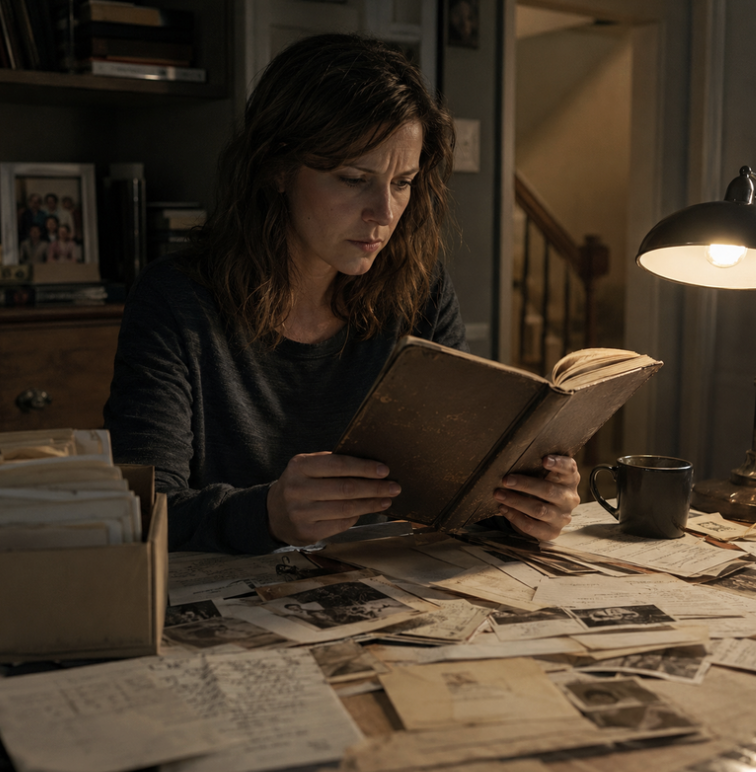
For twenty-three years, I believed my mother chose to die.
I never liked the explanation.
I never fully accepted it.
But eventually, I stopped fighting it.
When enough people repeat a story long enough, it becomes part of the landscape of your life.
Something painful.
Something permanent.
Something you stop questioning because the alternative feels impossible.
My name is Emily Carter.
I was nine years old when my mother died.
According to the official police report, she took her own life inside our family home.
Case closed.
No evidence of foul play.
No signs of forced entry.
No suspects.
No investigation beyond routine procedures.
Just a tragic woman struggling with depression.
That was the story.
The entire town accepted it.
My family accepted it.
Even I accepted it.
At least publicly.
Privately, things were different.
Because something about the story never fit.
Not perfectly.
Not logically.
Emotionally.
The mother I remembered wasn’t hopeless.
She wasn’t planning an ending.
She was planning a future.
That distinction haunted me for decades.
My mother wasn’t famous.
She wasn’t wealthy.
She wasn’t politically connected.
She was a high school librarian in a small Pennsylvania town.
The kind of woman who remembered birthdays.
The kind of woman who fed stray cats.
The kind of woman who carried extra umbrellas because she worried someone else might need one.
She laughed easily.
Loved gardening.
Read mystery novels.
Collected old postcards.
Nothing about her felt dangerous.
Nothing about her felt dramatic.
Yet every time I remembered the months before her death, a strange contradiction appeared.
She seemed busy.
Focused.
Determined.
Not defeated.
As a child, I ignored the contradiction.
As an adult, I couldn’t.
Still, I had no evidence.
Only feelings.
And feelings don’t reopen cases.
Twenty-three years passed.
Then I bought my childhood home.
The decision surprised everyone.
The house had been empty for years.
Neglected.
Aging.
Full of ghosts.
Not literal ghosts.
Memories.
Sometimes those are worse.
I told people I bought it because the price was good.
That wasn’t entirely true.
The truth was simpler.
I missed my mother.
Or perhaps I missed the version of her I never got the chance to know.
The renovations started immediately.
New wiring.
New plumbing.
New floors.
Everything needed work.
One afternoon, contractors began removing damaged wood panels from the wall inside my mother’s old bedroom.
I was there when it happened.
A worker called my name.
His voice sounded strange.
Concerned.
Curious.
I walked upstairs.
He pointed toward a narrow cavity hidden between wall supports.
Something was lodged inside.
A box.
Small.
Metal.
Covered in dust.
For some reason, my heart started racing.
The workers helped remove it.
The lock had rusted away years earlier.
Inside were several items.
Old photographs.
Newspaper clippings.
A cassette tape.
And a black notebook.
The moment I saw it, I knew.
My mother’s handwriting covered the front.
Diary.
I sat on the bedroom floor.
Ignoring the workers.
Ignoring the dust.
Ignoring everything except the notebook in my hands.
The first entries seemed ordinary.
Family events.
Book recommendations.
Daily frustrations.
The life of a normal woman.
I smiled while reading.
For the first time in years, my mother’s voice felt alive again.
Then something changed.
About halfway through the notebook, the tone shifted.
Subtly at first.
Then dramatically.
One entry read:
“Something is wrong.”
No explanation.
Just those words.
Another entry several days later:
“I wish I hadn’t seen what I saw.”
My pulse quickened.
I kept reading.
The next entries became increasingly unsettling.
“If I tell the wrong person, I could make things worse.”
“People trust him.”
“That’s what makes this dangerous.”
Him.
A man.
Someone known.
Someone trusted.
I turned pages faster.
The diary transformed from a personal journal into something else.
An investigation.
My mother was documenting things.
Conversations.
Dates.
Observations.
Meetings.
Odd financial transactions.
Arguments overheard in public places.
Strange late-night activities.
Names appeared frequently.
Except one.
One name never appeared fully.
Instead, my mother used initials.
Two letters.
R.H.
Over and over.
R.H.
Every few pages.
Every important observation.
Every suspicious event.
Always connected to R.H.
The deeper I read, the more frightened I became.
Because my mother wasn’t merely suspicious.
She was gathering evidence.
Detailed evidence.
Pages of it.
She believed R.H. was involved in something serious.
Something criminal.
One entry stopped me cold.
“I found the records.”
“If these are genuine, people could go to prison.”
I reread the sentence three times.
Prison?
What records?
What had she discovered?
The next several pages referenced a folder.
A hidden folder.
Apparently containing documents connected to R.H.
Unfortunately, the folder wasn’t inside the box.
Only references to it remained.
I continued reading late into the night.
Then I reached an entry dated twelve days before my mother’s death.
My hands began shaking.
“Someone knows I’m asking questions.”
The words seemed to leap from the page.
“I saw a truck outside the house again tonight.”
“The same one.”
“I don’t think it’s a coincidence anymore.”
A chill ran down my spine.
Because suddenly this no longer felt like paranoia.
It felt like fear.
Real fear.
The next entry was worse.
“If anything happens to me, it is not because I want to die.”
I froze.
Completely.
The sentence seemed impossible.
My mother had written it herself.
In her own handwriting.
Years before anyone found the diary.
I read it again.
Then again.
Then again.
Every word remained the same.
“If anything happens to me, it is not because I want to die.”
The official cause of death had been suicide.
Yet here was my mother directly contradicting that conclusion.
My breathing became shallow.
The room felt smaller.
The next pages referenced an upcoming meeting.
A secret meeting.
Someone willing to talk.
Someone willing to confirm what she suspected.
The meeting was scheduled for the day before she died.
Then came the final completed entry.
And it changed everything.
The final completed entry was written in hurried handwriting.
Unlike the earlier pages, the words were uneven, rushed, and filled with corrections.
It looked as though my mother had been writing under stress.
Or fear.
The entry began with a single sentence:
“I finally know who helped him.”
My eyes locked onto the page.
For years I had believed my mother’s story ended with her death.
Now it felt as though I was standing in the middle of something unfinished.
I continued reading.
“The meeting confirmed everything.”
“The records are real.”
“The money moved through accounts nobody would ever think to check.”
“If this becomes public, several people will fall with him.”
My heart pounded harder.
The entry never explained exactly what crime had occurred.
But it was obvious my mother had uncovered something serious.
Something large enough to involve multiple people.
Something large enough to make her afraid.
Then came the next paragraph.
“I made copies.”
“The originals are hidden.”
“If anything happens to me before tomorrow, someone must find them.”
Tomorrow.
The word felt heavy.
Because there had never been a tomorrow.
My mother died the next day.
I kept reading.
The final line on the page simply said:
“Tomorrow I go to the police.”
That was it.
No goodbye.
No despair.
No mention of ending her life.
No indication she planned to die.
Only plans.
Only action.
Only intention.
A woman preparing to expose someone.
Not a woman preparing to disappear.
I sat frozen for a long time.
Then I turned the page.
Blank.
Another page.
Blank.
Another.
Blank.
The diary ended there.
No final explanation.
No final answer.
Just silence.
The kind of silence that follows something unfinished.
For several days, I couldn’t think about anything else.
I took photographs of every page.
Read them repeatedly.
Made notes.
Compared dates.
Built timelines.
The more I analyzed the diary, the more disturbing it became.
Because my mother had not been speaking vaguely.
She had been documenting specific events.
Specific people.
Specific meetings.
And always, somewhere in the background, the initials remained.
R.H.
R.H.
R.H.
The entire mystery seemed to revolve around those two letters.
I eventually contacted a retired investigative journalist who had worked in the region during the 1990s.
His name was Alan Foster.
At first he seemed skeptical.
Then I showed him copies of the diary.
His expression changed immediately.
Especially when he saw the initials.
“Do you know who R.H. is?” I asked.
Alan didn’t answer right away.
Instead, he stared at the page.
Then he asked a question.
“Are you absolutely certain those initials appear throughout the notebook?”
“Yes.”
His face turned pale.
And for the first time, I felt genuine fear.
Not curiosity.
Fear.
Alan eventually explained why.
Twenty-three years earlier, there had been rumors.
Persistent rumors.
Never proven.
Never published.
Rumors involving corruption inside the town.
Missing funds.
Questionable land deals.
Suspicious contracts.
Nothing concrete.
Nothing that could survive legal scrutiny.
But enough whispers to attract attention.
One name repeatedly surfaced.
A respected local businessman.
A community leader.
A man known for charity work and civic involvement.
His initials?
R.H.
The revelation hit me like a physical blow.
Because I knew exactly who he meant.
Everyone in town did.
Richard Holloway.
For decades, Richard Holloway had been treated almost like royalty.
He funded scholarships.
Donated to churches.
Supported local projects.
His photograph appeared in newspapers constantly.
People trusted him.
People admired him.
People defended him.
Suddenly one line from the diary returned to me.
“People trust him. That’s what makes this dangerous.”
I felt sick.
Because the sentence finally made sense.
The deeper we looked, the stranger things became.
Public records revealed that several financial controversies had quietly disappeared during the years before my mother’s death.
Investigations were opened.
Then closed.
Questions were asked.
Then forgotten.
Nothing ever stuck.
Nothing ever reached court.
Nothing ever became public.
Almost as if someone had repeatedly ensured that uncomfortable questions vanished before answers appeared.
Then another discovery changed everything.
While reviewing old police records, Alan located the original incident report from my mother’s death.
I had seen summaries before.
Never the complete file.
One section immediately caught our attention.
A witness statement.
A neighbor reported seeing a vehicle parked outside our house shortly before police arrived.
The description was brief.
But specific.
Dark sedan.
Luxury model.
Distinctive front grille.
At the time, the detail seemed unimportant.
Now it didn’t.
Because Richard Holloway drove exactly that type of vehicle.
Coincidence?
Perhaps.
But then we found something worse.
The first civilian recorded at the scene after emergency services arrived wasn’t a relative.
Wasn’t a neighbor.
Wasn’t a family friend.
It was Richard Holloway.
I stared at the report in disbelief.
My mother spent months documenting a man.
She died the day before delivering evidence.
And that same man appeared at the scene before most people even knew she was dead.
The coincidence felt impossible to ignore.
Yet coincidence was all it remained.
There was still no proof.
No smoking gun.
No direct evidence connecting him to her death.
Only questions.
Then came the breakthrough.
The cassette tape found inside the metal box.
Initially we couldn’t play it.
The tape had deteriorated with age.
A restoration specialist eventually recovered most of the recording.
The audio quality was poor.
Crackling.
Distorted.
But understandable.
When I first heard my mother’s voice, I cried.
Not because of what she said.
Because I hadn’t heard her voice since childhood.
Then I listened carefully.
The recording was clearly intended as insurance.
A backup plan.
A message.
My mother described documents she had uncovered.
Financial records.
Transfers.
Payments.
Shell companies.
She repeatedly referenced evidence hidden somewhere outside the house.
Then, near the end, she spoke the words that changed everything.
“If you’re hearing this, then something happened before I could reach the police.”
I closed my eyes.
The statement was devastating.
Because it proved what the diary had already suggested.
My mother expected danger.
Not death necessarily.
But danger.
Then came the final section.
The most important section.
The section she recorded specifically in case she failed.
“The person I am documenting is Richard Holloway.”
For a moment, nobody in the room moved.
After twenty-three years, the initials finally had a name.
Not a theory.
Not speculation.
A name.
Spoken directly by my mother herself.
The tape ended less than thirty seconds later.
No dramatic accusation.
No confession.
No explanation of what happened next.
Just silence.
The recording stopped.
And so had her life.
What followed over the next year was complicated.
Investigators reviewed the new evidence.
Journalists revisited old stories.
Former witnesses came forward.
Old financial records were examined again.
Several previously unexplained transactions resurfaced.
Questions multiplied.
Public pressure increased.
Richard Holloway denied everything.
Of course he did.
At his age, criminal prosecution proved difficult.
Many records had vanished.
Many witnesses had died.
Too much time had passed.
In the end, no courtroom verdict ever arrived.
No dramatic conviction.
No perfect ending.
Real life rarely provides one.
But something important did happen.
The official narrative changed.
For twenty-three years, my mother’s death had been treated as a simple suicide.
An isolated tragedy.
A closed chapter.
That certainty no longer existed.
The new evidence forced authorities to acknowledge significant unanswered questions surrounding the circumstances of her death.
The case was reclassified.
Not solved.
Questioned.
Sometimes that is the closest thing to justice history allows.
People often ask whether I believe Richard Holloway killed my mother.
The honest answer is this:
I don’t know.
What I know is simpler.
My mother was not planning to die.
She was planning to act.
She was preparing evidence.
Scheduling meetings.
Making recordings.
Protecting documents.
Building a case.
Those are not the actions of someone preparing to end their life.
Those are the actions of someone preparing to expose the truth.
And perhaps that is the real twist of the story.
For most of my life, I believed my mother’s final chapter was about despair.
The diary revealed something entirely different.
Her final chapter was about courage.
A woman standing alone against someone powerful.
A woman who knew she was taking risks.
A woman who continued anyway.
The hidden diary did not merely change how I viewed her death.
It changed how I viewed her life.
Because the woman I thought was defeated was, in reality, fighting until the very end.
And after twenty-three years of silence, her voice finally found its way out of the wall where someone thought it would remain buried forever.


