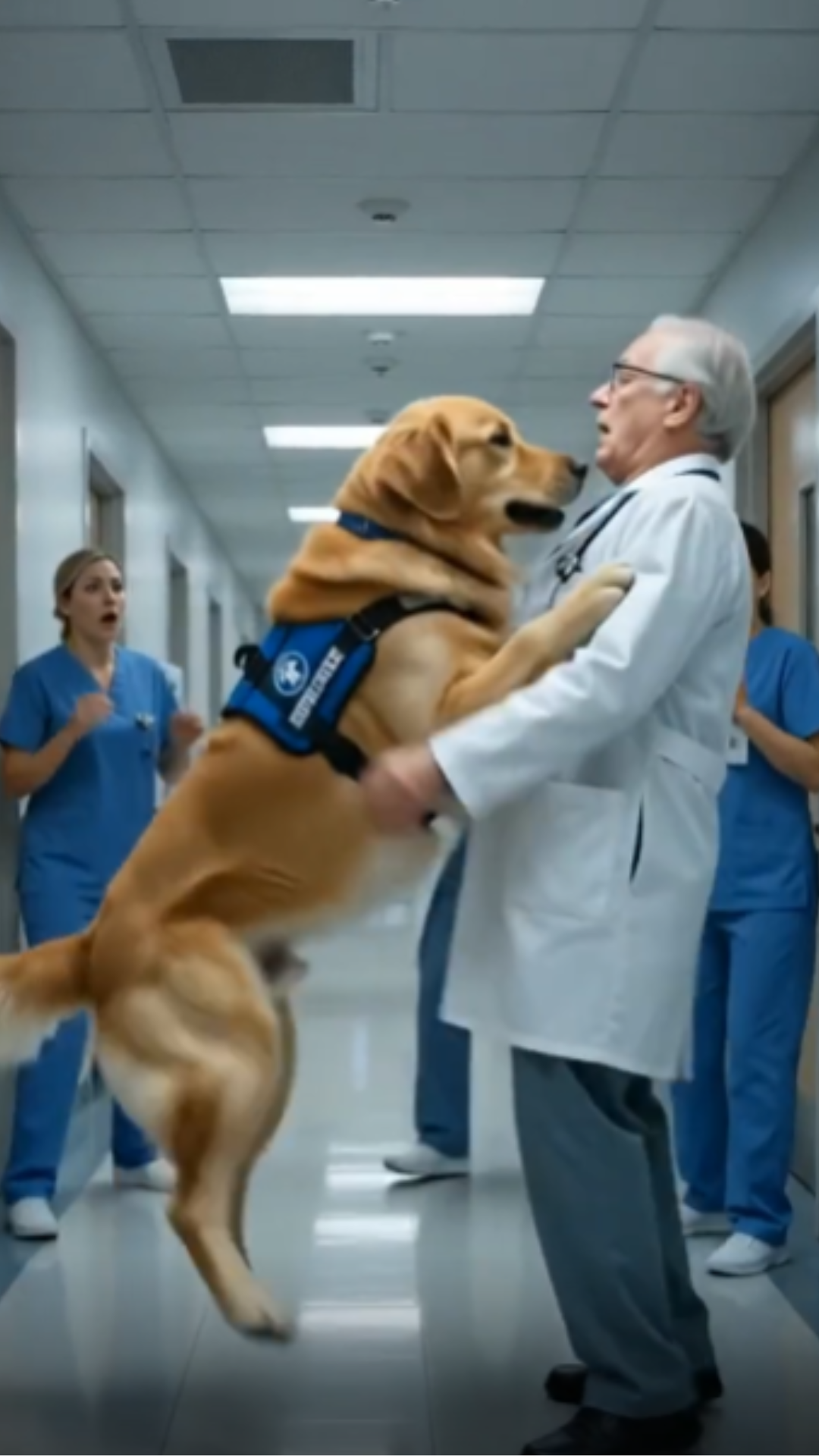
Pull that dog back, Dr. Pendelton, or I'll have security put him down right here! my neighbor Greg shouted as my service dog, Major, locked his legs and slammed his heavy body into my chest, knoc...


Part 1
The younger resident physicians muttered that I was seventy-two years old, losing my mind, and unable to control a rogue animal during an official facility inspection.
Four minutes later, a silent ethylene oxide gas line inside the sterile corridor ruptured completely—a toxic hazard that Major had picked up through the air vent long before human senses could register it.
If my dog hadn’t thrown me to the ground, seven medical staff members would have walked straight into an invisible cloud that causes immediate respiratory paralysis.
The freshly buffed floor of the St. Jude’s Memorial Community Clinic wing gleamed under the fluorescent lights, reflecting the crisp white coats of the administrators and a scattering of curious junior residents. Dr. Arthur Pendelton, at seventy-two, moved with the quiet authority of a retired Chief of Surgery, his gaze sweeping over every pristine surface.
Beside him, Major, an eight-year-old retired military search dog, trotted with a dignified gait, his golden retriever fur a vibrant contrast to the sterile environment. Major was usually a model of calm, his presence a comforting anchor for Arthur.
Today, however, a subtle tension rippled through Major’s sturdy frame. His ears twitched, constantly swiveling toward the vents high on the wall. A low, almost imperceptible rumble vibrated in his chest. Arthur barely registered it, chalking it up to the unfamiliar sounds of a brand-new wing.
“Everything looks up to standard, Arthur,” Greg Carver, Arthur’s forty-eight-year-old neighbor and a hospital board financial consultant, announced with an air of satisfaction. His voice, usually friendly and warm over their shared fence, held a sharper, more formal edge today. “These renovations are going to save us a fortune in overhead.”
Arthur nodded, but his attention was drawn to Major, who had suddenly stiffened. The dog’s tail, usually in gentle motion, was rigid. His powerful nose twitched, inhaling deeply. A faint, almost sickly sweet odor tickled Arthur’s nostrils, but it was so fleeting, he dismissed it as cleaning solution.
Then, Major let out a guttural growl, a sound Arthur hadn’t heard in years, a warning stripped of all playfulness. It wasn’t directed at anyone, but at something unseen, lurking in the air itself.
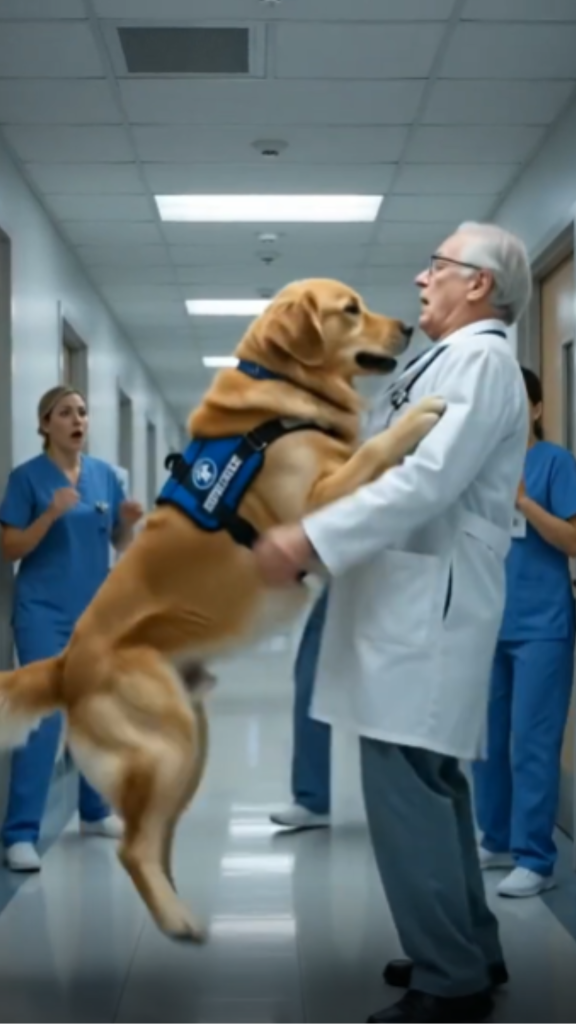
Before Arthur could react, before he could even question the sudden change in his dog’s demeanor, Major coiled. The dog’s body became a projectile. He lunged, not attacking, but slamming his heavy, muscular frame directly into Arthur’s chest.
The impact was astonishingly forceful. Arthur, taken completely by surprise, felt the air rush from his lungs. He stumbled backward, his arms flailing, and crashed onto the polished tile floor with a jarring thud. His glasses flew from his face, skittering across the gleaming surface.
Pain shot up his back, a familiar ache for a man of his age, but it was overshadowed by confusion and a deep embarrassment. He lay there, disoriented, Major’s head pressed firmly against his side, a low, urgent whimper rumbling in the dog’s throat.
“Dr. Pendelton!” Greg’s voice cut through the momentary shock, laced with thinly veiled anger. “What is the meaning of this? You cannot bring an uncontrolled animal into a sterile environment!”
A murmur spread through the small group of residents. Young Dr. Chen, barely out of medical school, whispered loud enough for Arthur to hear, “He’s seventy-two, you know. Been losing his faculties. Maybe the dog is sensing his master’s decline.”
Another resident, a young woman with a clipboard clutched tight, added, “Service dogs need to be retired eventually. Especially if they’re aggressive.”
Aggressive. The word stung Arthur more than the fall. Major was anything but aggressive. He was a protector, a gentle giant.
“Pull that dog back, Dr. Pendelton,” Greg insisted, stepping closer, his face tight with annoyance, “or I’ll have security put him down right here!”
The threat hung in the air, cold and definitive. Arthur started to push himself up, trying to regain some semblance of dignity, to defend his loyal companion. Major refused to move, his weight anchoring Arthur to the floor, his body a shield. The dog’s eyes, usually soft and intelligent, were wide with a primal fear Arthur had never seen.
A high-pitched hiss, almost too quiet to hear over the sudden hubbub, pierced the air from the ceiling vent directly above where Arthur and Major had been standing moments before. It sounded like a sudden release of compressed air, then a soft, almost imperceptible plume, shimmering like heat haze over asphalt, wafted from the vent.
A strange, acrid smell began to bloom, sharp and chemical, yet also sickeningly sweet. It was not the cleaning solution. It was something far more sinister.
Nurse Evelyn Ross, a sixty-year-old charge nurse from the older wing, who had been observing quietly, suddenly gagged. Her hand flew to her throat, her eyes widening in horror. “Ethylene oxide!” she croaked, her voice barely a whisper. “The sterilant!”
Panic erupted. The shimmering haze, invisible to the untrained eye in its nascent form, was now expanding. The sweet, cloying odor grew stronger, reaching everyone present. A younger resident screamed, clutching his chest. His face, moments ago full of judgment, was now a mask of terror.
Another administrator, a woman in her late fifties, stumbled backward, her hand reaching for the wall for support. Her breath hitched.
Arthur watched in dawning horror as the cloud spread, silent and deadly. He saw the first man to walk through it double over, his hands clawing at his throat, his eyes rolling back.
Major whined, a deep, mournful sound, his body trembling, still holding Arthur down, refusing to let him move. He had saved Arthur, but seven medical staff members were now walking straight into the invisible vapor.
Then the alarms blared, a piercing, insistent wail that echoed through the newly renovated corridor. Red emergency lights flashed, casting a lurid glow on the unfolding chaos. The pipe seal had given way completely.
Arthur looked at Major, his loyal, trembling dog, then back at the writhing figures of the staff. He had been seconds away from stepping directly into that silent cloud.
As emergency hazardous material crews, their faces grim behind respirators, stormed into the wing moments later, their heavy boots clanking on the tiles, Arthur lay on the floor, Major still firmly pinning him. He watched them secure the area, a chilling efficiency in their movements. He heard their hushed, urgent radio calls about a “Level 3 bio-hazard” and “respiratory paralysis.” He saw them administering emergency oxygen to two collapsed residents, their faces alarmingly pale.
The air was still thick with the lingering scent, a reminder of the invisible terror that had almost claimed them all. Arthur finally managed to sit up, his gaze finding Greg Carver, who stood frozen, his face ashen, staring at the chaos.
“The shut-off valve,” Arthur rasped, his voice raw. “Why didn’t the emergency shut-off valve activate?”
But Greg didn’t answer. He just kept staring at the gurney being wheeled past, a resident doctor struggling for breath, and Arthur’s words were lost in the pandemonium of flashing lights and shouted commands.
Part 2
The hazmat team finished their sweep, the air scrubbers humming loudly as they cleared the last traces of gas. Ambulances had already transported the most affected staff members to triage. I finally pushed myself off the floor, Major a warm, heavy presence beside me.
Greg was gone, vanished into the controlled chaos. I found Nurse Evelyn Ross overseeing a cleanup crew, her face still pale.
“The maintenance logs,” I said, my voice tight. “I need to see the digital logs for that gas line. The shut-off valve should have been automatic.”
She hesitated, glancing around, but the urgency in my eyes must have convinced her. “They’re on the main terminal in the administrative office, Dr. Pendelton,” she said, pointing down the hall.
Major padded silently beside me as I made my way through the still-buzzing corridor. The administrative assistant, a young man named Kevin, looked overwhelmed.
“Dr. Pendelton,” he said, “I’m not sure I’m supposed to—”
“This is an emergency, Kevin. Access the ethylene oxide system’s maintenance and safety records for the last 48 hours. Focus on the pressure test bypass logs.” My voice left no room for argument.
His fingers flew across the keyboard. The screen populated with a dizzying array of codes and timestamps. I leaned closer, my gaze fixed on the digital entries.
There it was. A log from yesterday, a “Rushed Safety Inspection Waiver.” It specifically bypassed the routine pressure integrity check, citing an “urgent operational deadline.”
My breath hitched. Below it, the digital signature. Clear as day. “G. Carver.” Greg. My neighbor.
The man who had brought me lasagna last Tuesday. The man who had shoveled my driveway after the last snowstorm. The man who sat across from me at the hospital board meetings.
I couldn’t believe it. I scrolled back, then forward, my eyes scanning for any other explanation. There was none. Greg Carver had signed off on a waiver that directly led to this disaster.
My mind raced, trying to reconcile the friendly neighbor with this stunning betrayal. I needed to talk to him, to understand.
I found Greg in the staff lounge, sipping a cup of coffee, looking remarkably composed. Two junior nurses sat nearby, chatting quietly.
He looked up as I entered, a faint smile on his face. “Arthur. Glad to see you’re back on your feet. That dog of yours certainly gave us a fright.”
“Greg,” I said, my voice low, walking directly toward him. I held myself upright, forcing the trembling from my hands. “We need to talk about the gas line waiver. The one you signed.”
His smile faltered, a flicker of something unreadable in his eyes. He set his coffee cup down, not spilling a drop.
He looked past me, then back at the nurses, a knowing, almost sympathetic look on his face.
“Arthur,” he said, his voice dropping to a gentle, almost patronizing tone. “I think you’ve had quite a shock today. Maybe it’s time to take it easy. We all saw what happened with Major. Your memory might be playing tricks on you after the fall.”
The nurses glanced at each other, their whispers stopping. They looked at me, then at Greg, a silent judgment forming in their eyes.
More Stories





+ There are no comments
Add yours