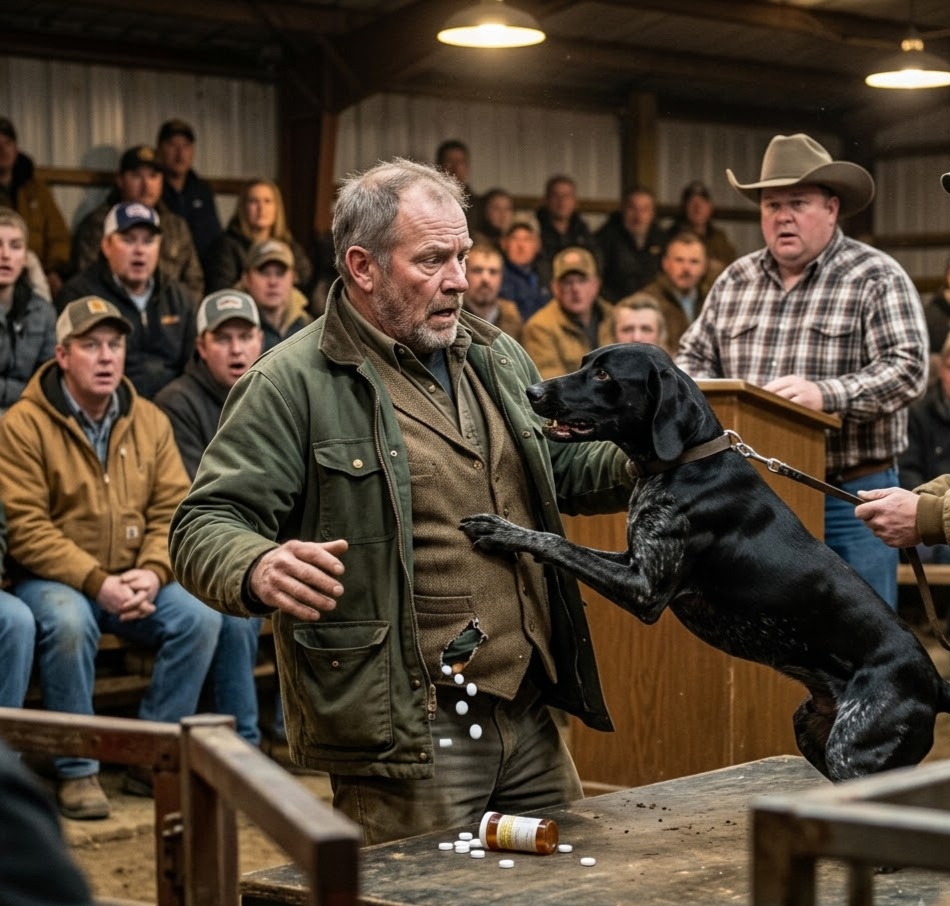
Returned 1946 War Veteran Silas Benedict Fights His Former Military Mentor to Save His Late Sister’s $45,000 Estate Hound, Only to Uncover a Fatal Poisoning Scheme and Paternity Deception.


Part 1
The cold seeped into Silas Benedict’s bones, a familiar ache that had nothing to do with the damp November air in the Loudoun Creek auction barn. He tugged at the collar of his worn greatcoat, the fabric rough against his neck. Each breath he took was a shallow cloud in the frigid air, quickly dissipating into the cavernous space.
His eyes, still haunted by the gray skies of Europe, scanned the faces around him. They were strangers, mostly, these Virginians who packed the barn this chilly afternoon in 1946. Farmers in overalls, women in sensible wool coats, a smattering of townsfolk with curious, speculative gazes. To them, he was just another returned veteran, an outsider who had only recently returned to the county, a ghost from a past they barely knew.
But to Silas, every creak of the floorboards, every hushed whisper, felt like a prelude to a betrayal. He felt Clara’s presence in the air, a faint scent of the lilac she always wore, a phantom warmth that his grief refused to release.
His sister, Clara Benedict-Halloway. Gone too soon. He had imagined her vibrant and laughing, even as the news of her passing reached him in a muddy foxhole somewhere in the Ardennes. Now, only a year later, her memory was being stripped bare in this public spectacle.
A murmur ran through the crowd, growing louder as the side door to the holding pens swung open. All eyes shifted to the small, elevated platform at the front of the barn, draped in a faded red cloth.
Silas’s jaw tightened. This was it.
A man stepped onto the platform, his figure instantly recognizable despite the passage of years. Major Edward Halloway. Silas’s former military instructor. Clara’s husband. The very man who had once drilled him on the parade ground, now stood before him as an adversary.
Edward, even out of uniform, carried himself with an air of unyielding authority. His dark hair was slicked back, a few silver threads catching the weak light from the bare bulbs strung overhead. He wore a crisp, tailored suit, far too formal for a dusty auction barn. He looked less like a grieving widower and more like a man of business, poised to finalize a transaction.
A thick rope was clutched in Edward’s gloved hand. At the end of it, with a mournful sigh, stepped Clara’s beloved hunting hound, Dutch.
The dog was magnificent, even now. A sleek, muscular pointer with a coat the color of burnished copper and eyes that held an intelligence Silas had always admired. Dutch was Clara’s shadow, her constant companion on their long walks through the autumn woods, her faithful sentinel by the hearth. He had been a wedding gift, a symbol of Edward’s supposed affection for Clara, back when things had seemed different.
Now, Dutch looked diminished. His head hung low, his tail tucked between his legs. His usual vibrant energy was replaced by a dull resignation, a visible sorrow that mirrored Silas’s own. He stumbled slightly as Edward tugged the rope, forcing him into position beside a hastily erected sign: “Item 34: One Male Pointer, Age 5, Purebred.”
A gasp rippled through the crowd. Clara’s dog. Edward was selling Clara’s dog.
Edward gave a dismissive flick of his wrist, signaling to a young assistant to secure Dutch’s rope to a sturdy post on the platform. The dog didn’t resist, merely sank to the floor, his chin resting on his paws, his gaze distant.
Silas felt a hot flush rise up his neck. This wasn’t just about a dog. This was about Clara. This was about Edward Halloway’s flagrant disregard for her memory, his callousness.
Edward stepped forward, his voice cutting through the murmurs, amplified by the natural acoustics of the barn.
“Ladies and gentlemen,” he began, his tone surprisingly smooth, devoid of any genuine emotion, “we have here a fine hunting animal. Regrettably, due to the unexpected and considerable debts left by my late wife, Clara Benedict-Halloway, I am compelled to liquidate certain assets to settle the outstanding sum of forty-five thousand dollars. These are marital debts, incurred solely by my wife prior to her passing, and as such, must be addressed without delay to protect the family estate.”
He paused, letting the figure hang in the air—forty-five thousand dollars. An astronomical sum in 1946. Silas knew Clara. She was many things, but a spendthrift, particularly one who would incur such a staggering, secret debt, she was not. It felt like a deliberate smear on her character, a way to justify this public indignity.
Silas watched Edward. The Major’s eyes scanned the crowd, meeting Silas’s gaze for a fleeting, cold moment. There was no recognition, no warmth, no flicker of their shared past. Only a hard, dismissive glint.
Edward turned back to the crowd, a practiced, almost professional smile plastered on his face. He picked up a wooden gavel from the podium. Its polished head glinted under the dim lights.
“We shall begin the bidding promptly,” Edward announced, his voice ringing with a false cheerfulness.
He raised the auction gavel high.
Part 2
Edward did not strike the gavel. Instead, his eyes fixed on Silas. “Unless, of course,” he announced, his voice carrying clearly, “someone wishes to resolve this matter more… amicably. Forfeit your ridiculous claim to Clara’s estate, Silas, and perhaps the hound finds a better home. Otherwise, I hear Mr. Crandall from Appomattox is keen on a cheap hunting dog, and he’s known for his… firm hand.”
A chill ran down Silas’s spine.
Edward then reached down, his fingers closing around Dutch’s collar.
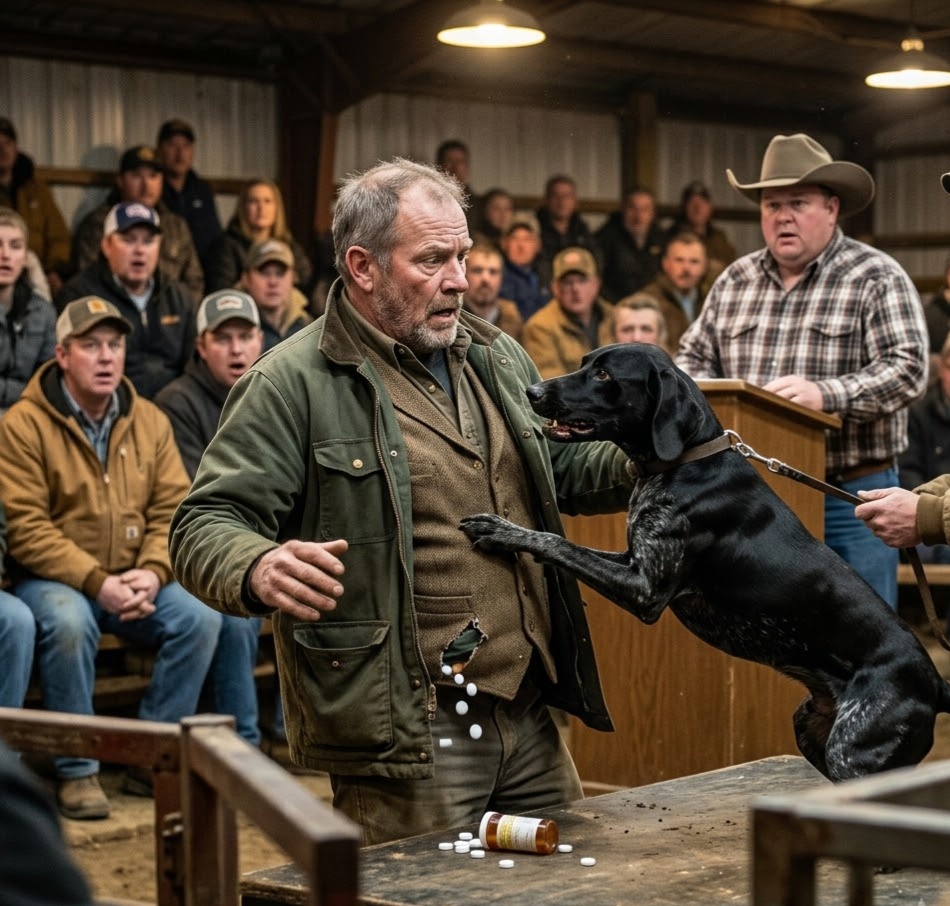
In a flash of copper fur and bared teeth, Dutch lunged, a low growl rumbling in his chest. The dog’s powerful jaws snapped, tearing Edward’s wool vest with a sickening rip.
A small, dark glass vial, previously hidden in the lining, tumbled to the wooden floor.
More Stories












+ There are no comments
Add yours