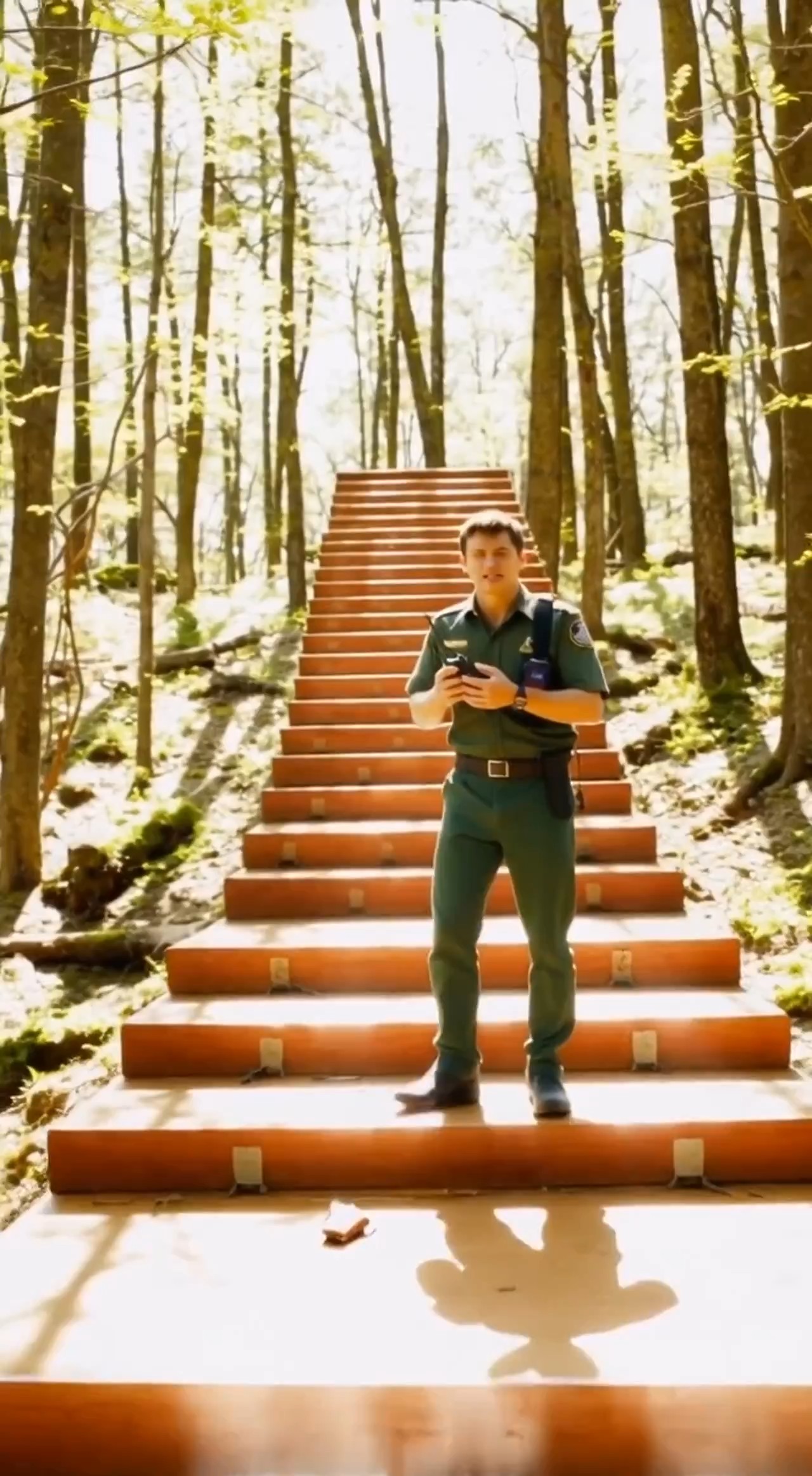
My Stepfather Sent Me To Patrol A Forest Sector With Standalone Wooden Stairs, Then Erased My Coordinates From The Dispatch Server


Part 1
On my third day patrolling Sector 4, I found a leather-bound notebook tucked inside the station safe with a handwritten rule on page one: “If you find a standalone wooden staircase in the deep brush, do not approach, do not photograph, and never step on it.”
Two hours later, deep off-trail, I found a polished oak staircase standing upright in a clearing, attached to nothing at all, surrounded by three pristine leather wallets belonging to hikers missing since 1998.
When I radioed the coordinates to Arthur, he didn’t call search and rescue; he told me to stand guard until midnight and deleted my GPS log from the central dispatch server.
The door to the Sector 4 outpost creaked open, exhaling a puff of stale air and the faint scent of pine needles. Dust motes danced in the single shaft of morning light piercing the grimy windowpane. My first solo patrol.
My ranger uniform felt stiff and new, still clinging to the scent of the dry cleaner. I tossed my duffel bag onto a narrow cot.
A quick scan of the small, spartan cabin revealed nothing out of the ordinary: a worn wooden desk, a single chair, and a cold fireplace. Standard issue, just like Arthur said it would be.
I ran a hand over the desktop, checking for the expected inventory list. My fingers brushed against a loose floorboard. It lifted easily.
Underneath, nestled in the damp earth, was a small, leather-bound ledger. Its cover was faded, the tooling almost entirely gone, but the date ‘1988’ was clearly embossed. It wasn’t a standard park inventory.
Curiosity pricked at me. I opened it.
The first page wasn’t a log but a rule, handwritten in elegant, looping script that filled the entire page: “If you find a standalone wooden staircase in the deep brush, do not approach, do not photograph, and never step on it.”
My brow furrowed. I reread the line, a chill tracing my spine despite the mild morning air. Standalone wooden staircases? It sounded like something out of a campfire story, not an official park regulation.
I stuffed the strange ledger into my backpack. Arthur would probably just laugh if I brought it up. Another Kincaid sensitivity, he’d say.
My patrol route for Sector 4 was clearly marked on the map pinned above the desk. Arthur, my stepfather and Senior District Ranger, had been very explicit during our morning briefing.
“Stick to the paved fire road, Jonah,” he’d barked, his voice tight. “No heroics. No off-trail explorations. Sector 4 is quiet, but it’s not to be messed with.”
His emphasis on “quiet” had felt less like reassurance and more like a warning.
I pulled out my portable radio, the weight familiar in my hand. Arthur’s voice crackled to life, even though I hadn’t called him.
“Kincaid, confirm your position.”
“Sector 4 outpost, sir. Checking gear, about to head out.”
“Good. Remember the path. No deviations. I’ll be monitoring your GPS.”
“Understood.” I clicked off the radio, but Arthur’s words echoed in my head, laced with his usual brand of paternalistic control. *No deviations.*
But the ledger… the stairs… It tugged at me. Sector 4 was mostly old-growth timber, miles of untouched wilderness. What could possibly warrant such a bizarre, specific warning?
A sense of unease settled in my stomach. Arthur’s casual dismissal of my GPS monitoring usually meant he trusted me to do my job. This time, it felt like he was laying down a trap.
I looked at the map. The fire road wound through the eastern perimeter, but the largest, darkest swaths of green—the deepest, oldest timber—lay two miles west, untouched by any official trail.
The temptation was too strong. I had to see if this strange rule was connected to anything real.
“Screw the fire road,” I muttered, slinging my pack over my shoulder.
I left the outpost, hiking west, pushing past the designated boundaries. The forest immediately grew denser, the canopy thick and oppressive. Sunlight became a distant memory, replaced by a humid twilight beneath the ancient pines and cedars.
The ground was uneven, a carpet of pine needles, moss, and tangled roots. Every few yards, I had to duck under a low-hanging branch or push aside a curtain of thorny brush. The silence was profound, broken only by the crunch of my boots and the distant call of a hawk.
After nearly two miles of arduous, off-trail trekking, the trees began to thin. A faint glow ahead hinted at an opening.
I pushed through a final curtain of ferns and stepped into a small, sunlit clearing.
My breath hitched.
In the center of the clearing, bathed in a pool of sunlight that seemed entirely out of place, stood a wooden staircase. It was made of polished oak, smooth and dark, and it rose abruptly from the forest floor, leading nowhere.
No house, no platform, no upper floor. Just a perfectly intact staircase, seemingly carved into the very air. Its base wasn’t set into any foundation; it just *was*, standing upright as if it had simply been dropped there.
It was exactly as the ledger described. The chill from earlier returned, stronger this time.
My eyes scanned the ground around the impossible structure. At the bottom of the lowest step, scattered amongst the fallen leaves, were three small, dark objects.
I knelt, heart pounding. They were leather wallets, old and weathered, their contents spilling slightly onto the forest floor.
I picked up the first. Its leather was cracked, but the stitching was still largely intact. Inside, a driver’s license showed a smiling young woman, Amelia Jones. The issue date was 1996.
I remembered the name. Arthur had mentioned it once, a cold case from his early years as district chief. “Runaway,” he’d called her, “just another kid who couldn’t handle the quiet.”
The second wallet held a student ID for a young man named David Chen. His picture, equally youthful, was dated 1997. Another “runaway” from Arthur’s files.
The third wallet was almost pristine. It contained a faded photo of a family, a father and two children, and a library card belonging to Mark Thompson. Missing since 1998, also officially listed as a runaway.
All three had disappeared during Arthur’s first year as district chief, their cases filed away as personal desertions, not disappearances.
I clutched the wallets in my hand, the leather surprisingly cold. They looked like they had been placed there yesterday, not fifteen years ago. My radio felt heavy, a sudden, urgent weight.
“Central, this is Ranger Kincaid. Do you copy?”
Arthur’s voice crackled back, instantly responsive. “Copy, Kincaid. What’s your status? You’re off-grid.” His tone was sharp, betraying a flicker of anger.
“I… I found something, sir. In Sector 4. Coordinates are…” I rattled off the numbers, my voice tight. “It’s a standalone wooden staircase. And there are three wallets. Amelia Jones, David Chen, Mark Thompson. All missing since ’98.”
A beat of absolute silence stretched across the radio. The only sound was my own ragged breathing and the soft rustle of leaves around the impossible stairs.
Then Arthur’s voice returned, eerily calm. “Jonah. Stand by. Do not move from your position. Do not touch anything else. And do not, under any circumstances, log this call in your paper ledger.”
Part 2
Arthur’s voice clicked off, leaving only the buzzing of cicadas. The silence after his command felt heavier than before. My hand instinctively went to my portable GPS unit, clipped to my vest.
The small screen glowed with my current coordinates, a tiny green dot marking my precise location in the vast, unmapped wilderness. I watched it, a knot tightening in my stomach.
Then, the green dot flickered. It shrunk, then vanished entirely from the live ranger network map displayed on the unit.
My breath caught. Arthur hadn’t just told me not to log the call. He’d reached into the central dispatch server and manually erased my shift route, wiping me from the system as if I’d never left the station. I was officially off-grid, unaccounted for, a ghost in the national forest.
The sun was dropping fast, painting the western sky in streaks of orange and purple. Long, distorted shadows stretched from the old-growth pines, making the clearing feel even more isolated.
I stood ten feet from the standalone staircase, the three weathered wallets still at its base, the IDs of the missing hikers staring up at me. My radio felt dead in my hand.
Then I heard it. A low, structural creak.
It wasn’t a branch rubbing, or the sigh of wind through the canopy; the air was perfectly still. The sound emanated from the top step of the polished oak staircase itself. A deep, resonant groan, like something impossibly heavy settling into place, or twisting under unseen pressure.
You are Jonah Kincaid. You are standing alone in the brush as the sun drops behind the ridge, holding your radio while your stepfather erases your location from the official record. What do you do?
A) Back away immediately, take high-resolution photos of the wallets, and retreat to the Sector 4 truck 👉 Read Chapter 2
B) Step onto the bottom stair to inspect the creaking noise and check for ground footings 👉 Read Chapter 3
More Stories
















+ There are no comments
Add yours