
City Councilman David Ramsey Offered a Muffin to a Homeless Girl — Then His Wife Launched a Public Smear Campaign Against Him


Armed with Lily’s poignant confession and Thorne’s veiled threats, David knew he needed to move beyond speculation. He needed official confirmation of the missing documents. He turned to Councillor Henderson, his loyal ally on the City Council, who had always maintained a quiet, principled stance against corruption.
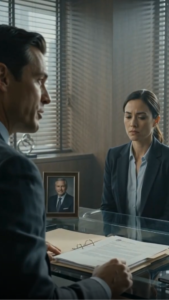
He met Henderson in his private office at City Hall, a small, unassuming space filled with stacks of old policy reports. Henderson, a man of quiet integrity, listened intently, his face grim as David recounted Lily’s testimony and Thorne’s disturbing implications.
“So, you’re saying Maria Mendez might not have died in an accident?” Henderson asked, his voice low, almost disbelieving. “And that Eleanor’s family is tied to it?”
“All signs point to it,” David affirmed, laying out the evidence: the denied claim by Coastal Assurance, Thorne’s connection to Alba Holdings and the vanished Elias Vance, and now Lily’s account of her mother’s agitation and the mysterious phone call. “The smear campaign against me, the obstruction of aid for Lily – it’s all connected. They want this buried.”
Henderson leaned back, his gaze distant, processing the magnitude of the accusations. “Arthur Albright is a powerful man, David. Judge Albright. His reach in this city is… extensive. You’re talking about taking on a dynasty.”
“I know,” David said. “But Lily deserves the truth. Her mother deserves justice.”
Henderson nodded slowly. “Alright. Let’s see what we can find. Officially, I can request access to all city records pertaining to the Mendez accident under my authority as a Council member. It’ll be slow, bureaucratic, but it’s legitimate.” The bureaucratic nature of the request, the formal channels that still had to be navigated despite the urgency, felt like another institutional cruelty designed to delay justice.
Within two days, David received a notification from Henderson. The city records for Maria Mendez’s case were ready for review. David immediately went to the city archives, a cavernous, dimly lit basement room that smelled of old paper and forgotten stories. He sat across from Detective Miller, a seasoned investigator from the City Police Department, whom Henderson had discreetly brought in for “an unofficial review” of the files, bypassing internal departmental hurdles.
Miller, a stocky man with tired eyes and a skeptical demeanor, meticulously spread out the documents. He was known for his thoroughness but also his adherence to strict protocol, which made him initially wary of David’s claims. He had, at first, dismissed David’s inquiries as a councilman meddling in police work.
“Councilman, these files are generally considered closed,” Miller began, his voice flat. “But Councillor Henderson’s request… unusual, but within his rights.” His tone conveyed a subtle disdain for the political interference, another form of institutional cruelty to David.
David ignored it. “Just look for anything out of place, Detective. Missing pages, strange entries, anything that raises a flag.”
Miller grunted, then began his methodical review. He pulled up the digital version of the original police traffic report. David watched him closely as Miller scrolled through the pages, his thumb pausing occasionally.
“Hmm,” Miller muttered, his brow furrowing. “This is… interesting.” He pointed to a section of the digital report. “The original police traffic report, the digital file, contains significant redactions. Not just a name or an address, but entire paragraphs, descriptions of the scene, witness statements. These aren’t standard privacy redactions, Councilman. These look like attempts to obscure information.”
David felt a surge of cold triumph, mixed with a chilling confirmation of his fears. “Redacted by whom?”
Miller shrugged. “No metadata on the redactions. They appear to have been made by an administrative account, shortly after the report was filed. Clean sweep.” The casual, almost invisible act of wiping critical information was a profound, specific cruelty. It erased not just data, but truth.
Next, Miller pulled up Coastal Assurance’s official case file, which had been shared with the police during their investigation into the accident. The file was thin, conspicuously so.
“See here,” Miller said, flipping through the sparse pages. “No photographs of the accident scene from Coastal’s own investigators. No detailed forensic reports they would normally commission. And a conspicuous absence of witness statements, even those from the original police report.”
“It’s almost like someone wanted this file to be as thin as possible,” David observed, his voice tight.
“Or someone went in and stripped it,” Miller confirmed, his skeptical demeanor replaced by a grim resolve. His eyes, once tired, now held a sharp, professional glint. “This is highly unusual for a fatal accident claim, Councilman. Especially one involving a dependent.”
The twist was clear: the case wasn’t just denied; it was actively sabotaged, scrubbed clean of anything that might point to a deeper truth. Someone had gone to great lengths to ensure Maria Mendez’s death remained a simple, tragic accident.
“And you’re sure these are actual redactions, not just missing data?” David pressed.
“Positive,” Miller affirmed. “The digital file indicates content was present, then removed. Not an empty field. Someone actively deleted portions of this report.” The confirmation of active deletion, rather than simple negligence, was a chilling detail.
David leaned back, a profound sense of shock washing over him. This wasn’t just incompetence or bureaucratic red tape. This was a deliberate, targeted cover-up. The official channels, meant to protect and serve, had been manipulated to conceal a crime. The institutional betrayal was stark. Lily’s mother had not only been denied justice; the very evidence of injustice had been erased.
“This changes things, Detective,” David said, his voice quiet but firm. “This changes everything.”
Miller nodded, his expression unreadable. “Yes, Councilman. It certainly does.” He closed the files, gathering them with a deliberate precision. “This warrants a closer look. A very close look. Officially.”
The detective’s shift from skepticism to professional commitment was a crucial turning point. David had finally gotten through. But the implications were terrifying. They were no longer dealing with simple corruption; they were dealing with a meticulously orchestrated cover-up of a potential murder, designed to silence someone who knew too much. And the deeper he dug, the closer he got to Eleanor.
More Stories
















+ There are no comments
Add yours