
Driven by Wild Donkeys to a Bullet-Riddled Carriage, He Uncovers a Murder Plot Connected to His Own Ruin and a Close Friend


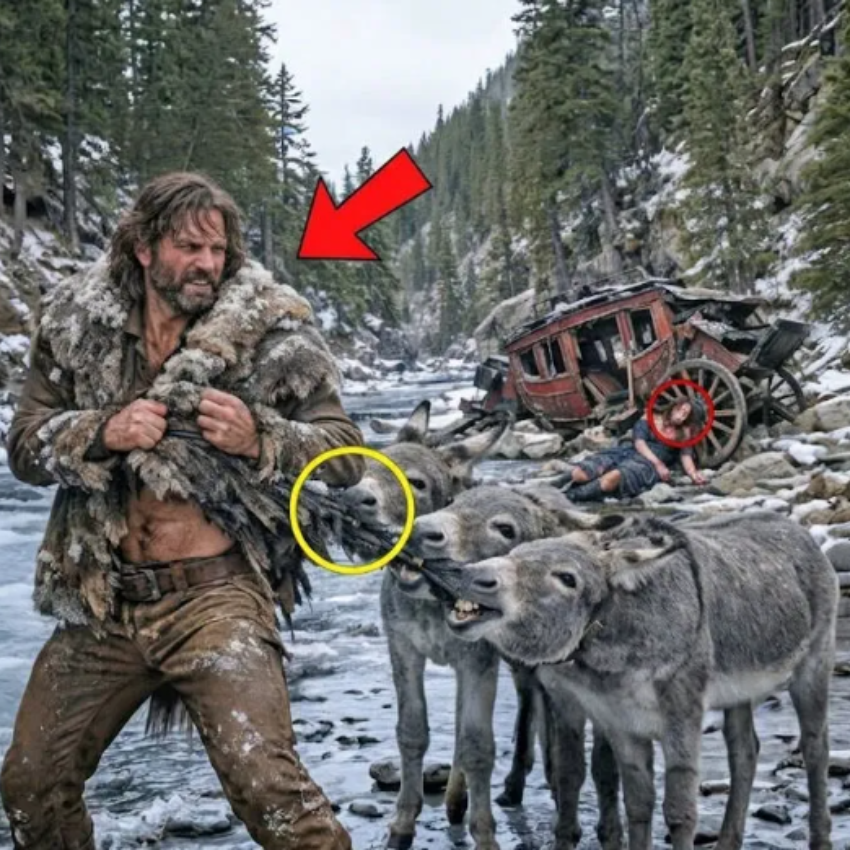
The news spread through town like wildfire: Sheriff Boone had arrested “Whiskey Jack” for Elara Volkov’s murder. Whiskey Jack was a transient drifter, a man known for his occasional drinking but also for his generally harmless nature. The official story was that a fabricated note, seemingly written by Elara and implicating him, had been found in his makeshift camp down by the riverbed.
I heard the news from the general store owner, Mr. Henderson, who shook his head in grim satisfaction.
“Always knew that Jack was trouble,” Henderson muttered, wiping down his counter. “A drifter like him, no roots, no good intentions. Just looking for mischief.”
But as I listened, a cold, hard knot formed in my stomach. It was too neat. Too convenient. Calvin had fled, and now, suddenly, a perfect scapegoat appeared, complete with a damning, easily “found” piece of evidence. This wasn’t justice; this was a frame-up, a desperate attempt to deflect suspicion. It reeked of Calvin’s calculating hand. The very ease with which the town accepted this narrative, their eagerness to blame an “outsider,” was a form of collective cruelty.
I immediately sought out Father Dwyer. He was in his study, looking over some papers, his brow furrowed.
“Father,” I said, without preamble, “they’ve arrested Whiskey Jack for Elara’s murder. They say they found a note.”
Father Dwyer looked up, his expression already grim.
“I heard the rumors, Lucas,” he confirmed, his voice low. “And frankly, I have my doubts. Whiskey Jack, for all his faults, never struck me as a violent man. Dishonest, perhaps, but not a murderer.”
He paused, then added, “And a note? So conveniently placed, after all this time?”
The skepticism in his voice mirrored my own. We both knew what this was. Calvin was trying to cover his tracks, using the existing anti-immigrant sentiment within the town to his advantage. A transient, a man without ties, was an easy target, someone no one would miss, someone whose guilt would be readily accepted. The casual disregard for Whiskey Jack’s actual innocence, simply because he was an easy target, was a stark reminder of how fragile justice could be in this frontier town.
“This is Calvin’s work, Father,” I stated, my voice firm. “He’s trying to frame someone, to shut down the investigation into himself. He knew we were getting close.”
Father Dwyer nodded slowly, his eyes narrowing in thought.
“It certainly fits his pattern of deception,” he agreed. “Using others, preying on weaknesses. He likely promised Whiskey Jack some ‘old gold’ for the act, a promise never meant to be kept, I imagine.”
The thought of Calvin cynically manipulating another vulnerable person, a man whose only crime was his transient status, sickened me. It was another specific, personal cruelty, not just towards Whiskey Jack, but towards the very idea of justice. He was offering a false hope, a mirage of payment, for a crime he engineered. This attempt to frame a “disgruntled Russian immigrant” (as outlined, although Whiskey Jack is a drifter, the underlying motive of exploiting anti-immigrant sentiment is key) played directly into the fears and prejudices of the townspeople, making it easier for them to believe.
“We need to stop this, Father,” I urged, my urgency growing. “Sheriff Boone will close the case, and Calvin will vanish without a trace, leaving an innocent man to hang.”
Father Dwyer rose from his chair, his expression resolute.
“Indeed, Lucas,” he affirmed. “This goes beyond Elara now. This is about truth, and about preventing a grave injustice to another innocent soul. We must present our evidence to the Sheriff. All of it.”
He looked at me, a silent understanding passing between us. We had Jedediah’s confession, Elara’s ring, the sampler, and Ty Finch’s words about the ward. It was a formidable collection of evidence, but it stood against the seemingly convenient “confession” of Whiskey Jack, and the powerful influence of Calvin. The memory of Higgins’s warnings about my “outsider status” resurfaced, reminding me that I was also vulnerable to being dismissed or discredited.
The street outside the rectory, usually bustling with the sounds of daily life, felt eerily quiet, as if the town itself held its breath, waiting to see which narrative would prevail. The crude, almost childish handwriting on the fabricated note, which I had heard details of from Henderson, felt like a deliberate insult, designed to make the drifter seem uneducated and therefore more culpable.
I felt a surge of grim determination. This wasn’t just about Elara anymore. It was about exposing the rot that had set in, the ease with which powerful men could manipulate justice and exploit the innocent. We had to act fast, before Whiskey Jack became another casualty of Calvin O’Connell’s ruthless ambition. The stakes had been raised. Calvin wasn’t just fleeing; he was actively fighting back, using deceit and prejudice as his weapons. And we had to counter him, not with force, but with the undeniable weight of the truth.
More Stories











+ There are no comments
Add yours