
In the Arizona Territory, a Teenager Races to Save His Mother from the Gallows After Their Butler Frames Her for Murder


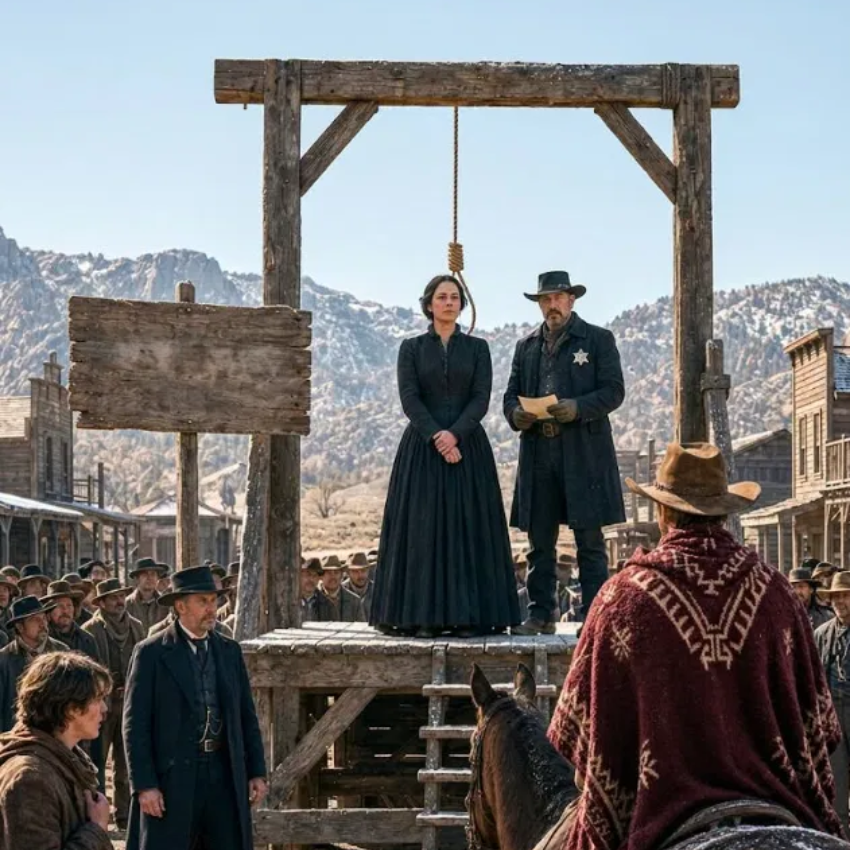


Back in town, the days bled into a torturous countdown. The sun, which usually brought warmth and life to the Arizona Territory, now felt like a harsh, indifferent eye, marking the slow march towards Eleanor’s execution. My stomach was a knot of anxiety, and sleep offered no escape, only nightmares of gallows and silent crowds.
The construction of the gallows in the town square was a constant, stark reminder of the impending tragedy. Every hammer blow, every creak of timber, echoed in my soul. It was a public spectacle, a brutal piece of civic theater designed to instill fear and moral certitude in the townsfolk. It was a deliberate, personal humiliation for my mother, a final declaration of her guilt.
One morning, the sheriff’s deputies arrived at the jail. I watched from the window of our shack, my heart pounding, as Eleanor was moved. She was not being released, as my desperate, naive hopes had once imagined. Instead, she was transferred from the main jail to a smaller, isolated holding cell directly adjacent to the courthouse. It was a practical measure, designed for easy access on the day of the hanging, but to me, it felt like a cage being moved closer to the slaughter.
She walked with her head held high, her shoulders back, her gaze fixed on some distant point. Her resilience, even in the face of such overwhelming despair, was a source of both pride and agonizing pain. The sight of her, so strong yet so utterly trapped, tore at me.
The town, usually bustling, was now buzzing with a morbid anticipation. Merchants spoke in hushed tones, women averted their gazes, and men gathered in small, grim clusters, their faces reflecting a mixture of judgment and dark curiosity. The air was thick with the scent of gossip and impending death. It was a suffocating atmosphere, designed to break any spirit.
I felt utterly alone, isolated by the town’s collective condemnation. Silas was a ghost, Martha Bell a distant hope. My mother was within sight, yet unreachable, imprisoned by stone walls and the impenetrable judgment of our community. The coded letter from Silas, promising “hope found,” felt increasingly fragile with each passing hour.
One afternoon, desperate for anything to do, anything to distract myself from the crushing weight of helplessness, I decided to walk into town. Perhaps a fresh perspective, a chance encounter, could yield something. The town square was a grim tableau. The gallows stood tall, casting a long, skeletal shadow.
As I walked past the courthouse, I noticed Sheriff Shaw’s deputy, the same Deputy Collins who had been at the ranch, engaged in a quiet, furtive conversation with Mr. Bartholomew “Barty” Croft, the slick Pacific Western Railroad land agent. Croft was a man whose expensive suits always seemed out of place in our dusty town, his smile too smooth, his eyes too calculating.
They stood partially hidden behind a large oak tree, their heads bent close together. Deputy Collins looked nervous, his hands fidgeting with the brim of his hat. Croft, on the other hand, exuded an air of calm authority, a predatory stillness.
I tried to get closer, to overhear their conversation, but a group of townspeople blocked my path, their gazes hostile. I pretended to tie my shoe, straining my ears, but I could only catch fragments.
“…discreet…” Croft murmured, his voice low but clear. “…finalized… no loose ends…”
Deputy Collins nodded, his face pale. He pulled a folded piece of paper from his coat pocket and handed it to Croft. It looked official, perhaps a deed or a legal document. The transaction was swift, almost imperceptible.
Croft took the paper, his lips curling into a satisfied smile. He then reached into his own pocket and pulled out a small, heavy pouch, which he discreetly slipped into Deputy Collins’s hand. The metallic clink of coins was unmistakable, a soft, telling sound of a specific, personal payment.
Deputy Collins’s hand closed around the pouch, his fingers tightening. His eyes, however, were filled with a profound unease, almost a shame. He avoided Croft’s gaze, his shoulders hunched. The deputy, a man sworn to uphold the law, was clearly accepting a bribe, a personal betrayal of his oath. The very sight of it was a crushing blow to my fading trust in the justice system.
Croft clapped him on the shoulder, a condescending gesture, then turned and walked away, his stride confident, leaving the deputy standing alone, looking utterly lost and miserable. The deputy quickly pocketed the pouch, glanced around nervously, then hurried off in the opposite direction.
I couldn’t make out the specifics of the document, or the exact amount of money exchanged. But the meaning was clear. Corruption. A deeper, more insidious layer of Bracken’s scheme, reaching into the very heart of local law enforcement. Deputy Collins, a man I had known since childhood, was compromised. His personal weakness, his financial vulnerability, had been exploited by Bracken’s larger plot.
This wasn’t just about a forged will or bought rumors; it was about the complete subversion of justice, engineered through small, personal acts of bribery and manipulation. The deputy, a figure of authority, was Bracken’s pawn. It was a chilling realization, another specific betrayal of the system I had desperately clung to.
The transaction left me with a bitter taste in my mouth, a fresh wave of despair. If even the law was compromised, what hope did we have? Bracken had bought off half the town, fabricated a will, and now, it seemed, he had even corrupted the very men sworn to uphold the peace.
As I walked back to the shack, the gallows loomed larger in my vision, stark and unforgiving. The sun was dipping towards the horizon, casting long, menacing shadows. My mother was in her cell, awaiting a verdict that seemed predetermined. Silas was somewhere out in the vast, dangerous desert. And I, a sixteen-year-old boy, felt the crushing weight of an entire corrupt system bearing down on me.
I looked at the coded letter from Silas, which promised “hope found,” and wondered if that hope was already too late. The trial was tomorrow morning. The gallows awaited. And the conspirators, the men who had plotted my father’s murder and my mother’s demise, were moving with impunity, their network of lies and corruption tightening around us.
More Stories






+ There are no comments
Add yours